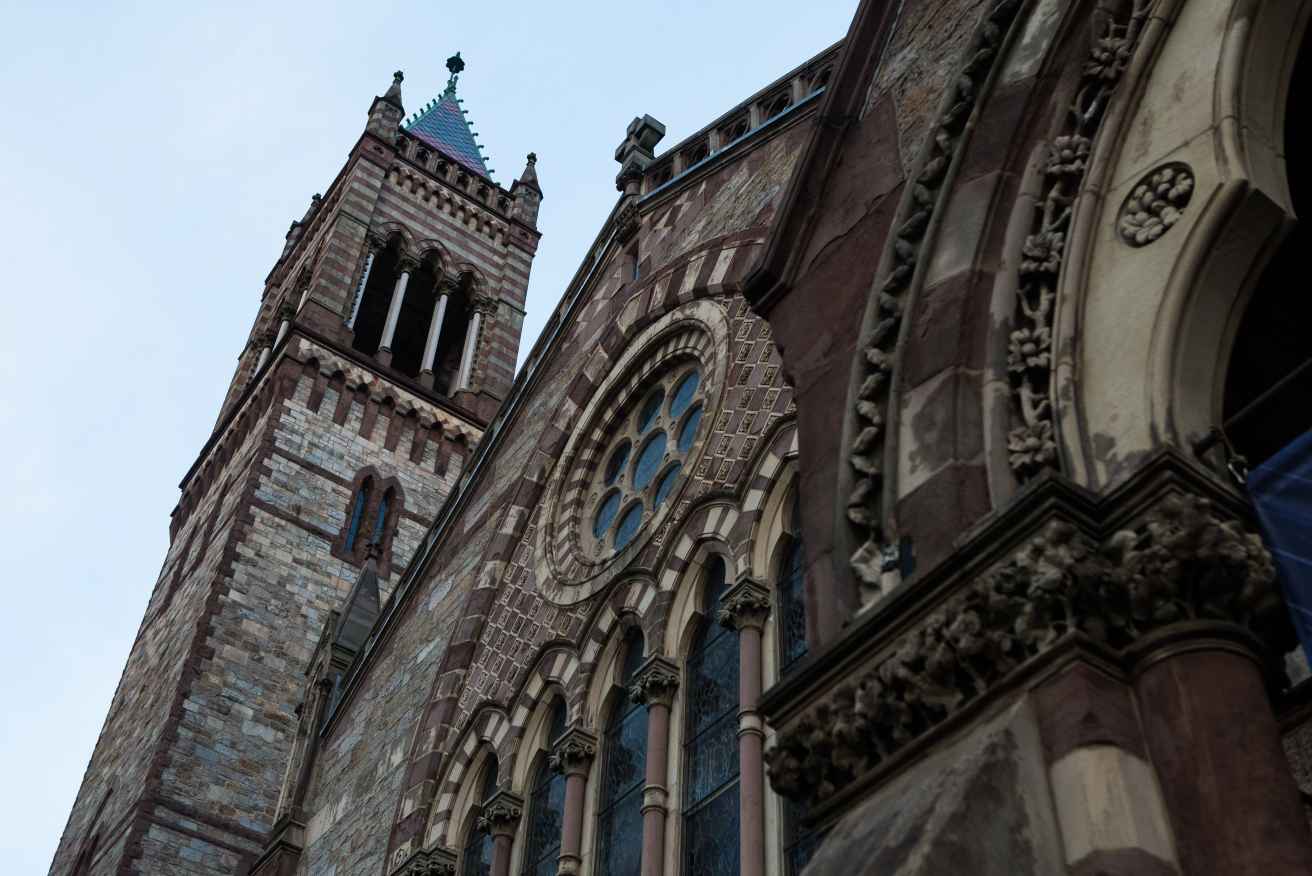
Old South Banner
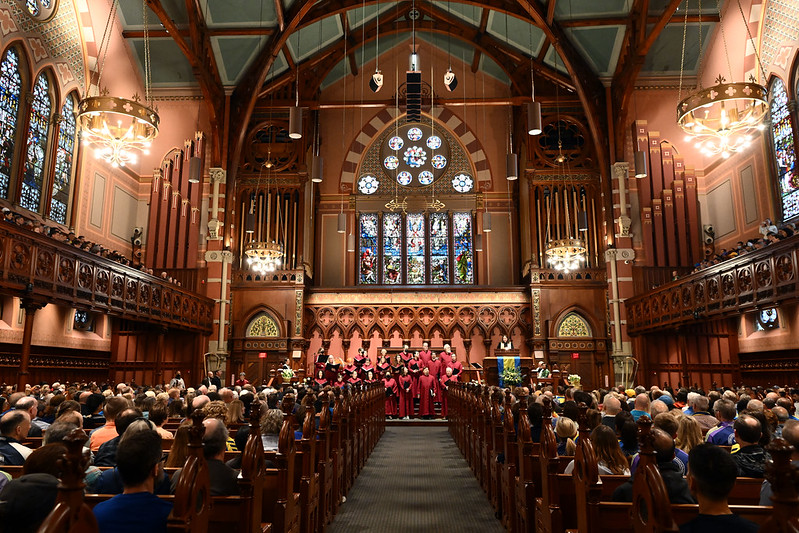
Old South Sanctuary (photo by Sarah Musemuci)


Copyright © 2009, Old South Church and by author.
Excerpts are permitted as long as full accreditation is made
to Old South Church and to the author.


Old South Sermons:

Are We There Yet?

by Rev. Dr. Arlene K. Nehring

Deuteronomy 34: 1-9

June 14, 2009  Pride Sunday


Before I dive into today’s message, I just want to say how privileged and honored Stephanie and I feel to be here this weekend.

I joined pastoral staff here at Old South Church 21 years ago this week, just after being ordained by the Central Association of the Iowa Conference, and my home church, Union Congregational UCC, in Reinbeck, Iowa. It’s been quite a journey for me, and this milestone and your invitation has given me cause to take stock and notice more intentionally what God has been up to our lives these past 21 years.

Stephanie and I think of Old South Church (OSC) as our spiritual home as a couple, because we first met here 21 years ago, though our courtship and commitment to each other weren’t forged until after I left Boston in 1992.

It’s great to be back here today, to see so many familiar faces, and to celebrate your ONA anniversary and the way that you have lived into this identity. It’s not lost on Stephanie and me how much Old South has evolved in the past two decades. When we left Boston, Old South had not yet begun to discuss the ONA process, offer the rite of Christian marriage to same gender couples, or participate as a church in Gay Pride.  So walking with the Old South contingent in yesterday’s Pride parade, and being here this weekend, has been an amazing and healing experience for us.

Of course, today is not only a special day for Stephanie and me. It is also a special day in the life of Old South Church, as we celebrate some important milestones in the lives of individuals and this congregation as a whole, through the celebration of the sacrament of baptism, the rite of church membership, and the silver anniversaries (and more) of several long-time members.

In a day and a time when most Mainline Protestant churches are in decline, and the average length of church membership is five years, our long-time members are even more of a treasure than ever before. So to our long-time members, we say, “Thank you! Thank you for your faithfulness. Thank you for your commitment to Christ. Thank you for your service to the Old South Church. You are a blessing and a treasure to all of us!

The invitation that I received from Quinn and Nancy today was to help you reflect on and celebrate Old South’s 15 years on the ONA journey. As I told them, “I’m no expert on the ONA process here. I was long gone when the statement was adopted, and the process hadn’t even been started before I left in 1992. All I could contribute would be the “proto-ONA history.”

“Good enough,” they said.

Another qualifier that I’ll add today is to remind you that my story is just one story. There are many other stories about the ONA process around here, and they are all authentic. You need to know these stores, and tell them to each other.

As I think you understand, Old South’s ONA journey didn’t just begin 16 years ago, when you started working through the ONA process, and it didn’t conclude when you adopted your first ONA statement in 1994, or your subsequent revisions to this statement in 2004 and 2007. It’s part of a much larger faith narrative having to do with the unfolding of God’s love and justice in the world.

As my friend Mike Schuenemeyer, Executive for LGBT and HIV and Health and Wholeness Ministries for the United Church of Christ, is fond of saying, “The ONA journey is a long journey, and we’re all on it—whether we want to be or not. We’re on the journey whether we are: ‘ONA No Way!’ or ‘ONA All the Way!’ We’re all somewhere on that journey, because the journey is God’s and the journey isn’t over until God’s shalom is fulfilled—not just for LGBT people—but for all people.”

II

Biblically and theologically speaking, the journey toward the full inclusion of lesbian, gay, bisexual, and transgender (LGBT) persons into the life and ministry of the church and society is grounded in the biblical story of Exodus, in the mission of Jesus Christ, and in the Apostles’ vision of the New Jerusalem come on earth.

Today’s scripture reading is one reminder of how long the journey is, and one example of God’s invitation and encouragement to keep on keeping on. Here in Deuteronomy 34 we encounter an important milestone in the forty-year road trip of the Hebrew people from slavery to freedom. The setting is Mt. Pisgah in the land of Moab. This is the place where Moses pointed Joshua to the Promised Land, and anointed him and pointed him  there.

Part of the bittersweet history of Moses’ life is that he was gifted and guided by God to lead the slaves out of Egypt and through the wilderness and even to glimpse the Promised Land, but he did not live long enough to enter the Promised Land himself. He was, however, compelled and propelled by the vision of the Promised Land that God had given him back in Midian.

Moses, like people of faith in every time and tradition, kept his “eyes on the prize” (as the choir sang) of a better day and a better way, and of a better land and a better life. It was this same sort of vision that inspired our Puritan ancestors to set sail for the New World and to forge what they hoped would be a “city on a hill,” and “a light to the nations.” It was this same spirit that moved the founders of the Old South Church to establish this congregation, and to be a more inclusive community of faith than the one that they had grown up in. It was this same ideal that lay at the heart of Old South’s commitment to enter into the ONA process, and to adopt the ONA statement 15 years ago, and to keep improving on and living into the true meaning of the statement that is now part of the boilerplate of every significant church publication.

III
 

The Open and Affirming (ONA) program was the brainchild of the UCC Coalition for Lesbian, Gay, Bisexual, and Transgender Concerns, and was later embraced by the General Synod of the UCC (in 1985) and recommended to local churches for implementation.

Back in 1988 when I arrived at OSC, the thought that we would become an Open and Affirming Church was mostly a dream that I held in my heart for you. I doubt that anyone other than my pastoral colleagues had heard of ONA here at Old South Church then, because the ONA program was a relatively new idea in those days.  However, in the weeks, months, and years ahead, OSC would take important steps in the spiritual discernment process called “Open and Affirming” and eventually live into that heart-felt dream.

In my view, Old South’s ONA process is not only grounded in the biblical and lived experience of our ancestors in the faith, it is grounded in the faith journeys and personal testimonies of the LGBT members of this congregation who had the courage and faith to believe that the promises of the gospel were meant for them, for us, and for all.

I lived a pretty closeted life back in the days that I was on the staff here. It was hard enough to find a call to ministry then as a woman, much less as an out lesbian or gay person. I doubt that I would have had the courage to pursue the ONA process—or even the proto process, for my own sake. It was the personal testimony and the pastoral care needs of this congregation that compelled me to press our church leaders into starting the LGBT Fellowship Group, and the AIDS Prayer Group, which laid the foundation for the ONA process here at Old South.

The story goes like this. Shortly after I arrived here in 1988, a steady trickle of lesbian and gay folks wondered into my office and began sharing their stories with me. They talked about their coming out processes and their struggles with self-acceptance and rejection by friends and family. They described their experiences of discrimination in employment, housing, healthcare, marriage, and family law.

Each of these stories was a faith story, a testimony, that included expressed or implied theological and spiritual questions about self-acceptance, about God’s purposes and hope for our lives, and about biblical interpretation and church teaching, and more. As I listened to these stories, I began to realize that most of the people who came to me didn’t know each other, or if they did know each other, they didn’t know whether each other was gay or lesbian, and they were often afraid to inquire. Most, as a result, expressed feelings of isolation and anxiety. So I began to ask, “Is there something that I or our church could do that would be helpful to you?”

The responses that I heard pointed to the need for an LGBT fellowship group, where folks could feel freer to be themselves, make friends, and explore their faith and identity with other Christians on the journey. The need was clear. The goal was clear. But so was the challenge.

I felt that it was imperative for the spiritual health of participants, and for the integrity of the congregation, to have “official” church endorsement for the founding of the fellowship group. That meant securing the ministers and deacons’ support for the group. The establishment of a clandestine group, I thought, would merely reinforce the mixed messages that most of us were already experiencing from our families and within the larger society.

So I screwed up my courage, and began some conversations with the other pastors here at Old South. I spoke first with Marc Walker, and then with Bob Christensen. They were both supportive from the get-go. As I have shared with Jim Crawford on a couple of occasions in recent years—and this says as much about where I was at in those days as it does about Jim—the thought of discussing this idea with him was terrifying to me back in those days, because the stakes felt so high.

There were fewer than a handful of out lesbian and gay pastors serving anywhere in parish ministry in those days. We all knew that it was professional suicide to be out in the search and call process, or in the parish. So I looked for further support from Marc, and asked him to go with me to discuss this idea with Jim. Marc and I ran the idea of a lesbian and gay fellowship “up the flag pole” with Jim—more more than once. Jim didn’t say “no” the first few times, but he didn’t say “yes” either for quite a while. By the time I got to the “yes” with Jim, Marc had left for Tacoma, Washington, and Bob was stricken with a brain tumor.

Those were not easy conversations for Jim or me. But I kept nudging him. I kept nudging him, because I knew that Jim was a person of deep compassion and a person with a strong commitment to social justice. In the end, love won out, and Jim gave me his blessing to go to the Board of Ministers and Deacons and to ask for their support for the founding of a lesbian and gay fellowship here at Old South Church.

The deacons were instantly supportive, and so was the Church Council. The announcement about a new fellowship group soon followed in the church bulletins and newsletters. So did a little controversy. Jim, I am sure, took more than one proverbial “bullet” for me, but he was kind enough never to mention the fact to me.

The first gatherings of the Lesbian and Gay Fellowship Group were held in members’ homes and in my apartment, in order to protect the privacy of participants. Eventually the group’s comfort level evolved, and we decided that it was necessary—particularly for newcomers—that we be more visible to the membership and the public. So we took another step on the journey, and began meeting at the church.

IV

About the same time that the Lesbian and Gay Fellowship Group was coming together, parishioners were also seeking me out for support and counsel about AIDS related concerns. Some were sick. Some were caring for loved ones who were ill. Some were trying to decide whether to get tested. Others were working in health care fields and starting to burn out. And still others were among the worried well.  

One person, in particular, made a significant impact on me, and on the AIDS ministry of this church. His name was Brad. Brad came to meet with me a few weeks after he began attending worship at Old South. Brad told me that he had AIDS and that he was involved in an experimental treatment program. Everything was experimental back in those days.

Brad told me that living with AIDS had forced him to pay more attention to his spiritual life, and that he felt compelled to look for a church home. I asked him how we could help. He said, “You know Arlene, I have a lot of doctors and nurses in my life. I also have a pharmacist, a social worker, and a psychotherapist.  What I don’t have is someone to pray with. I am hoping that you and others at this church will pray with me.”

After a few more conversations like that one, I went again to Jim, and to the Deacons and the Church Council for support—this time to launch the AIDS Prayer Group. They didn’t even blink. They were immediately supportive. Once again I announced the start-up of a new group in the bulletin and newsletter. People came out of the woodwork to talk with me, and to attend the prayer group.

Most prayer group participants were far more closeted about their disease or association with Persons With AIDS (PWAs) than about their sexual orientation in those days. (Most people who participated in our prayer group back then were gay.) Given people’s fears, I started the AIDS Prayer Group in the living room of my apartment. Eventually, like the LGBT fellowship, the prayer group participants became more courageous and decided to move the meetings to the church. We met once a month for an hour or less in my office. (Sick people don’t have a lot of stamina.)

Our liturgy was simple. We welcomed each other, formed a circle, and created a simple worship center on the coffee table. Our worship center included a blue pillar candle, which was a symbol of hope and healing for PWAs, a daily devotional for PWAs, and roll of rainbow ribbon and some safety pins.

Each session began with me lighting the blue candle, and saying something like this:


Welcome to the circle. My name is Arlene. I am one of the pastors here at Old South Church. We are a church with AIDS. We are also a church with and for people with AIDS. You’re welcome here. Feel free to share what’s going on with you today, this week, or this month as you are able. If you prefer to pass, that’s OK too. Who would like to be next?

Sometimes people talked about what was happening with their physical health, but mostly, in keeping with Brad’s request, participants shared what was happening in their spiritual lives.  

By the end of the hour, each person present was given a chance to talk. After the last person spoke, we held hands—which was crucial because so many were afraid to touch people with AIDS for fear of getting sick. We held hands, and I gathered up the joys and concerns of the group in a pastoral prayer. Before participants left the gathering, anyone new received a daily meditation book and a rainbow ribbon. We hugged. We made sure that everyone had rides to appointments, food on the table, and someone checking on them. We took care of each other.

Four other significant AIDS ministries at Old South Church grew out of this prayer group. They included Old South’s involvement with Interfaith AIDS Ministries; our participation in the Ecumenical AIDS Healing Services; our partnership with J.S. Waterman’s and Sons; and the establishment of the Truesdale Fund.

The Interfaith AIDS Ministries offered essential resources such as food, home furnishings, transportation, and pastoral care visits to PWAs. Volunteers stockpiled food and used furniture in a storeroom under the Parish House, and distributed it to PWAs in Boston neighborhoods south of the Charles. In the course of offering that ministry, we encountered many pretty desperate situations. I’ll never forget the time that George and I delivered a bedroom set and groceries to a Haitian immigrant family on Mission Hill. There were three adults and two children in the household. Every one of them: the mother, father, uncle, preschooler, and infant, had AIDS. Our visit there reminded me of a scene from a Third World relief hospital.

I remember too fielding calls from a dispatcher associated with Interfaith AIDS ministries, and being asked to make death-bed visits to people whose pastors and churches had thrown them out on account their HIV/AIDS diagnoses.

Our pastoral care role with PWAs extended beyond the Interfaith AIDS Ministry to local funeral parlors, including J. S. Waterman’s  & Sons in Kenmore Square, where one of our members was in a lead position serving the Chinese and gay communities. Pretty frequently in those days, I received calls from Waterman’s asking me to preside at the funerals of Christians who had been rejected by their churches on account of having AIDS. Despite how weary I felt in those days, my sense of fatigue and loss were small compared to many. I’ll never forget the memorial service at which I opened up the mike for personal sharing, and heard the testimony of young man from Buffalo who said, “This is my 47th friend who has died of AIDS.”

These and similar experiences, and an invitation from the founders of the Ecumenical AIDS Healing Services, gave us the nudge, indeed the mandate, to reclaim the ancient healing liturgies of the church and to offer one of the first Ecumenical AIDS Healing Services in the City of Boston. We sponsored two healing services in the years that I served here. The deacons and the AIDS Prayer Group members served as ushers and coffee hour hosts for both of those services. Part of the good news associated with these healing services is that because of them, so many churches woke up to the need to offer this type of ministry that eventually congregations had to get in line to host these services.

These aforementioned ministries and the needs that prompted them inspired a generous memorial gift from Brad’s employer. Monies set aside in a special Fund provided a free public concert performed by the Old South Choir of John Rutter’s Requiem and a city-wide conference held at OSC that brought together healthcare workers, social service organizations, faith leaders, and PWAs. The theme of the conference was “By the Waters of Babylon,” which was based on Psalm 137. The purpose of that concert and the conference were to help hold and sooth the grief and offer spiritual nourishment and practical resources to people who were nearly overwhelmed with suffering and loss in the midst of the AIDS pandemic.

Through that memorial gift, and the ministries that it funded, Old South was able to offer to others what Brad knew he needed most for himself—a community that would pray with and for him and everyone who was living with AIDS.

There’s so much more to share, but I’ll stop there with my reminiscences, and hope that I have shared enough to give you a better sense of how important it was for Old South Church to have sponsored the LGBT Fellowship and the AIDS Prayer Group, and to have entered into and pursued the ONA process.

V

Recalling the history of these important ministries illustrates for me, and I hope for you too, how long the ONA journey has been, and to realize that the journey isn’t over. We’re not there yet. We are like Joshua standing on Mt. Pisgah. We have been shown the Promised Land, we can see it from here, and we’ve been given some general directions on how to get there—but we are not yet living in that land.

So long as marriage inequities exist for same-gender couples in this country and around the world, we are not living in the Promised Land. So long as the health and safety of lesbian, gay, bisexual, and transgender and transsexual persons are jeopardized, we are not living in that land. So long as one of the leading causes of suicide among youth and young adults is related to self-hatred resulting from homophobia and bullying, we are not living in that land. So long as physicians who provide for women’s reproductive health care are gunned down in church or anywhere, we are not living in that land. So long as white supremacists are walking into memorials like the Holocaust Museum and gunning down African-American security officers, we are not living in that land.

So, perhaps, we are agreed. We are not living in the Promised Land. How are we going to get there? How are we going to get from Moab to Cana?

The answer, I believe, is written into the tradition of the Old South Church.

Step 1: We need to continue to follow our founders’ example by striving to be a more inclusive church than the one we grew up in. Like our forebears who expanded the scope of those to whom the sacrament of baptism was extended, we too need to continue to offer the rites and sacraments of the church to the whole people of God, and not just to some.

Step 2: We need to continue to reach back into the tradition of our church and reclaim some of the ancient liturgies and practices of the church, like we did with the AIDS Healing Service and the AIDS Prayer Group, and reaffirm that there are resources in our tradition that come out of the ancient wisdom of the church that can be a blessing to those most in need of it today.

Step 3: We need to reclaim personal testimony in the life of our congregation, and dare to hold scary conversations with our bosses and coworkers, family and friends, next door neighbors, and perfect strangers. We need to tell those dear to us that we have not yet arrived in the Promised Land, and that there are still some steps that we have to take to get there.

We also need to tell our “coming out” stories as LGBT people AND as allies, and we need to tell our stories using the language of faith—because our stories are part of God’s holy history, and because we need to reclaim the language of our faith—rather than abandoning it to those who would use Christian vocabulary and testimony to discriminate and diminish anyone who does not look like, behave like, or believe like them.

So, the answer to the question, “Are we there yet?” is “No.” But, the good news is that God has made it possible for us to see the Promised Land. And God has given us the examples of Moses, the ancient prophets, Jesus Christ, and the Apostles, who have pointed us in the direction of the Promised Land. Our job now is to continue to take the steps God is calling us to take on the path that leads to the Holy City, the New Jerusalem. Friends, let’s keep our eyes on the prize, and keep taking those steps. Amen.


Copyright © 2009, Old South Church and by author.
Excerpts are permitted as long as full accreditation is made
to Old South Church and to the author.

Old South Church
645 Boylston St. Boston, MA 02116
(617)536-1970 Tel (617)536-8061 Fax

You can E-mail us by clicking here: OSC Communications

Copyright © 2009, Old South Church