Old South Banner
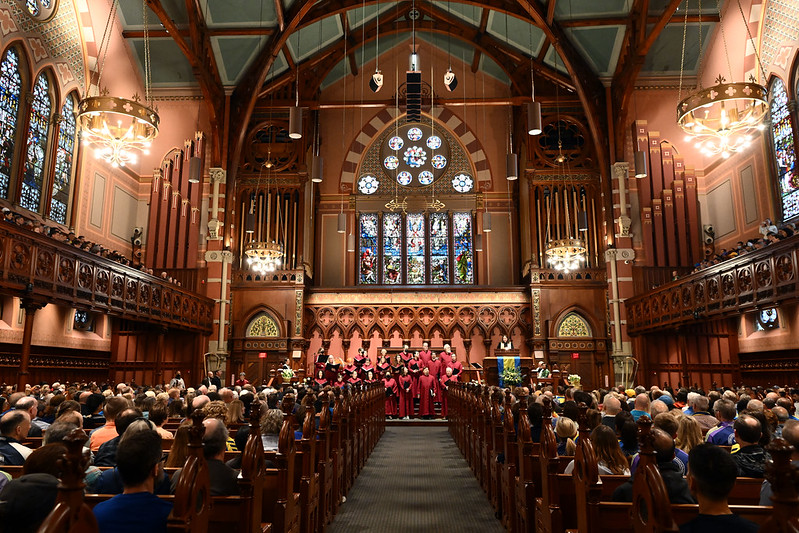
Old South Sanctuary (photo by Sarah Musemuci)


Copyright © 2009, Old South Church and by author.
Excerpts are permitted as long as full accreditation is made
to Old South Church and to the author.


Old South Sermons: 


Skyward

by Rev. Gregory Mobley

November 15, 2009, Consecration Sunday

Based on Daniel 12: 1-3

Listen to this sermon


    And at that time, he will stand:
    Michael, the great prince,
    the one who stands over the sons of your people.
    And it will be a stressful time
    like has never been since nations have been
    until this time.
    
    And at that time, your people will be rescued,
    all who were found written in the Scroll.

    And many who sleep
    in the dusty ground will awake:
    Some to forever life
    and some to shame and to forever alienation.

    And the wise ones will glow
    like the glittering skydome,
    and the ones who nurture virtue
    like the stars forever and ever.


In this poem from an ancient prophet we have our oldest, clearest vision of eternal life.  

In your Christian Bibles, Malachi is the final book of the Old Testament. In a Jewish Bible, the final book of the canon is 2 Chronicles. But from the standpoint of history, Daniel is the latest book that made it into the canon of the Jewish Bible and the Christian Old Testament. Daniel 12 is the final section of the final book to be written in the Hebrew Bible.

Daniel was composed around 175 BCE, in Jerusalem (that great people-watching town Nancy talked about last Sunday). At that time a Syrian tyrant terrorized the Jewish people. His name, Antiochus Epiphanes, was Greek and he had pretensions to great learning and culture, but he was just another of history's parade of bullies. In the next turn of history, this wannabe would become history, overthrown by Jewish revolutionaries known as the Maccabees, events that are celebrated each Hanukkah.

But before that, there were the bad times that the author of Daniel lived through. Life in Diaspora, singing the Lord's song in what seemed like a foreign land. Antiochus Epiphanes outlawed the worship of the LORD, persecuted Jews, and even desecrated the Temple by erecting a statue to Zeus inside it and having a pig sacrificed on its altar.

And in this crucible of pain, before any revolt was evident, when the bad guys were winning, Daniel dreamed that the martyrs of his day would be rewarded in the world to come.

This was a new story. Before Daniel, the Israelite belief was that you went to Sheol, the underworld, after you died. You got your reward in this life. After Daniel, the Jewish and Christian belief was that the righteous lived past death: the Christians talked about Heaven, the Jews about olam habba, the "World-To-Come." In this text in Daniel, we can see the turning point in the evolution of ideas about what happens when you die.

The ancient text in Daniel 12 preserves a delicate leaf of hope in the amber of poetry under immense pressure.

This image of the wise glittering like the skydome, of the righteous shining like the stars, this single frame in the slide show of humanity's spiritual yearnings, is our oldest, clearest vision of eternal life.

Here in Daniel 12 is one of the first recorded stanzas in a song entitled . . . the hopes and fears of all the years.

What is the picture here in Daniel of eternal life? It is astral projection, literally. The wise will glitter like the skydome, the righteous like the stars.

It is about Heaven and going to Heaven, but Heaven here is not God's celestial city with pearly gates and apostolic border guards and streets of gold. We don't get that stanza of the song until the book of Revelation two hundred years later. Heaven here is the night sky where the righteous live forever as stars. Daniel is saying, dreaming or imagining, that the righteous become stars.

And this also has something to do with the righteous becoming angels, because the ancients imagined that the stars were angels and that the angels were stars when they were off-duty,  when they weren't announcing births to Hannah's or Mary's, or protecting George Bailey's from despair on Christmas Eves in Bedford Falls.

Remnants of this stage in the history of Heaven remain embedded in our culture and are so much a part of the ensemble of our spiritual house that we may not even notice them anymore. When an old cartoon dissolves from the image of a person dying to a new star appearing in the sky, we get it. When we hear children's stories about the littlest angel, we get it. Even when we hear that Latter Day Saints and Swedenborgians imagine that the righteous evolve into angels in the afterlife, we get it, even if we don't buy it. When we are emotionally satisfied to see the hero at the end of Steven Spielberg's film "Close Encounters of the Third Kind" ascend skyward in a spaceship and we feel like this ending completes a story we already know, we get it.

How should we think about eternal life?

Do we become stars? Do we become angels? Do we join a celestial choir or rock on the front porch of a cabin in the sky or attend a family reunion or embrace our departed Romeos, our departed Juliets? There are so many ways we imagine the Life that is beyond the Door.

And there is also another way to view eternal life. Eternal life is a quality of being alive that is beyond the tensions of tense-past tense, present tense, future tense, and is wholly, utterly Now. The great book of Jewish mysticism is called the Zohar. Zohar means "shining." The paths of Jewish and Christian spirituality are designed to make us shine, shine, shine, in this life and in the world to come, like stars. We become what the path makes us.

Now and then we get intimations of immortality when we feel ourselves fully in the vivid moment, fully one, undivided, free. This is the place that prayer, that worship, that exhausting, satisfying exercise, that physical intimacy, that tender rest take us.

And eternal life is also a hope against all odds that there is real substance to things hoped for, that the stuff that dreams are made of is not some painted over treasure, not some Maltese Falcon, but something elusive yet wholly real, like the bird that hovered over Jesus one day on a sandbar in the Jordan River.

Eternal life, at least, is a hint, an intuition, that there will finally be harmony between our own small stories and the big Story of all reality. That despite the puzzles and loose ends of this mystery play in which we act our roles without a clear script, the plot is ultimately inclining skyward, Godward, loveward.

Let me try to be crystal clear about these matters that we only see through a glass darkly.

The Christian idea of eternal life is the medicine dispensed at the apothecary known as Old South. There are other locations where other balms and elixirs for healing are dispensed, in Mosques and Synagogues, and on the river banks of the Ganges and the temples of Thailand. But the Christian idea of eternal life has its own formula and that's what is dispensed here at Old South.

And it is based on the special paradoxical magic of the Trinitarian formula. Just as God is inherently relational-Creator, Christ, and Holy Ghost, diverse and unified at the same time-on the other side of this Vale of Tears, we will join a greater All and at the same time find our truest expression of self.

The Christian idea of eternal life is not that we dissolve into a blinding field of unending light, but that each of us will shine, shine, shine, points of light in Heaven's array, like the stars forever and ever.

I cannot guarantee the fulfillment of this Christian vision of eternal life, since I speak on this side of the Looking Glass.

But this I do know: if we live against the backdrop of eternity, if we know our citizenship, our core identity, our heart, is in Heaven, and we follow that road, we will glitter and shine and become what that path makes us.

Take a deep breath and rest in the energy and feng shui and mojo and magic of this chamber.

The arches pull us straighter in our seats. The beautiful windows compel us to lift our gaze. The immense expanse of air above us reminds us that the unseen world dwarfs in scope the flat horizon of our normal sight. It preaches to us, "There's more."

And above all, above us, the blue dome. No one in Copley Square can see it, but inside, can you feel its magnetism elevating and elating us, changing and challenging us skyward, Godward, loveward?

Old South is an embassy, a consulate of a foreign nation, the Kingdom of Heaven, the Kingdom of Hope. Inside there is sanctuary. Inside there is Eden's intimacy and Sinai's drama and Calvary's painful triumph.

Through celebration of this Good News, through constitution of Gospel community, a door opens here that inspires us to hold our heads high, and to know we count and that every creature's welfare counts. Let this space work its magic on you, and lift you skyward, inspiring faith, renewing hope, and with the help of your teammates orchestrating works of love.

    "Lay up for yourselves treasures in heaven, for where your treasure is, there your     heart is also" (Mt 6:20).

Invest your faith, your hope, your love, and on this Stewardship Sunday, your treasures too, in Eternal Life.


Copyright © 2009, Old South Church and by author.
Excerpts are permitted as long as full accreditation is made
to Old South Church and to the author.

Old South Church
645 Boylston St. Boston, MA 02116
(617)536-1970 Tel (617)536-8061 Fax

You can E-mail us by clicking here: OSC Communications

Copyright © 2009, Old South Church