Ezekiel 37:1-14
One of the questions ministers always get asked in casual conversations is, “so what are you preaching on?” Typically, a preacher answers with the text for the week, and the questioner responds with something like “hmm” or “nice,” then moves on to the next topic.So over the last few weeks, I have answered that casual question with today’s text. Ezekiel and the Valley of Dry Bones, I say. Not once has someone responded with a “nice.” Without fail, the mere mention of this text prompts a different, much bigger reaction—a torrent of words and feelings. These reactions have taken one of two forms.
The first form is best exemplified by my own spouse, who responded to my “Ezekiel and the Valley of Dry Bones” with an “O.K. Sounds pretty weird, kinda creepy even.” From others of like mind, I heard: “What are you going to do with that?” and “Now that’s one I just don’t get.” I think at least a few of them were really just thinking creepy and weird.
For these folks, the story of Ezekiel and the Valley of Dry Bones brings to mind ghastly images. A wild-eyed prophet preaching to a graveyard. The face of God, cheeks puffed out, blowing wind across the dusty desert. Even cartoonish skeletons rising up out of the ground, rattling their bones about and starting to dance out the tune of the old African-American spiritual: “dem bones, dem bones, dem dry bones,” on and on in some ghostly absurdity.
This, my friends, is a reasonable response to the story of Ezekiel and the Valley of Dry Bones. It is creepy and weird. It’s a dream, a vision, and as in most dreams, unnatural things happen. This one might rightly even be called a nightmare, in full Wes Craven skeletal style.
But some people don’t react that way. Some people hear “Ezekiel and the Valley of Dry Bones” and respond with a gasp, “aah, what a great passage!” They swoon and clutch their chests as though the Holy Spirit’s mighty power took hold of them at the mere mention of this holy text.
These folks’ imaginations also leap into action, but with metaphor and allegory in hand. Their minds travel to different boneyards, to present-day places of death and decay—blighted neighborhoods, war-torn landscapes, refugee camps, tsumani-ravaged villages, abusive homes and shelters for the mentally ill. They do not conjure ghosts and skeletons, but real-life human beings who have become like heaps of dry bones—the unloved children, the abandoned elders, men and women whose daily drudgery have sapped the life from them, leaving walking skeletons, unable to feel love or life. Perhaps even these folks themselves feel like dry bones, cut off from warm flesh and disconnected from the Spirit of Life. They see hope in this text—God’s breath of life can revive and restore even the most broken and decayed souls.
As you might have guessed, I am one of those whose imagination works this way. But I am grateful to my spouse and others like him for reminding me how strange it all is, how fantastical and unbelievable is the transformation. Ezekiel is called to prophesy hope and resurrection where there is only death and abandonment—and by simply speaking the words of hope, he calls down the very breath of God, the Spirit of Life into those bones. How can this be? Can the very promise of God’s everlasting love and faithfulness bring our dry bones back to life? Ezekiel’s vision says yes.
Toni Morrison’s novel Beloved, itself a ghost story about the harsh world of slavery, captures the way words of hope and love can restore flesh to dry bones. Baby Suggs, holy, gathers with fellow slaves in sacred place simply called the Clearing. Broken and battered in body and spirit, the enslaved men, women and children huddle at the edge of the trees. Positioning herself atop a flat rock, Baby Suggs summons them forth. First the children, who she commands to laugh. Then the men, ordered to dance until “groundlife shuddered under their feet.” And to the women, Baby Suggs says, “Cry…For the living and the dead. Just cry.”
Morrison unfolds the scene:
It started that way: laughing children, dancing men, crying women and then it got mixed up. Women stopped crying and danced; men sat down and cried; children danced, women laughed, children cried until, exhausted and riven, all and each lay about the Clearing damp and gasping for breath. In the silence that followed, Baby Suggs, holy, offered up to them her great big heart. …“Here,” she said, “in this here place, we flesh; flesh that weeps, laughs; flesh that dances on bare feet in grass. Love it. Love it hard. Yonder they do not love your flesh. They despise it. … This is flesh I’m talking about here. Flesh that needs to be loved. Feet that need to rest and to dance; backs that need support; shoulders that need arms, strong arms I’m telling you. … hear me now, love your heart. For this is the prize.” Saying no more, she stood up then and danced with her twisted hip the rest of what her heart had to say while the others opened their mouths and gave her the music. Long notes held until the four-part harmony was perfect enough for their deeply loved flesh.
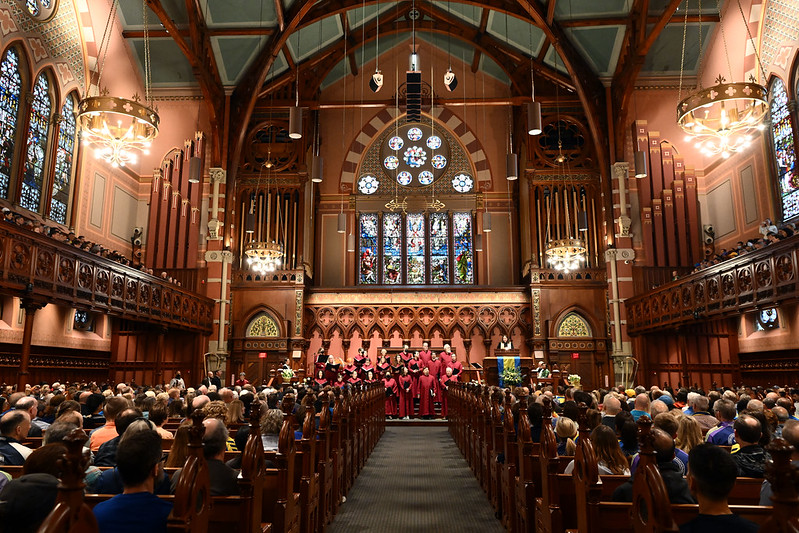
That’s what I believe we do here each and every week as we gather for worship. Weeping, crying, dancing, we come. Like Ezekiel in the valley of dry bones and Baby Suggs in the Clearing, together we sing and speak words of hope and love, that we might be restored to life. With the people of Israel, we confess: “our bones are dried up, our hope is lost; we are cut off completely.” And we listen, week after week, as God says, “O dry bones, hear the word of the Lord. I will cause breath to enter you, and you shall live.” This is the central mystery of our faith: Christ has died, Christ has risen, Christ will come again—and therefore we always have hope. The ancient order of the mass, which we follow in our worship each week and especially this week, this ancient order reenacts this central mystery: the dying and rising of Christ, the movement from dry bones to living flesh, God’s never-ending word of hope, “you shall live.” Inhaling the word of the Lord, the breath of hope, we are revived.And as with every breath that fills our lungs, breathing hope has two motions, two inseparable parts. As we gather here and inhale the breath of hope and new life in the mystery of our faith, we must also scatter out to exhale that breath of hope and new life into the world.
Inhale, exhale—one breath.My friends, the world is full of dry bones crying out for a word of hope. So come and hear the word of the Lord, the promise of life, the breath of hope to revive our souls. Then go forth, and prophesy—show the world that God’s everlasting love and faithfulness can breathe life into even death itself. Live in the mystery of our faith, and, with every breath—inhale, exhale—breathe hope.
Hear the word of the Lord, and prophesy—one breath.
Hear hope and speak it—one breath.
Copyright © 2005, Old South Church and by author.
Excerpts are permitted as long as full accreditation is made
to Old South Church and to the author.