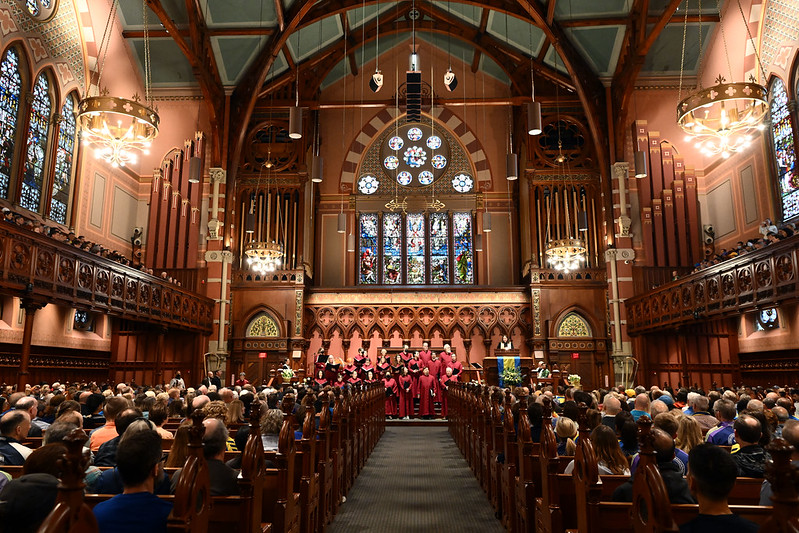
The Old South Church in Boston

Unexpected Turns

A Sermon by Rev. Jennifer Mills-Knutsen

August 14, 2005
Matthew 15:21-28
 
It’s hot this morning, and I don’t know about you, but when it’s hot, my mind gets a little sluggish. So before we get too deeply into the sermon this morning, I want to get our minds in gear a little bit, get you all thinking and attentive. So let’s start with a little quiz. The first part is fill in the blanks. I’ll give you an incomplete sentence, and then, together, I want you all to shout out the word that finishes it. Ready? O.K.

California is a state out on the West ______ (Coast).

If I have a party, then you are the guest and I am the ________ (host).

And into my toaster I would put _________(toast!).

Toast, did you say? No, you put bread into the toaster, then toast is what comes out of the toaster.

Let’s try another one. This time I’m going to tell you some information, then ask a question about it. Don’t worry, you can do it without a calculator.
 

I’m driving a bus from Boston to Worcester. In Boston, 17 people get on the bus. In Brighton, 6 people get off, 9 people get on. In Newton, 2 people get off, 4 people get on. In Natick, 11 people get off, 16 people get on. In Framingham, 3 people get off, 5 people get on. In Marlboro, 6 people get off, 3 people get on. The bus then pulls into the Worcester bus depot.

What was the name of the bus driver?


What, were you not listening? Or was that not the question you were expecting? I said I was driving the bus, so the driver’s name is Jennifer.

So other than getting our brains at attention, what these little exercises show is how much our expectations shape what we hear and how we respond. It’s not for lack of listening that you could not answer my question—your expectations of a math question just fooled you.

This kind of listening through our expectations is a natural part of how the human mind operates. It’s the only way our brains can process the enormous volumes of information our senses apprehend in any given moment. Throughout our lifetime, we accumulate trillions of little pieces of information, and as we grow and learn, we assimilate all of them into patterns. Any new information then gets sorted and processed instantly through these pre-existing systems. Cognitive scientists call these giant patterns, “frames,” and have discovered that they are embedded in our very neurons and synapses. The circuitry of our brains is hard-wired into these frames and patterns.1 When I introduced that second exercise by saying, “Don’t worry, you don’t need a calculator,” I set you up. I made your mind frame everything that followed as a math problem.

Malcolm Gladwell, in his new book Blink: The Power of Thinking without Thinking, takes up a similar discussion about the powers and pitfalls of this unconscious internal computing. Gladwell looks at countless examples of snap judgments—from studies that show five minutes in someone’s bedroom can give you an accurate assessment of their personality to the popular singles phenomenon of speed-dating. What he finds is that “decisions made very quickly can be every bit as good as decisions made cautiously and deliberately.”2 Deciding based on our patterns, analyzing through our frames, judging based on our expectations, whatever you call it—it works most of the time, as well as or even better than our rational analysis, because it’s based on prior knowledge and experience.

But such snap judgments do not work not all of the time. Like in the trick questions I asked you a few minutes ago. Sometimes our expectations actually serve to mislead us, because, in an instant, we will respond based on the pattern we expect, not based on really listening. In an instant, frames trump facts. Expectations trump actualities. Gladwell points to the tragic shooting of Amadou Diallo by four New York City police officers. A black man in a bad neighborhood at midnight reacting to police by running away, then reaching into his pocket for a small black object. The officers see “gun”, and fire off forty-one shots, killing the 22-year-old Diallo, who was only trying to show them his wallet. The whole incident lasted less than eight seconds. When they reacted in the blink of an eye, the officers saw only what they expected to see—and their expectations prevented them from seeing what was really there.3

Jesus is on a journey in unfamiliar territory, outside Jewish lands between the pagan cities of Tyre and Sidon. As he and the disciples walk along the road, a woman begins screaming at them.  “Have mercy on me, Son of David; my daughter is tormented by a demon!” Jesus glances over and sees: a woman, a Canaanite, a local, a pagan. He fills in the blanks: no husband, no security, no status, no one of importance. He does not answer her. But the woman must have kept on screaming at him, because the disciples ask Jesus to send her away, just to stop the shouting. Jesus responds, true to the pattern of his ministry: “I was sent only to the lost sheep of the house of Israel.” He was sent for the Jews, he healed Jews. She was not a Jew, therefore not within the scope of his healing.

She persists. Kneeling before him, she cries, “Lord, help me!” Jesus speaks again from the place of his assumptions: “It is not fair to take the children’s food and throw it to the dogs,” and he keeps on walking. It’s a snap judgment, out of racism, bigotry, sexism, prejudice, impatience, who knows what. And now it is our expectations that have been upset. This is not the wise and compassionate Christ we have come to know and love. This is a disturbingly human Jesus, with neurons and synapses hard-wired like ours to automatic responses, even into patterns of discrimination.

But the Canaanite woman refuses to be judged by Jesus’ expectations. She demands that he listen to her, see her for who she is, not for who he expects she is. “Yes, Lord,” she says, “yet even the dogs eat the crumbs that fall from their masters’ table.” Jesus might have let his expectations continue to dictate his assessment. He might have kept on his way, continued finding faith and practicing healing with his Jewish brothers and sisters.

But he didn’t. Jesus stopped. I imagine him on the road finally stopping, turning, looking at this woman … the glazed look replaced with a steady focus as he begins to actually see her … his face slowly softening as he begins to actually hear her …

A woman, a Gentile, unclean.

Yet when he looked past his expectations, what did he see?
Faith, real and alive.
A child in need of healing.

What did he discover, when he set aside his assumptions?
Compassion, broader and deeper than he imagined possible.
Conversion, not the woman’s, his own.
He found the face of God, in her face, the most unexpected of places.

“Woman, great is your faith! Let it be done for you as you wish.”
And her daughter was healed instantly.

Like all human beings, Jesus functioned by means of his expectations and instant judgments. But Jesus shows us in this encounter with the Canaanite woman that we are not bound to our synapses. Our minds can be changed. All it takes is a moment to stop, listen, look—at facts over frames. I can prove it to you.

One more little mind exercise—only this time, you know what’s coming, you know to slow down and listen past your expectations. Ready?

In unison, I want us all to say the word “SHOP” five times.
(SHOP, SHOP, SHOP, SHOP, SHOP)
Now, what do you do at a green light?
“Go!”

Well done.

Now imagine taking that same moment’s pause, that same space to stop, listen, look, out in the world. How different things would be! What might we encounter, past our expectations? I believe we will find what Jesus did. We will find compassion, broad and deep, for persons and problems we had thought outside our circle of concern. We will find conversion, reforming our hearts again and again in the shape of love. But most importantly, we will find the face of God, who waits for us in the most unexpected places. May it indeed by so. Amen.


1. George Lakoff, Don’t Think of an Elephant: Know Your Values and Frame the Debate—an Essential Guide for Progressives (Chelsea Green Publishing Company, 2004), 17, 72.
2. Malcolm Gladwell, Blink: The Power of Thinking without Thinking (Little, Brown, 2005), 14.
3. Gladwell, 189-244.


Copyright © 2005, Old South Church and by author.
Excerpts are permitted as long as full accreditation is made
to Old South Church and to the author.

Back to Sermon Page

The Old South Church in Boston
645 Boylston Street
Boston, MA 02116
(617) 536-1970