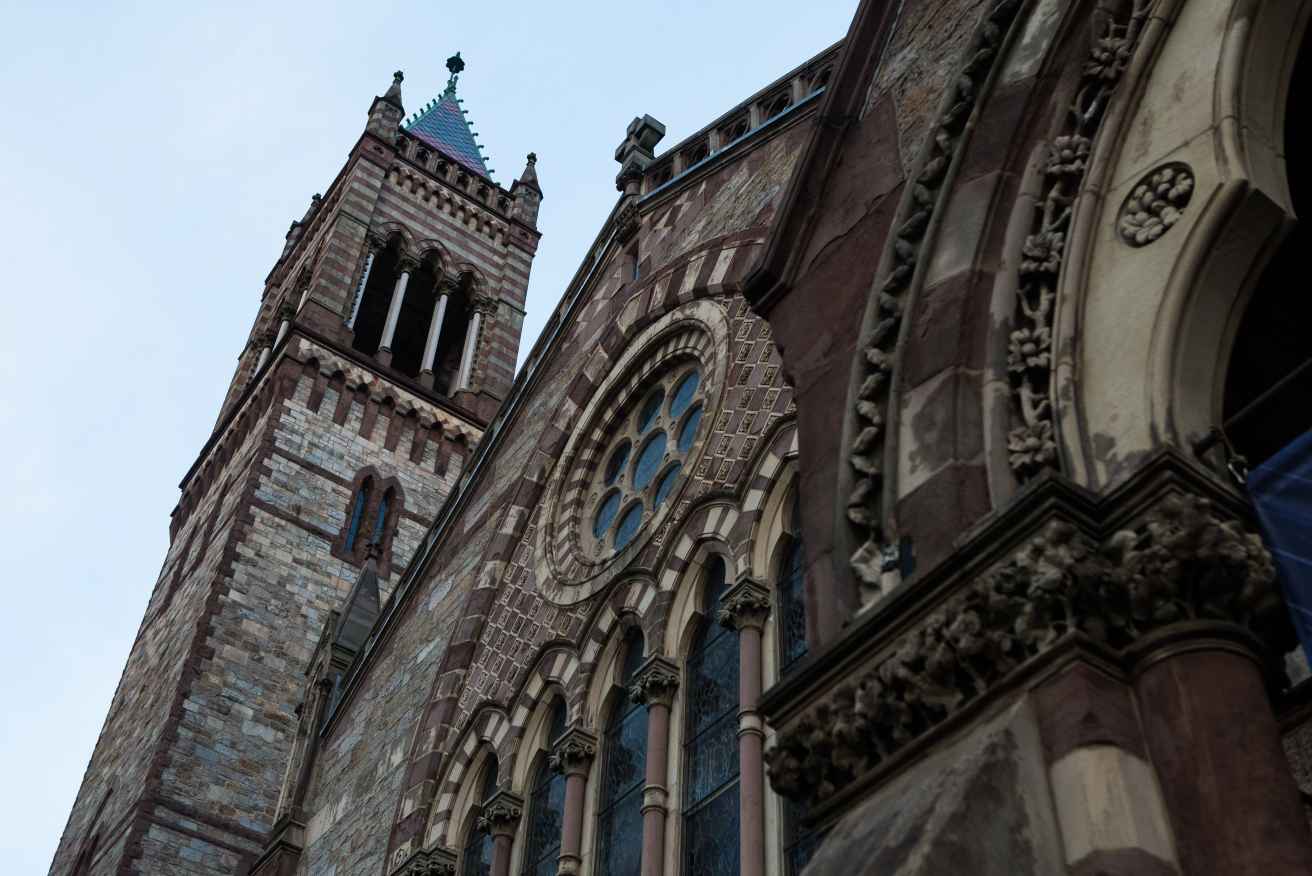
Old South Banner
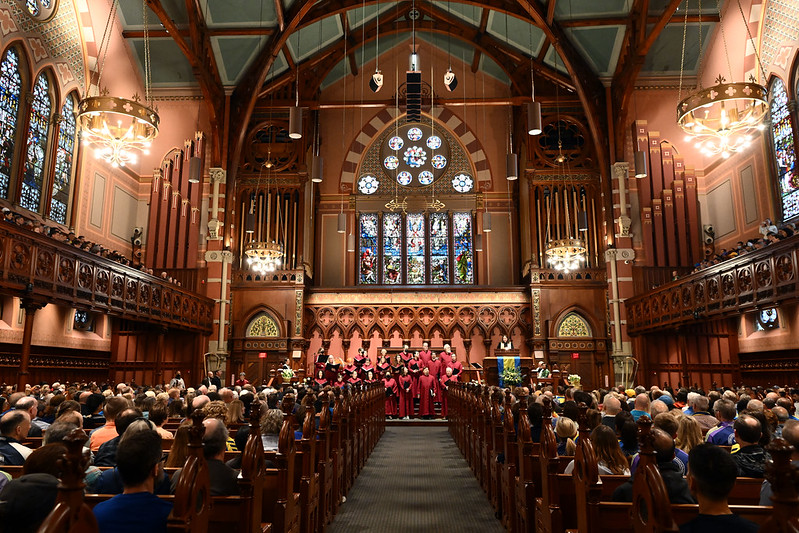
Old South Sanctuary (photo by Sarah Musemuci)


Old South Sermons:

A Hoax? Or What?

by James W. Crawford, Senior Minister Emeritus

2nd Sunday of Easter, March 30, 2008

Listen to this sermon


THE GREETING
  
 Linda and I, along with a couple of our four children, all veterans of the Old South  church school, their spouses and children eagerly  join you for worship this morning. We’ve had a special weekend together, all four children and 14 grand children,  celebrating Linda’s closing out of her seventh decade. It’s been a blast, of course, and those of us remaining in town are pleased to gather here again with you in our church home.

    And yes, we’re here to witness the vibrant, exciting, challenging, prophetic mission this Church exercises with Nancy’s creative and inspiring leadership, the exquisite contribution of Quinn, the excellence of your programmatic and administrative staff, as illustrated partly by these two fine interns, and, of course, deeply committed congregational officers, really, second to none.

       Aren’t you glad spring’s here, and baseball’s begun again? Our son Robert, you know, because of some tremendous organizing work by Nancy Taylor, members of this church and the United Church of Christ across Massachusetts serves as the so called Vice President of “Red Sox Nation.” He returned from Japan this last Thursday. What a trip! He has a son, you know, 8 year old Robert, Jr. who is no less devoted to strategy, statistics and the game’s  mysteries than any of the rest of us.  Indeed, at his school last week he was asked by his teacher, along with the rest of his class, to name the nine greatest men in American history. His classmates answered the question easily, Washington, Jefferson, Lincoln and the like. But little Rob just couldn’t seem to finish. His teacher became impatient and  wondered what took him so long. “Can’t you think of nine great Americans?” she asked. “I’ve got eight all right,” answered little Rob. “But what I still need is a second baseman.”

  Again, we are pleased to be with you. 

 L et us pray: May the words of my mouth and the meditations of our hearts be acceptable to you, our strength and our redeemer.  Amen


A Hoax?  Or What?
OSC, March 30, 2008
John 20:19-31

      Binjamin Wilkomirski. . . .Binjamin Wilkomirski . . .

Does that name ring a bell?  I read a reflection of his a week or so ago. He entitled it,”Fragments.” Wilkomirski tells brilliantly - almost with Faulknerian elegance - he tells  of his near infancy and early childhood in Nazi death camps. The story unravels in a stream of consciousness as Wilkomirski witnesses and experiences unimaginable cruelties and brutality. Born in 1939, ripped violently by the Nazis from his family in Riga, as a first memory he watches a truck deliberately crush his father against a wall.

A mysterious woman swoops in to save him and delivers him instead to the death camp at Madjanek.  near Lublin, Poland. There,  dusted by ash from the crematorium and later a peculiar victim of a Mengele associate, he then finds himself transported from camp to camp, ragged, starved, beaten, the object of malice, both casual and savage. He finally escapes with others as the Allies approach and his Nazi captors abandon the camps.

    Maurice Sendak, author and artist of that popular child’s bedtime tale,”Where the Wild Things Are,” said of this reflective work: “ . . .These broken ‘fragments’ slice into the soul and draw blood. More than justice, fine art is rendered in these unsmoothed-out memories.”

     And Daniel Jonah Goldenhagen, a discerning Holocaust historian, confirms that “even those conversant with the literature of the Holocaust will be educated by this arresting book. All will be deeply moved.”

     And Goldenhagen speaks truth.  Wilkomirski became an academic, documentary and talk show   eminence, appearing all over Europe with his “Fragments.”       

       As the book itself comes to a close, Binjamin Wilkomirski informs us he finally lived with foster parents in Switzerland. His adopted parents urge him, he tells us, to forget all the terrors.  “A dream,” they insist. He writes that as much as he wanted to share his story with them, he cannot complete a single sentence without their scepticism, “You’re making this up,” they say.
     
        They were right. Binjamin Wilkomirski made it all up. He survived no death camp. He was not Jewish. He was not Latvian or Polish. He was not even Benjamin Wilkomirski. He was Bruno Grosjean, a Swiss Citizen, a Christian, born in 1941. Binjamin Wilkomirski, as one observer suggests, was “either a viciously cynical huckster or a pathetically warped madman.” Either way - or both - Benjamin Wilkomirski was a fraud, a sham,  a monumental hoax.
                                       
    Now, I use that story as you may suspect, to broach the introduction of one of the New Testament’s unique and memorable characters: Thomas. Thomas believed the Easter appearance of Jesus to be, just like                  Binjamin Wilkomirski’s claims of Death Camp survival experiences,  - Thomas believed the Easter appearance of Jesus a living lie, a fake, deception, a fraud, a hoax. You see, after what Thomas witnessed on Good Friday - the messy, bloody, brutal death of one he treasured most in the world - Thomas cannot believe in a loving God anymore. No one can convince him  a loving God  would let such a horror happen as happened to Jesus of Nazareth. No argument can persuade him. No hearsay convince him. He receives the testimony of his friends and instead of rejoicing with them, he replies to them, I suspect, something like this: “As much as we want life to be different, as much as we covet a world where goodness counts, where truth claims the edge, where compassion makes a difference - as much as we want that kind of world we know now it is simply wishful thinking. This world,” asserts Thomas - “this world is finally like Calvary - that Cross, that mob, that cynical governor, that denominational hierarchy, our own cowardice during those crucial hours: life comes down finally to that. Nothing can reverse for me the dark and cruel message struck by the death of Jesus. No, my friends, the dream is dead, the cause is lost, the forces willing to mutilate life, the powers crippling us, the near misses, the failed promises breaking our hearts: these, in our lives, bear the last word. Unless I see the prints of the nails and touch the wound in his side, a conquering Christ seems preposterous in a world where the lies of crucifixion holds sway. No Sunday hope can nullify that Friday catastrophe. You tell me of nothing but a giant hoax. I survive - but I survive without hope.

II

     Does Thomas speak for you or for me? Does he speak for the pain in our world denying the Easter promise? I don’t know what pricked your heart or tested your souls this week. But a quick review of the headlines might put the Easter hope of for grabs.

      Brockton, Massachusetts: Oliver Baptiste, 15, murdered by his best friend over possession of a video-game. “It just didn’t happen. It just didn’t happen” insists the 18 year old who pulled the trigger.  A numbed teacher protests: “It’s the kind of thing that doesn’t make sense to anybody.”

         Or as the Wall Street Journal reports, “Tibet’s capital, Lhasa  is left scarred and scared;” 22 dead say the Chinese; 140 say the Tibetans in religious and cultural conflict with the ruling Chinese,  The Dali Lama claiming “unimaginable and gross abuses of Tibetans’ human rights.”

    Or, Baghdad:  A bomb lifts a Humvee five feet off the ground and engulfs it in flames. “That’s when we left hope at the door” writes one solider as he watched his buddies die.  Or another, “We had already lost enough people that we just thought, you know, ‘Why?’”
                        
     Why? The promise of Easter Day: is it believable?  Today, a week later. Low Sunday, no powerhouse brass, no “Hallelujah Chorus,” no thundering crowds -  does the Easter hope hold true?

    A wise poet by the name of Ann Weems has a hard time believing it herself. She lost a son, killed wantonly  amid an inner city gunfight. It well nigh killed her and in a compilation of her own “Psalms,” she cries,

“O God, explain to me
the cruelty of your world!
Make sense of those
who make no sense!
Tell me why the innocent die
and evil people live
to kill again!
Tell me why the faithful
     are shunned
and the self-righteous
point their fingers!
Tell me why the wounded
are wounded
and sorrow falls
on the shoulder of sorrow!
Tell me why the abused
are abused,
and the victims victimized!
Tell me why the rains
come to the drowning
and aftershocks
follow earthquakes.
O God, is this any way
to run a world?
O Merciful One, let us rest
between tragedies!
Speak to us
for we are your people.
Speak to us of hope
for the hopeless
and love for the unloved
and homes for the homeless
and dignity for the dying
and respect for the disdained.
Speak to us, O God
of the Resurrected One!
Speak to us of hope
for in spite of the wave of tears
we remember your story of new life!
Tell the world again,
O God, of creation!
Tell us that winter will fade
 and spring will wash us new,
and the world will be green again,
and we will be new creations
in the garden of our God.
Free us from these tentacles
 of sorrow,
and we will fall on our face
 and worship you,
O God of goodness,
O God of a new green world!”

     One week after Easter when we revel in the triumph of God, we look around and see so much denying the Easter Promise we might just as well be
 “Doubting-Thomas” ourselves, refusing to believe unless we put our fingers in the marks of the nails and our hand in the wound of his side. Don’t tell us about
Easter - our world is still risky and dangerous, our wounds still run deep, our losses overwhelm Easter promises. The evidence points to a giant hoax. .
                 
      III

     Really? Does the story  end there for some of us?
Perhaps. But not for John. As John tells us, eight days later the disciples retreat again to their secret room. They lock the doors.  Jesus breaks in among them announcing “peace.”  He says to Thomas, “Put your finger here and see my hands. Reach out your hand and put it into my side. Do not doubt, but believe. As the father sent me so I send you.”

     Here friends, we encounter the heart of the Christian faith.  Here we confront the glory of Easter’s steadfast promise. I implore you hear it, for here we discover, not just “Good” but  fantastic news. I beg you look to the Cross,  here, above the chancel. What do we, in the first place, see there? Death. Execution. Injustice. The destruction of the best human life ever offered. That’s what Thomas sees. That’s why he doubts. But let me ask again: what, in faith, do we see there?  Why do we set this great Cross at the head of our nave? What gleams from that instrument of execution? What radiates from that tool of the death penalty?  And here, friends,  lies the mystery, the  paradox, the glory of the Gospel, the Easter Truth.  At the Cross we discover the true power of God lies not so much in preventing the things that compel us to doubt, but over time, inexorably, Providentially the power of God, for those who believe, lies in transforming those devastating things.  Do you see? At the Cross, we discover the love of God alive and at work even amid the woundedness of human life. At the Cross, during this wondrous Easter season we glimpse the Christian hope when everything seems against it. Here we learn the love of God can be found at those places it seems to be in evidence the least. Our hope can be discovered in those moments and events we label hopeless. Thomas’s encounter with the wounds of Christ compels him - no -  compels us - to understand what makes God, God. And what is that? The revelation of love and hope at those very places love and hope seem most blasted and beaten down. The wounds of Christ bear the love of God. Our hope rests in the costly love that moves where it is needed most.
                      
    Forty years ago next Friday, April 4, 1968, I found myself, in the early evening, on the way to a church meeting in lower Manhattan and waiting for a light to change at 14th Street and Fifth Avenue. A Yellow Cab pulled up to the curb and a black face, itself lost in the dusk, shouted through the passenger window, “Did you hear? Did you hear? Dr. King’s been shot! Dr. King’s been shot!” This astounding prophet  seeking to bring justice and reconciliation among the races of this nation; this Biblical seer, rooted and grounded in the visions of  those ancients  pleading that “justice roll down like waters and righteousness like an ever rolling stream;” this nation-changing agent and force standing as he did at that moment amid a garbage strike in Memphis and taking virulent abuse for his cries for peace as the Vietnam  crisis devoured President Johnson and polarized our politics and our churches; this decisive presence whose life among is came, as he entitled one of his essays, as a “Testament of Hope”: “Dr. King’s been shot! Dr. King’s been shot.”

         My soul! It’s forty years following Dr. King’s death, and today with the national dialog about race in our politics, in our churches, in our denomination - yea, at its heart, Barack O’Bama, one of our almost literally rainbow brothers from Trinity Church in Chicago, whose Pastor by the way, Jeremiah Wright, three years ago delivered the Crawford lecture from this very pulpit . . . and provocative and challenging it was - forty years later we pursue this troubling personal and public issue, and Dr. King continues, regardless of who we are, to spread the vision before us.

       Listen: Stockholm, 1964, The Nobel Peace Address: (and you’ll permit me, please, to use to use the nouns and pronouns as he did in 1964.)

   “I accept this award today with an abiding faith in America and an audacious faith in the future of humankind. I refuse to accept the idea that the ‘isness’ of man’s present nature makes him morally incapable of reaching up for the eternal ‘oughtness’ that forever confronts him.
    I refuse to accept the idea that man is mere flotsam and jetsam in the river of life which surrounds him. I refuse to accept the view that mankind is so tragically bound to the starless midnight of racism and war that the bright daybreak of peace and brotherhood can never become a reality.
    I refuse to accept the cynical notion that nation after nation must spiral down the militaristic stairway into the hell of thermonuclear destruction. I believe that unarmed truth and unconditional, love will have the final word in reality. That is why right temporally defeated is stronger than evil triumphant.
   I believe that even amid today’s mortar bursts and whining bullets there is still hope for a brighter tomorrow. I believe that wounded justice lying prostrate on the blood flowing streets of our nations, can be lifted from this dust of shame to reign supreme among the children of men.
    I have the audacity to believe that peoples everywhere can have three meals a day for their bodies, education and culture for their minds. And dignity, equality and freedom for their spirits. I believe that what self centered men have torn down, men other-centered can build up. I still believe that one day mankind will bow before the altars of God and be crowned triumphant over war and bloodshed, and non-violent redemptive good will proclaim the rule of the land. And the lion and the lamb shall lie down together and every man will sit under his own vine and fig tree and none shall be afraid. I still believe we shall overcome.”

    Jailed. Hosed. Cursed. Clubbed. Bombed. Assassinated. In this human being we see one who understands in our fallen, sinful world the kind of justice and peace among us Jesus promises involves wounds, risk,  perhaps blood and maybe a life and a death on the line. Here’s one, Martin Luther King, Jr. who no more than Thomas saw Jesus, but who believed and whose belief, as demonstrated by his very being, challenges and inspires our own. Indeed, here’s one, Martin Luther King, Jr., who heard the words of the wounded,  risen Christ, “As the Father sends me, so I send you,” yes, and you and me and the Old South Church in Boston, sent not to smug and complacent settings but to settings  looking like those where Jesus plunged,  where love seems always on the cusp of a vast bottomless pit, settings calling for faith, arenas forging our hope. “Just as the Father sent me so I send you.”

        And thus our question this week-after-Easter in this troubled world of ours: when we confess God’s ultimate victory over the powers threatening to do us in and destroy us, do we engage in a giant hoax or dare we wager on Love’s steadfast promise? The Gospel of John and the testimony of the Church for over two millennia remain unshaken. Believe it, my friends; we can trust without reservation the ultimate triumph of God through the worst life can do to us. And be assured, that when in our lives we encounter the risen Christ, we will be sent - as he was - to those most troubling and, perhaps, perilous human flash points, risking inevitably some serious wounds of flesh or heart or mind - yet, we too, through it all, in awe, in faith - in commitment and readiness to serve  - may find ourselves alongside Doubting Thomas,  confessing, finally,  with our lips and with our lives, “My Lord and my God.”

   Let us pray: We gather, O gracious God, in worship this morning, knowing that worship and mission are one; and that as you sent Jesus into this world of risk and danger to bear healing, reconciliation and peace, so you send us. Grant we may remain faithful to this high, wondrous and urgent calling. Amen     


THE BLESSING

      My friends, as you leave this gathering, I pray that we, like our forebears in the faith, who themselves did not see, but believed - that we too may believe and with vision and compassion, unshakable hope and indomitable courage, hear and follow the urgent mandate of our Sovereign and Savior: “just as the Father sent me, so I send you.”
    And may the grace of our Lord Jesus Christ, the love of God and the communion of the Holy Spirit rest and abide with you this day and forever more. Amen.


Copyright © 2008, Old South Church and by author.
Excerpts are permitted as long as full accreditation is made
to Old South Church and to the author.

Old South Church
645 Boylston St. Boston, MA 02116
(617)536-1970 Tel (617)536-8061 Fax

You can E-mail us by clicking here: OSC Communications

Copyright © 2008, Old South Church