All Saints’ Day is a solemnity celebrated
on November 1st in Western Christianity in honor of all the saints,
known and unknown, commemorating those who have attained the beatific
vision of heaven. Today at Old South Church we mark the observance by
remembering our own beloved dead.
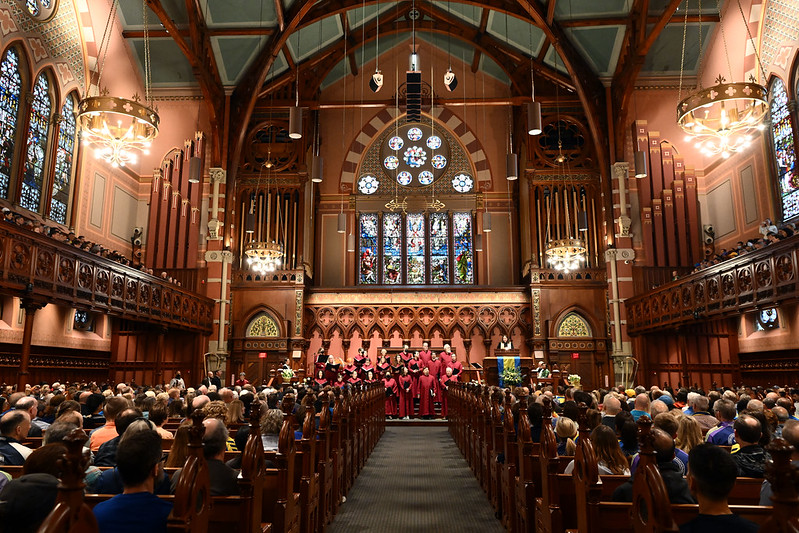
The Requiem is a liturgical
service for the repose of the souls of the deceased. It is
notable for the large number of musical compositions that it has
inspired. Originally, such compositions were meant to be performed in
liturgical service; eventually however, the dramatic character of the
text began to appeal to composers to an extent that made the requiem a
genre of its own, and today such compositions have been taken out of
their sacred context and have become a perennial favorite of the
concert stage. On this All Saints’ Day we reclaim the ancient practice
of presenting a composed requiem in the context of a service that will
include a ritual remembering of all those who rejoice with us, but from
a farther shore, and in a greater light, and with whom we are one in
Jesus Christ.
_________________________
“For when we were baptized into Christ Jesus, we were baptized into
Christ’s death. If we have been united with Christ in a death like
Christ’s, we shall certainly be united with Christ in a resurrection
like Christ’s.” - Romans 6:5
_________________________
There are two preachers at every funeral. So writes Thomas Long,
professor of preaching at Candler School of Theology. “Death –
capital-D Death – loves to preach and never misses a funeral. Death’s
sermon is powerful and always the same: ‘Damn you! Damn all of you! I
win every time. I destroy all loving relationships. I shatter all
community. I dash all hope. I have claimed another victim. Look at the
corpse. Look at the open grave. There is your evidence. I always win!’”
(Accompanying Them with
Singing: the Christian Funeral, by Thomas G. Long, p. 188)
Death’s sermon is sharp and wounding … it cuts to the bone, it cuts to
the soul, it tears at the heart.
The evidence Death sites – the corpse, the grave – is convincing.
Almost unanswerable. But not quite.
For here’s the thing: there are two preachers at every funeral.
The other preacher? All of us … our combined forces and voices:
singers, instrumentalists, conductors, composers, clergy and the
congregation … including the bereaved.
If you have hiked in bear country, grizzly country … you may know that
to happen upon a grizzly bear is a fearsome thing. Grizzlies are
enormous, wild and very powerful. Their massive paws are equipped with
rapier-like claws. Their teeth are huge.
If you have hiked in grizzly country, you have likely been coached
about what to do if you happened upon a grizzly.
While grizzlies have a keen sense of smell, they have poor sight.
If you see a grizzly and if it sees you … the idea is to bunch up
together. Whatever number of hikers you are, bunch up together, huddle
up, so that the grizzly, with his poor eyesight, perceives one bulky,
outsized, giant of a human … something hefty and fearsome … big enough
and threatening enough, to make that bear think twice.
The rangers will tell you: “Speak to the bear. Speak in low, confident
tones. Let the bear hear the sound of your voice. Let it hear that you
are human.”
At a Christian funeral, we come together, we bunch up together, to take
our stand together against a fearsome foe … Death. We bunch up together
and preach back at Death. We come together, all of us, across time and
beyond time: the author of the 23rd Psalm is there and the Apostle Paul
is there. Gabriel Fauré and Ralph Vaughan Williams are there.
Harry Huff, the Chancel Choir, and an orchestra. Don Wells, Elizabeth
Myer Boulton and Jocelyn Gardener …
and you, all of you, most all of whom have felt the sting of death …
We come together and when Death cites as evidence the corpse and the
grave, we concede this much: we concede that flesh is mortal and
fleeting, that our bodies only carry us so far. After all, as
Paul has said: we who were baptized into Christ Jesus were baptized
into his death. We know something about death! We concede that.
But then we counter with our evidence, with what we know. We counter
with the evidence of the empty tomb, the risen Christ, the saints in
light, the choirs of angels, the cloud of witnesses. We cite as
evidence the works of Botticelli and of Bach, the courage of Bonheoffer
and of Dr. King. We counter with the evidence of 2000 years of
testimony and experience that says Death is not the end. Death does not
win.
When Death, with its rapier-like claws and its powerful jaws, points to
the grave and to the corpse, threatening us, laughing at us, damning
us, mocking us… we bunch together – we raise ourselves to the full
height and stature that are ours as children of God – and with one
voice we speak out the words of Jesus:
I am the resurrection and the
life;
all who believe in me, though they die, yet shall they live,
and whoever lives and believes in me shall never die.
When Death attacks us with its terrible speed and brute strength … when
Death taunts us, asserting that the dead are now severed from us, lost
to us … we bunch together, we stand our ground, we stare it down and we
tell Death what we know:
… that neither death, nor life,
nor angels, nor principalities,
nor things present, nor things to come,
nor powers, nor height, nor depth, nor anything else in all creation,
will be able to separate us from the love of God
in Christ Jesus our Lord.
Death’s sermon is painful and threatening … it tears at us … wounding
us. God knows, Death hurts. And so it is that we come together, bunch
up together, anointing Death, bathing Death, drowning Death, with the
waters of our baptisms.
When Death nears, mocking and damning us, threatening us with its jaws
and claws, preparing to claim its next victim, we answer with our
voices and we speak back at Death, we sing at Death we address Death
with music that is almost unbearably beautiful, sweet, tender,
soothing, triumphant: with sweet melodies with strong words of light
and salvation, of peace and rest … taming the beast called Death.
Now, there is a rumor out there that just so long as we who are alive
remember those who have died, they live … they live on in our memories
… they live on in our hearts.
That is true. But it is only a part of the truth.
What Christians claim at the time of death is something quite
different. What we claim at the time of death, and what we proclaim
each year on All Saints’ Day is that mortals do die … the life goes out
of us, breathing ceases, the heart stops beating … and yet, and then,
we are given our lives back … we who were dead, are made alive again in
Christ, we are raised with Christ.
We who were buried with Christ in baptism, are raised with Christ in
glory.
Our loved ones are not merely alive in our memories – although they
are! Their aliveness is not dependant on your memory. They are alive!
You are reasonable and educated people. You know that what we are
proclaiming here is not rational … this is not natural … this is not
humanly possible. I know who you are: PhD’s and medical doctors,
lawyers and teachers, students and librarians, accountants and
musicians, engineers and contractors. Why would you believe this? You
don’t believe in Creationism!
Yet this is what the Church proclaims. This is the ground on which we
take our stand.
We proclaim that the dead have traveled to the edge of mystery (which
is as far as you and I in this flesh can go)... and then they move
beyond where you and I can go …but to where we will follow them.
We proclaim that they have attained the resurrection-promise of
baptism. We proclaim that they still rejoice with us but upon a farther
shore, and in a greater light.
This is the other sermon. This is our sermon. This is what we preach.