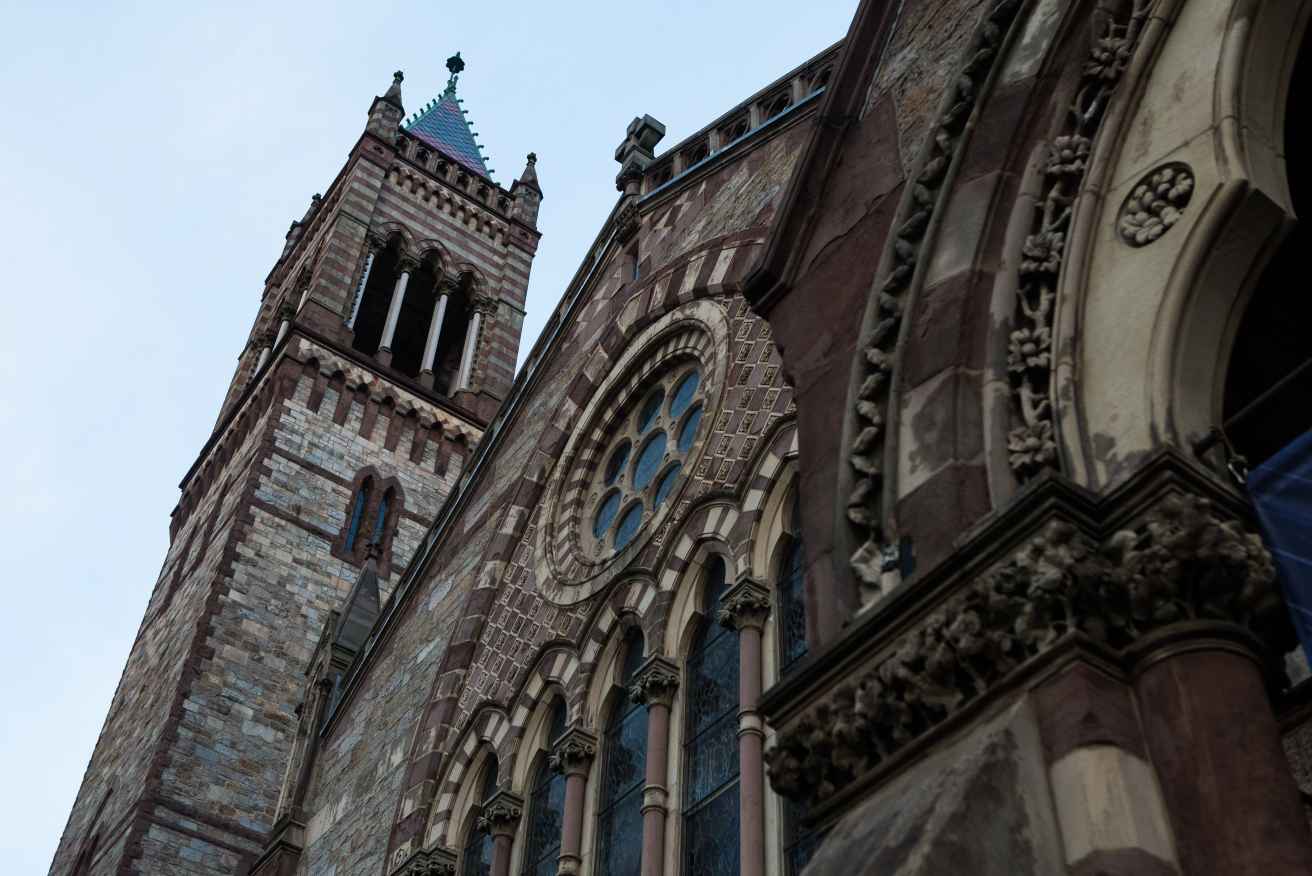
The Old South Church in Boston

"A butcher, a bricklayer, a brewer..."

A Sermon by Rev. Nancy S. Taylor

Based on the story of the Transfiguration, Matthew 17: 1-9

February 3, 2008 - Transfiguration Sunday


Listen to this Sermonmp3 file


A butcher, a bricklayer, a brewer, a bookseller, a shoemaker, two ship’s captains,
 a tailor, two felt-makers, an apothecary, a mint-master, and a schoolmaster


In my office here on the third floor I have a complete set of The Great Books of the Western World … a gift from my family on the occasion of my ordination to ministry. Its fifty-four volumes span twenty-five centuries and include seventy-four authors from Homer to Freud and William James.

The premise behind this collection is that the tradition of the West is embodied in a great conversation. Beginning at the dawn of human history the conversation continues, year after year, century after century. The premise is that in books, we have access to the words and ideas, the thoughts and arguments of the greatest minds that have gone before us. Through books and libraries we engage with those of previous generations: debating, conversing and learning.

The editors of the Great Books argue that the spirit of Western civilization is the spirit of inquiry. Nothing is to remain undiscussed. Everybody is to speak his or her mind. No proposition is to be left unexamined. The exchange of ideas is held to be the path to the realization of the potentialities of the human race.1

Whatever you might feel about the collection of the Great Books, surely conversation is at the heart of Western civilization. Surely, it is by means of conversations and debates, meetings, summits and synods, assemblies, conventions and congresses, conferences and councils that we learn from one another, make decisions and move forward. After all, it is only tyrants who shun the advice or input of others. It is only despots, bullies and fools who suppress the free exchange of ideas.

At this very moment in our nation, we find ourselves in the midst of a long election season conversation – a rolling conversation and debate, ranging from New Hampshire to Michigan, from South Carolina to Nebraska, from California to Florida. On Tuesday (Super Tuesday) it will explode all across these United States.

Our nation is in the process of talking and debating its way through some of the great matters of our time and day: immigration, international relations, race and gender, the use of torture, the efficacy of warfare, whether healthcare is a right or a privilege, the matter of climate change, the influence of faith and religiosity on elected leaders, to name a few.

The biblical story assigned for today – the story with which most Christian churches will wrestle this very morning – is the story of a conversation.

The story of the Transfiguration of Jesus is among the strangest stories in the New Testament. It is mystical, perhaps magical, perhaps even fantastical.

At its heart and core, however, it is the occasion for a conversation that spans centuries: a conversation among Moses, Elijah and Jesus.

Moses, hailing from the 13th century BCE, Elijah from the 9th century BCE and Jesus from the 1st century of this Era, meet and talk. One can’t help but wonder if this extraordinary conversation – one that occurred in the East – was the inspiration for The Great Books of the Western World. After all, it was for this that the Great Books aimed: a conversation that spans the centuries but occurs in real time!

Who were these centuries-spanning conversationalists? Moses, was God’s best friend. He was the giver of the law. It was Moses who bound a loose band of former slaves into a community, a civilization under God and under God’s law. Elijah was Israel’s most celebrated prophet. He was known for his help for the poor and those in danger. To this day Jewish legend holds that it is Elijah who will announce the coming of the Messiah.

It was upon another mountain at a different time that God had given to Moses the Ten Commandments to carry down to the people. It was upon yet another mountain, at yet another time that Elijah had heard God’s still small voice.

The story of the Transfiguration occurs at a turning point for Jesus. He is headed toward Jerusalem. He is headed toward confrontation with the powers and principalities of the world. He is headed toward his death.

It is poignant to imagine Jesus, at this moment in his life, engaged in earnest conversation with Moses and Elijah – these three colleagues, if you will, comprising together a league of extraordinary gentlemen. It is poignant to imagine this conversation, because it occurs just as Jesus is about to reach the point of no return. Will he continue to his death or turn back? What is God asking of him? Is he misguided? Has he misunderstood God? Is he on the right path?

Eager as are Jesus’ disciples to support him, they do not have the wisdom or gravitas to help him with these painful questions. While they will grow in wisdom and stature over the course of the years to come, they are ill-equipped at this time. Jesus requires the wisdom of the ages. That is what he gets in Moses and Elijah.

While we are not privy to the words spoken at this unusual summit, Jesus returns from this conversation strengthened and emboldened to carry on. He descends the mountain and, as the New Testament puts it, sets his face toward Jerusalem.

Three hundred and thirty-nine years ago twenty-eight men came together not far from here, for a private meeting. They included a butcher, a bricklayer, a brewer, a bookseller, a shoemaker, two ship’s captains, a tailor, two felt-makers, an apothecary, a mint-master, and a schoolmaster. They belonged to different generations and different social locations.

They were poised to embark upon a course that would wrench families and whole communities … a course of action that would sever them from their beloved church. They needed to consult, to debate, to argue, to inquire about their options, their direction, the path upon which they would embark. This would be no ill-considered or undiscussed matter. They would vet this, weigh the consequences and examine the implications.

The question at hand, the question of the day in 1669 had to do with baptism. Who could be baptized and who could not? Who was in and who was out?

The population of Boston was only several thousand at the time. The entire population was riveted on this question of baptism. It was all the talk in the year 1669 in Boston: at the docks, in the dry goods stores, on the streets, in the taverns, around the dinner table and, of course, at church meetings

These twenty-eight men were the founders of this church … a break away faction from Boston’s First Church. The founders of our church argued for leniency, a wider and wetter welcome at the baptismal font. Having failed to convince the majority of their more liberal position, they felt they had no choice but to secede. Painful as it was, they determined to confront the powers and principalities and set their face toward a different way of being church.

As the descendants of the twenty-eight men who founded this church in a firestorm, we continue to take baptism seriously. I would argue that the baptismal font is the single most important piece of furniture in this sanctuary. We put it to good use on many occasions this year. It is where and how we welcome newcomers into the family of Christ. It is how and where we give thanks to God for the gift of new life. It is how and where we replenish ourselves. It is at the font that we rededicate ourselves to the privilege and responsibility of passing on the faith to the next generation.

This afternoon at 12:30 we will gather for the 338th Annual Meeting of Old South Church. Old South began in a firestorm over baptism. It began with an act of defiance and an act of succession … an act which was, for our founding fathers, an act of faith.

But the founding of Old South was also the consequence of many profoundly searching conversations: conversations that occurred over the course of several decades prior to their act of succession … conversations about the nature of faith, the nature of salvation, the nature of God and the purpose and shape of the church … conversations about the future to which God is calling us.

In a few minutes we will welcome new members to Old South. In joining this church they step into the stream of a great conversation about the nature of faith and the purpose of the Church. They will join us in centuries-old conversations about how to follow the Prince of Peace in a violent world; about living with hope in a time of cynicism and despair; about living with courage and principle in a dog-eat-dog, everyone-out-for-themselves culture.

These conversations occur every week at Old South: in Theological Book Group and Bible Study, at Council meetings and Christian Education meetings, among the Board of Deacons and the Stewardship Committee.

All around us in Boston and all across this country, large old city churches are dying. They are being renovated into condominiums or artists studios. Other large city churches are in slow decay: their once stately buildings crumbling with lack of upkeep, growing shabbier and shabbier with each passing day. Not all will survive. Some of this is natural evolution. Some is because we are no longer a patently Christian nation; but some of it is because these congregations failed to engage the next generation. They were frozen in a 1950’s model of music and ministry.

On the occasion of our 338th Annual Meeting, I cannot help but marvel at the courage and faithfulness of the 28 layman who defied convention and followed the dictates of their conscience. They opened the doors of the Christian church to a new generation.

It is ours to take up the mantle of the great conversation they have bequeathed to us. It is ours to discern how to emerge day after day and year after year with a compelling message of Christian faith for ever new generations.

This is our future. This is God’s call.

God be with us.

1 The Great Books of the Western World, Encyclopedia Britannica, Inc. Volume I, The Great Conversation, p. I


Copyright © 2008, Old South Church and by author.
Excerpts are permitted as long as full accreditation is made
to Old South Church and to the author.

Back to Sermon Page

The Old South Church in Boston
645 Boylston Street
Boston, MA 02116
(617) 536-1970