Then I saw a new heaven and a new earth; for the
first heaven and the first earth had passed away, and the sea was no
more. And I saw the holy city, the new Jerusalem, coming down out of
heaven from God, prepared as a bride adorned for her husband.
And I heard a loud voice from the throne saying, "See, the
home of God is among mortals. He will dwell with them as their God;
they will be his peoples, and God himself will be with them; he will
wipe every tear from their eyes. Death will be no more; mourning and
crying and pain will be no more, for the first things have passed
away."
And the one who was seated on the throne said, "See, I am
making all things new." Also he said, "Write this, for these words are
trustworthy and true." Then he said to me, "It is done! I am the Alpha
and the Omega, the beginning and the end." --
Revelation 21.1-6
_______________________________
If our eyes are windows into our souls, then what do you make of John's
soul? What do you make of the soul of John of Patmos . . . John the
Revelator . . . John the Divine . . . John the Seer . . . author of the
Book of Revelation? What do you make of the soul of the
one who sees this vision of a new heaven and a new earth?
A lot has been made of this vision. The
Book of Revelation, the
last book in the New Testament,
is the most contested and controversial book of the Bible. It is easily
the most difficult . . . and it is the easiest to abuse.
Fourth century bishops argued heatedly against including it in the
biblical canon and, in truth, it almost didn't make it. John Calvin,
theologian and reformer, wrote about the
Book of Revelation
that he had, "grave doubts about its value." The German Reformer,
Martin Luther, distained it. A nineteenth century agnostic,
Robert Ingersoll, described the
Book of Revelation as "the
insanest of all books."
And yet, as scholar M. Eugene Boring has noted
i, John's
vision inspired a fabulous series of woodcuts by Albrecht Dürer,
as well as Michelangelo's
Last Judgment in the Sistine Chapel,
and Hubert and Jan van Eyck's
Adoration of the Lamb in the
Ghent altarpiece . . . one of Belgium's masterpieces and one of the
great artistic treasures of the world.
Sir Isaac Newton was a student of the
Book of Revelation, as
were D. H. Lawrence, Dante Alighieri, Edmund Spencer, George Eliot,
Thomas Hobbs and John Milton.
Scholars attest that the very form of the medieval cathedral, down to
the smallest details, was influenced by the pattern of the heavenly
city of Revelation 21 and 22.
On the other hand, Thomas Jefferson considered John's writing to be
"nonsense" and "the ravings of a maniac."
But here's the thing, if you look into John's eyes, you will see the
soul of a revolutionary. In spite of Jefferson's assessment of it,
John's revelation bears a remarkable similarity to Jefferson's
Declaration
of Independence.
But first, if we are to see into John's eyes, to gain access to his
soul, we need to locate him. John is alone, in a cave, on a small
island in the Aegean Sea . . . the island of Patmos . . . an island to
which he has been exiled by the Roman Empire.
Cut off entirely from human community and, in particular, from his
beloved Christian sisters and brothers, John's revelation is first and
foremost, a letter. It is no book at all; it is a letter written for
and to seven particular churches… churches in the throes of
persecution.
John's letter to those Christians is a defiant declaration of
independence from Caesar. It was as stirring, as lofty, as
courageous and dangerous in its day and time, as was in its day,
Jefferson's
Declaration of Independence from the King of Great
Britain.
If you look deeply into John's eyes, you will that he looks across the
Sea which isolates him from his beloved churches. Over on the mainland
he sees what is happening to his Christian brothers and sisters. If you
look into John's eyes, what you see is pain.
John's eyes are filled with images of Christians being arbitrarily
rounded up, detained, and made to pledge allegiance to the emperor.
Christians were made to proclaim: "Caesar is Lord!" which was a direct
contradiction of the Christian confession that "Christ is Lord!" In
addition and at the same time, these Christians were required to curse
Christ.
ii
John watches helplessly as Christians who comply are handed a
certificate exempting them from persecution.
John watches helplessly as Christians who do not comply - who refuse to
pledge allegiance to Caesar -- face anything from torture, to
imprisonment, to exile, to death . . . and, at worst, all four in due
season.
What is a Christian to do? Their choices are limited.
iii
1) They can quit being a Christian, which many are
doing. The cost s too high; after all they have children to provide
for, families to protect.
2) They can lie. That is to say, they can confess
publicly and aloud that Caesar is Lord, while maintaining in their
heart of hearts that Christ is Lord. They can say one thing, and do
another.
3) They can take up arms and fight Rome.
Except, they are pacifists!
4) They can adjust by making room in their hearts and
allegiances for both Jesus and Caesar. (This, by the way, is what
perhaps the majority of Christians in the United States do: pledge
allegiance simultaneously to Jesus
and to the flag of the
United States of America and the republic for which it stands . . .
hoping against hope that Jesus and the US government are more or less
aligned.)
5) Finally, the Christians in the seven churches of
Asia Minor can do what John urges them to do in his letter: they can
refuse. They can resist. They can reserve their loyalty for Christ
alone and, as John has done, they can face the consequences with
courage and determination.
Why did this matter? Why risk one's life by confessing Christ? Why not
simply pledge one's allegiance outwardly to Caesar and then quietly go
about one's day as a Christian: humming hymns under one's breath,
sharing bread and cup with others, hearing and telling the stories of
Jesus?
Why does this matter so much? Here's why. Pledging allegiance to Caesar
as God and to the Roman Empire, meant pledging allegiance to a way of
life ordered by and dependent upon violence - the violence of armies,
soldiers and weapons . . . the way of empire is the way of violence.
It meant pledging allegiance to a society ordered by class distinction,
by wealth, privilege and patriarchy.
These were repugnant to the early Christians. Anathema! The early
Christians to whom John wrote his letter were pacifists. They were
committed to a radical re-ordering of community. They recognized slaves
and slave owners, men and women, Roman citizen and alien, Jew and
Gentile as equals.
The Christians ordered their lives around ethical commitments with
political consequences . . . commitments that the Empire experienced as
treasonous.
The burden of the
Book of Revelation is to implore frightened,
threatened Christians to hold fast to, to give witness to this
extraordinary way of life that threatened empire.
The
Book of Revelation is John's best argument for why
Christians in the seven churches (located on the Western coast of what
is today's Turkey) . . . should nurture a courageous and defiant
loyalty to Christ alone. He sees a glorious, shining city in which
people live under the rule of Christian ethics.
John's vision was in its day and way as defiant, as lofty, as perilous
and courageous as was Jefferson's
Declaration of Independence
from Great Britain.
But here's the difference:
The thirteen colonies were willing to engage in
violent combat to assert their independence. The
early Christians were not.
The thirteen colonies were simply creating a new
form of empire, exchanging one for the other.
An over simplification? Perhaps so, in some of our eyes, but not in the
eyes of these early Christians to whom John was
writing.
The early Christians, on the other hand, were
engaged in the establishment of a polis, a city
state, one that did not and could not rely upon either force or class
distinction; a polis arranged around the principles
of peace, justice, equality, abundance . . . a polis ordered
around the commitments of the heart of Jesus. Talk
about all things new!
John's letter is not addressed to us. It is not addressed to Christians
in North America in the 21st century. In many ways it is so foreign
that it appears to have little to say to us, other than its value as a
part of Christian history.
On the other hand, there are similarities between the circumstances
faced by Christians in Asia Minor in the latter half of the first
century and Christians in the United States who have just entered the
second decade of the 21st century.
The Christians to whom John wrote were in the throes of tumultuous
times . The empire was troubled by wars. Nero's tyranny and death were
still fresh in their memories. They had experienced the instability of
three different emperors in two years. There was broad famine among the
poor and most of the Christians of that time were poor. They were in
the midst of a long season of earthquakes, including the eruption of
Vesuvius in 79 . . . which destroyed two significant Roman cities and
killed between 10,000 and 25,000 people. Not least, in the midst of all
of this instability and insecurity, Christians were often the targets
of persecution.
John lived and wrote in a pre-Christian world . . . a world in which
Christians were considered anything from a laughing stock, to
treasonous, to pathetic.
We live in a post-Christian world . . . but also in tumultuous times.
iv
Our nation is troubled by wars and our world is troubled by terror . .
. as well as by a devastating and growing division between poor and
rich. There is famine across the globe. In this nation schools are in
crisis. The youth in our cities are shooting each other, and shooting
up. Glaciers are in catastrophic retreat and icebergs are melting. And,
on top of all of this, the Christian faith is often misused,
misunderstood . . . both by Christians and by others. The simple faith
of our pacifist leader, of Jesus, has been used as a rallying cry for
such horrors as pogroms and crusades and slavery.
In this midst of all of this, it is the purpose and aim of each
Christian Church to at least hint at the new heaven and the new earth
John sees in his vision.
It is our intention in this Christian community, to practice radical
allegiance to Christ . . . to order ourselves in such a way that there
is among us no fundamental distinction between rich and poor, male and
female, straight and gay, educated and illiterate, black and white,
red, brown and yellow, immigrant and citizen.
It is our intention to be peace-makers who are governed by the
practices of forgiveness and gentleness. There is no entrance fee here.
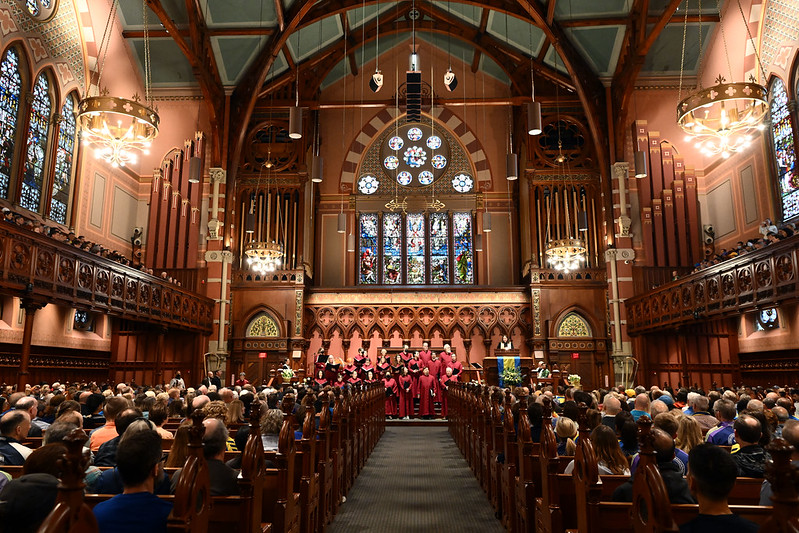
We open the doors to this house and home of God seven days a week. Each
Sunday morning and Thursday evening we offer food, both to the well fed
and to the hungry . . . and we offer warmth, beauty, music, fellowship
and hospitality to each and all …without regard to station or
circumstance. In addition, we pool our collective resources to provide
material as well as spiritual assistance and sustenance to those in
need.
As the calendar turned the page from 2009 to 2010, this reading appears
in the lectionary.
John's vision and John's soul intrude themselves upon us. The challenge
and rigors, the costs and consequences of the Christian life is thrown,
like a gauntlet all the way from the small island of Patmos.
I wonder what others see of our souls when the look into our eyes? Can
others see reflected in our lives glimpses of the new heaven and the
new earth to which John's vision invites us? Can they?
i. Boring, M. Eugene. REVELATION: Interpretation,
a Bible Comentary for Teaching and Preaching, John Know Press,
Louisville (1989), p.61
ii. Ibid. p. 13
iii. Ibid. p. 21
iv. Ibid. p. 60