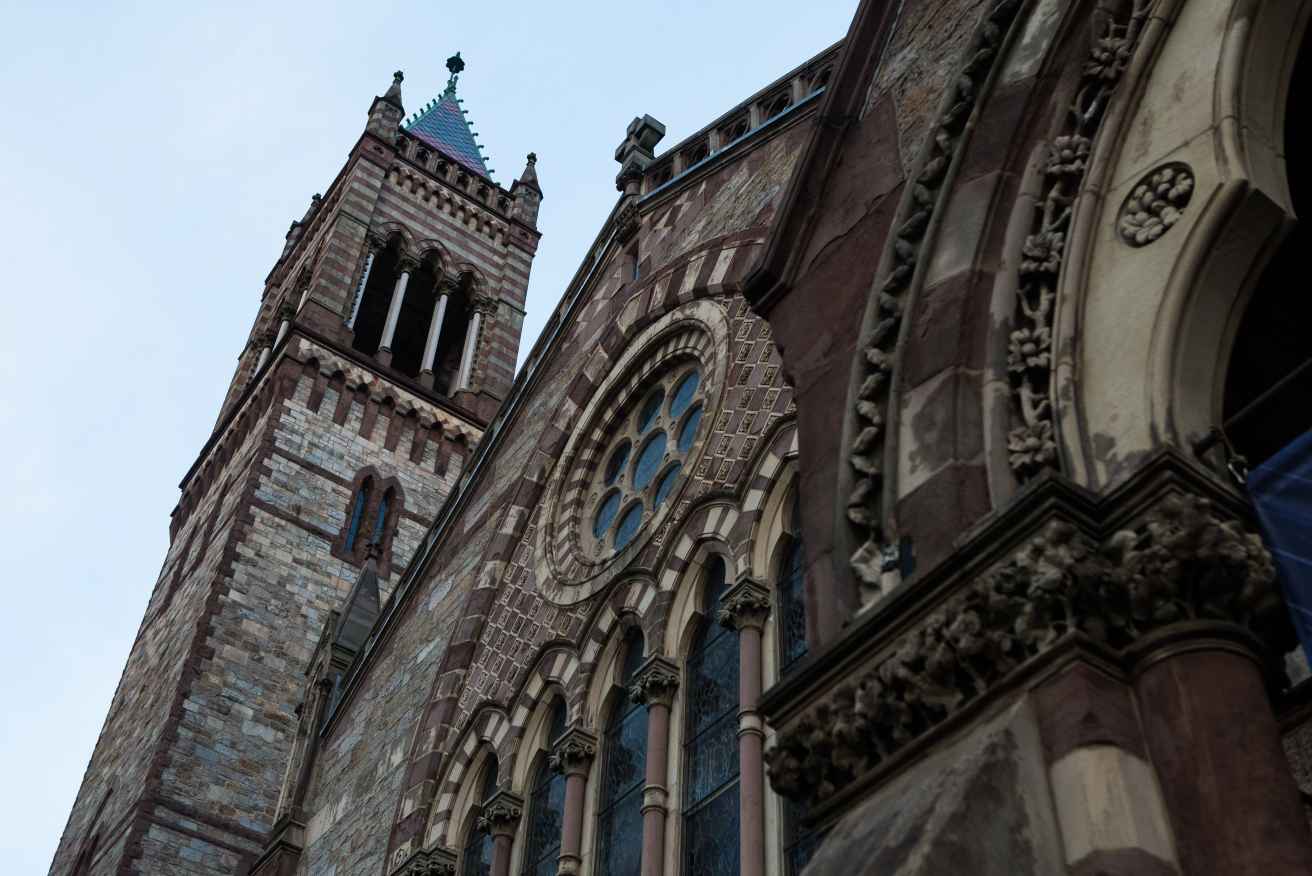
The Old South Church in Boston

Threeness

A Sermon by Rev. Nancy S. Taylor

plus
Remarks by Rev. S. C. Campbell Lovett
on behalf of the Sidney Lovett Family

June 3, 2007

A Reflection on Mt. Vernon’s 165th Anniversary

Listen to this Sermonmp3 file


Threeness: the condition of existing as three persons or things


Today is Trinity Sunday. A medieval innovation of the English Church, Trinity Sunday since the 14th century, has been a feast day in honor of the Holy Trinity.

The doctrine of the Trinity is the theological assertion that God is three is one: Creator, Christ and Spirit. Objectively speaking it is a difficult, if not inexplicable concept.

Having studied and read theology for many years, I some time ago arrived at the conclusion that the Trinity is one of those mysteries that is best left as just that: a mystery.

Nevertheless, I could not help but follow a tantalizing claim I happened upon yesterday deep inside my computer. I happened upon a link that announced: The Trinity Explained! It went on to boast of A Detailed Explanation of the Holy Trinity in Easy Terms.

Relieved to have discovered A Detailed Explanation of the Holy Trinity in Easy Terms I clicked my mouse and learned that the Trinity can be explained by understanding H2O. Water, ice and steam, it said, are all H2O. As water, ice and steam are one, and yet different, so are Father, Son and Spirit one, and yet different –  three different forms of the same entity or being.

Well, as satisfying as that explanation is, I think I may have happened upon an even better one … also by way of science and of analogy.

We know from science that there are some things you cannot get at directly … things we cannot observe with our own eyes or instruments. And yet we know about them, we believe they exist, because we can observe the effects they create, the traces they leave, the impact they impose upon the world around them.

I believe that the mystery of the Trinity is like that. It cannot be observed directly. But we can observe the difference it has made, the passions it inspires, the traces it leaves in its wake.

The Mt. Vernon Congregational Church, whose anniversary we celebrate today, was formed in 1842 to provide a voice – a pulpit – for a passionately Trinitarian preacher in the midst of the Unitarian Controversy. Dr. Kirk inspired his congregants to acts of service and sacrifice, the effects of which have been felt around the world.

Members and leaders of Mt. Vernon were instrumental in founding numerous educational and mission institutions, including: Mt. Holyoke, Wellesley, Wheaton, Northfield Mt. Hermon, MIT, Pinkerton Academy, Doshisha University in Kyoto, the American Church in Paris, the Mt. Vernon Church in Africa, and Plymouth Congregational Church in Lawrence, Kansas.

If you want to understand the Trinity, ponder the powerful, passionate and tender ministries developed and nurtured by the members of Mt. Vernon.

When Mt. Vernon fell on hard times in the late 1960’s  – a result of changing demographics in the Back Bay – our own Tom Boates, then an Associate Minister of Old South, helped facilitate the merger of Mt. Vernon and Old South … a relationship we maintain today.

Today Mt. Vernon remains an independent congregation. Quinn and I serve as its ministers. We have officers, deacons, committees, a powerful legacy and a two million dollar endowment, the interest of which we distribute to causes, organizations and ministries in keeping with the historic interests of Mt. Vernon.

I’d like to ask the Mt. Vernon Church moderator, Ken Campbell, and all the members of Mt. Vernon to rise.

Also, Dorothy Turkington to rise. Dorothy is one of the last two surviving members of the 1970 Mt. Vernon Church.

I am delighted that we have with us this morning, the grandson of the Reverend A. Sidney Lovett, the 5th Minister of Mt. Vernon. Uncle Sid, as he was called, was a beloved and highly respected minister in the Boston area. He served Mt. Vernon for thirteen years until his was stolen from Mt. Vernon to serve as the chaplain to Yale University … which he did with distinction for many years.

Uncle Sid’s grandson, the Reverend Sidney Charles Campbell Lovett, comes from a long-line of distinguished Congregational leaders. Campbell serves today as the Senior Minister of the Newman Congregational Church, UCC in East Providence, Rhode Island. Campbell and I go back a long way as we were in the same class at Yale Divinity School.

Representing the Lovett family, and possessed of the very DNA of the 5th minister of Mt. Vernon, please give a warm welcome to Campbell Lovett.


Words on Behalf of the Sidney Lovett Family

On the Occasion of the 165th Anniversary of Mt. Vernon Congregational Church

June 3, 2007 ~ Old South Church, Boston
 

Good Morning. I bring you greetings on behalf of the Sidney Lovett family, and I thank you for this opportunity to share with you remembrances about my grandfather and his tenure as the fifth pastor at Mt. Vernon Congregational Church.

            Since Nancy has set the framework within the context of three-ness, I would like to follow suit with three sets of threes. Allow me to begin with an introductory set of three confluences with Old South – through Nancy Taylor, a long name, and a shared history.

            I’m grateful to your Senior Minister, Nancy Taylor, for this invitation to join you in this Anniversary Service. Nancy and I were classmates at Yale Divinity School, and I am glad for this opportunity to catch up with her right after her 25th reunion and just before mine. As we were both child prodigies of theology, we matriculated at a young age, thus our youthful appearances in spite of our many years of experience.

I was startled to see my full name in a draft for the order of service having never seen this except on my birth certificate. Being the third in a row of Sidney’s, I always went by “Campbell” so as not to cause confusion. And, being the first son in a family of five children, I was named for both grandfathers: Sidney Lovett and Charles Campbell – a privilege in middle age but an albatross in my youth. As a result of my being the repository for family names, my younger brother is simply, Peter Lovett, who worked as a summer intern here for two summers in 1986 and 1987. Peter is my second union with Old South.

When I served as a co-pastor at the First Church of Christ in New Haven in the early 1990’s, my colleague and I came to Boston to meet with Jim Crawford, Nancy’s predecessor, regarding our shared history. It seems that the founding pastor of First Church, John Davenport, was called from New Haven in 1667 to serve as Pastor to the First Church in Boston. As he was an unyielding opponent to the Half-Way Covenant – the theological dilemma of the day - some wise members of First Church, also lovingly called the ‘dissenting brethren,’ split off to form Old South in 1669. My distant predecessor in New Haven apparently was a catalyst for the creation of this church.

            Well, after that long introduction, I’d like to share some reflections on the matter at hand – a connection I never fully realized: The importance of Mt. Vernon Congregational Church in the ongoing mission and ministry of Old South and the role my grandfather played there in his season of service.

I’ll let my grandfather explain his formative experiences leading up to his serving Mt. Vernon. In his writings is this reflection: “Three personal experiences shaped my course at Union Theological Seminary more than its theological disciplines. The wife of my youth died in childbirth. This set me hard and long lessons in the vocation of bereavement. Field work with Norman Thomas in East Harlem proved decisive in my subsequent career. A conscientious objector to World War I on Christian principles, I should have been sent to Leavenworth save for the unbeknownst intervention of a friend with influence in Washington. This summary reprieve created a dilemma between belief and action I have never wholly resolved. I did learn never to tamper with another person’s conscience.”[i]

While in college, Sidney Lovett worked summers with Norman Thomas at the American Parish in East Harlem learning about social work and working with street gangs. After college, he attended Union Theological Seminary and continued his affiliation with Thomas. In September of 1916, his wife of 15 months died in childbirth, and he moved into the parsonage with Norman and Violet Thomas (a woman he called “Mom” as long as she lived). In these supportive surroundings he worked as an assistant until his graduation and fell in “wholly with Thomas’s pacifism and absorbed some of his radicalism.”[ii] Because of this pacifism he could not be ordained until war’s end. Thus, for two years he served the Maverick Church in East Boston described as “a workingman’s church” not concerned with ecclesiastical credentials.[iii] Finally in 1919, he was ordained by the Boston Association of the Congregational Church, as he had received a formal call to what he termed “a student oriented church in Boston’s Back Bay”[iv] - Mt. Vernon.

He served Mt. Vernon from 1919 to 1932 with a year’s study leave at Oxford University in England. During his years at Mt. Vernon, there were three influences that shaped his emerging ministry: Mt. Vernon’s strong affiliation with the City Mission Society of Boston, Herrick House, and the Beacon Street neighborhood.

In Mt. Vernon’s affiliation with the Boston City Mission Society Sidney was a natural for working with youth. He helped direct Camp Andover for Girls founded in 1920 – which I’m sure was an easier assignment than the gangs of East Harlem. While directing the camp one summer, Sid met Esther Parker, a camp counselor, who in 1922 would become his wife, and, in due course, my grandmother. So the family is thankful to Mt. Vernon and Old South for that rendezvous.

Herrick House, named after the second senior minister of Mt. Vernon was a great outreach of the church. Herrick House, from what I can tell, was not only a dormitory for students, many of them from foreign countries, but also a lively hub of discourse and fellowship. Sid hired Everett Baker, a recent graduate of Harvard Divinity School, to serve as an assistant. Ev lived at Herrick House and helped manage the evening service and lecture series always described in a weekly ad in the MIT student newspaper. Ev also got to direct Camp Waldron for Boys in New Hampshire – another of the Mt. Vernon supported Boston City Mission endeavors. Ev Baker, who would go on to be the Dean of Students at MIT, and my grandfather, who became the chaplain at Yale, were shaped by Mt Vernon’s work on behalf of an international Christian student fellowship.

            Mt. Vernon was also a community parish for those who lived on and around Beacon Street. It was a family church as well for my grandfather whose brother-in-law, Reeves Chipman, was the Senior Deacon. During my grandfather’s sabbatical, Chipman sent him raucous fictional letters about how the church was falling apart from scandal after scandal in his absence.[v] My grandfather encouraged Mt. Vernon to be a unified household of faith for a diverse membership of saints and sinners, writing this in a church newsletter: “Yet it is fair to remind ourselves on All Saints Day that the difference between these great ones and ourselves should be a difference in degree, not in kind. The power and beauty of life which is theirs is a quality to which in varying degrees we may attain. Even now we should be a little bit like them, and have a sort of family resemblance, as though we belonged to the same household.”[vi] An international, student-oriented, community church for the city: Mt. Vernon had many faces in the 1920’s.

My final set three. Being a multi-faceted parish, the church and my grandfather were influenced by three issues of the day and sought a Christian response to each: The Boston’s Policemen’s strike of 1919, the Sacco and Vanzetti case 1920 – 1927, and the beginning of the Great Depression.

The Boston Policeman’s strike and the ensuing dismissal of the striking policemen and replacing them with returning World War I veterans changed the social and political landscape not only of Boston, but the entire country.  It fostered fears of Bolshevism, and catapulted Governor Calvin Coolidge to a national stage.

The Sacco and Vanzetti trial with its appalling anti-Italian bias, and the subsequent electrocution of the men, was spoken out against by my grandfather, and condemned by his older brother, Robert Morss Lovett, editor of the New Republic.[vii] Thus this sentence in another Mt. Vernon letter from the Minister: “The way of co-operation is the only point of view tenable for a Christian. God has no favorite color, or race, or nation.” [viii]

And, the Great Depression with the loss of 33,000 manufacturing jobs from Boston, as well as financial hardship for many, certainly recalled for my grandfather his work in East Harlem many years earlier and the need for people and parishes to be of great comfort and support to one another.

In some ways not a lot has changed since my grandfather’s tenure – perhaps just the names. People’s patriotism is still questioned due to their conscientious objections to a war in Iraq; ethnic suspicion of our Middle Eastern brothers and sisters runs rampant; and discrimination against immigrants – now those of Hispanic origin - makes the message of the Good News of Jesus more important and the mission the church more necessary.

On this day of remembrance then, let us resolve to live out in our own lives the tasks of ministry served so ably by the people and pastors of Mt. Vernon; and let us rekindle - for our generation - the values of forgiveness and reconciliation that they cherished that that spirit might live on in our humble efforts, to the glory of God in three persons, blessed Trinity. Amen.

S. C. Campbell Lovett


[i] From his Apologia pro Vita Mea – read at his Memorial Service in Battell Chapel by William Sloane Coffin, April 6, 1979. Can be found in Uncle Sid of Yale, Yale University Press, 1981

[ii] Cited in Norman Thomas The Last Idealist by W. A. Swanberg, Charles Scribner’s Sons, 1976  p. 45

[iii] Uncle Sid of Yale, p. 9

[iv] Apologia pro Vita Mea

[v] Reflections of Sidney Lovett, Jr.

[vi] Uncle Sid of Yale, p. 31

[vii] More complete reflection in All Our Years, The Autobiography of Robert Morss Lovett, Viking Press, 1948, pgs. 183 – 190.

[viii] Uncle Sid of Yale, p.45


Copyright © 2007, Old South Church and by author.
Excerpts are permitted as long as full accreditation is made
to Old South Church and to the author.

Back to Sermon Page

The Old South Church in Boston
645 Boylston Street
Boston, MA 02116
(617) 536-1970