Old South Banner
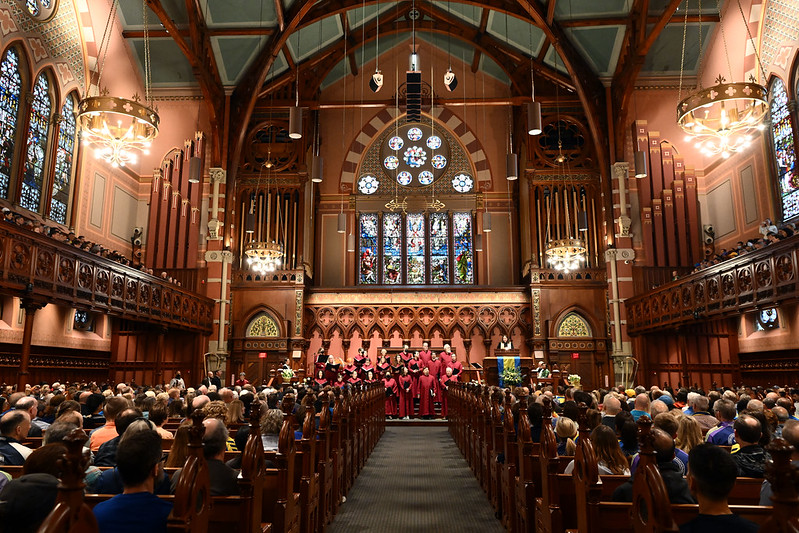
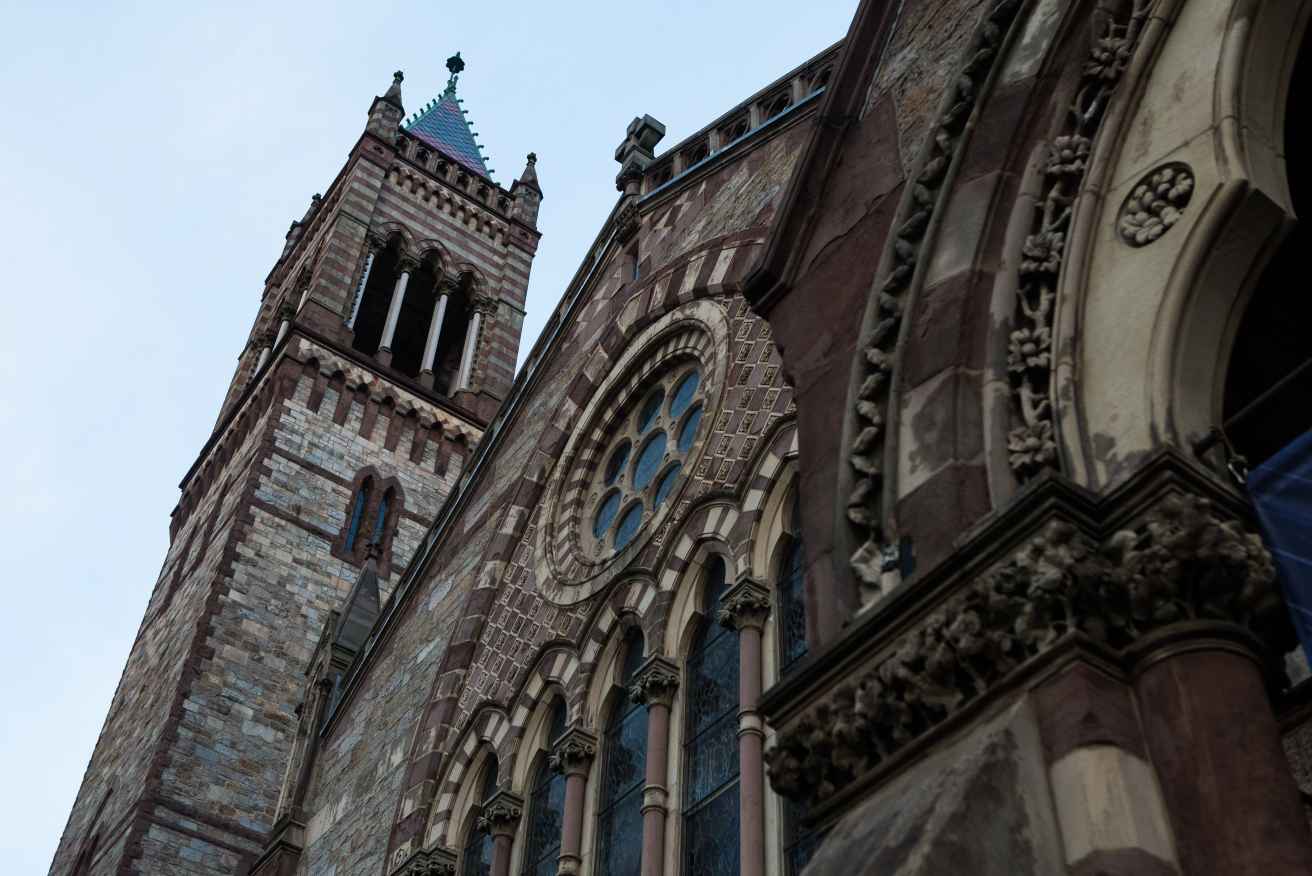
Old South Sanctuary (photo by Sarah Musemuci)


Copyright © 2009, Old South Church and by author.
Excerpts are permitted as long as full accreditation is made
to Old South Church and to the author.


Old South Sermons:

The Magi

an Epiphany sermon
by Rev. Nancy S. Taylor, Senior Minister

Based on Matthew 2:1-12, the journey of the Magi

Sunday, January 4, 2009

Listen to this sermon


They found him, so the story goes, by looking up, by reading the night sky, consulting charts of stars, by following a single, bright star all the way to Bethlehem … all the way from Persia to Bethlehem … traversing, not merely mountains and plains as they progressed, but also cultures and countries, religions and races, customs and tongues.

Having found the child, the strangers bent their bodies to fit the cramped space until they were kneeling. Mary and Joseph, with heads tilted and ears cocked, listened as the strangers’ clothing – so thick and crisp and rich – rustled against the cool dirt floor.

Then, opening a chest, the strangers presented the infant with gold that glittered by the light of the oil-lamp.  They presented frankincense, and its aroma rushed into the small space, overwhelming the humid smell of the animals. Finally, they presented a reddish, brown, sticky substance, a resin … and instantly the scent of raw myrrh – sharp, pleasant and somewhat-bitter – mingled with the other smells.

To this day, the visit of the Magi to the infant Jesus – their presence, their journey, their gifts, the surprise and incongruity of their appearance – is marked and remembered by the Church of the Nativity.

Situated on Bethlehem’s Manger Square, the church is built over a grotto where Mary is said to have given birth to Jesus.

If the visit of the Magi evokes paradox, freedom, compassion,   contemplation, tolerance, mysticism and pilgrimage, the Church that honors their visit is, by contrast, inelegant and fortress-like. It is presided over by armed forces representing the Palestinian Authority.

The Church itself is controlled jointly, by an uneasy agreement among three Christian traditions, each of which claims to be the true church: the Armenian Church, the Roman Catholic Church and the Greek Orthodox Church.

For centuries the area was one of the most contested holy places … in a contested Holy Land. It has been seized and defended by a succession of armies: including Persian, Muslim and Crusader forces.

The church's large fortress-like exterior stands as a testament to its turbulent history:

The main access to the church is by the very small Door of Humility, which visitors must enter by bending over awkwardly. The Door is said to have been made during the Ottoman era to prevent warriors entering on horseback.

In 1847 inside the Church, Greek monks beat Latins with staves in an attempt to drive them from holy sites in Bethlehem.

It was in that same years that Latins took possession of a tapestry which they deemed marked a portion of the church that was theirs.

Later a Greek Bishop was wounded in a clash with members of the Latin clergy.

This was followed by the mysterious disappearance of the silver star in the Grotto of the Nativity, which marked the site of Jesus’ birth. The Latin’s accused the Greeks of stealing the star.

During the annual 1983 and 1984 Christmas cleanings of the church, 50 Armenian and Greek priests came to blows using for weapons brooms, chairs and ladders. Over what were they fighting? Over the right to clean a disputed section of the church …6-meter-by-15-centemeter area.

In 1985 in an attempt to prevent a similar brawl, the two sects agreed to leave the disputed area uncleaned.

In 1989 Latins and Armenians protested Greek attempts to repair the leaky roof of the church. They both felt that the act of repairing the roof was an attempt by the Greeks to assert control over the roof. Eventually, in 1990, the Israeli government came in as a neutral third party and fixed the leaks.[1]

The Church of the Nativity, like so much in the Holy Land, has had a strange, fraught, often violent past … so incongruous with the gentle story Christians choose to associate with this site.

But here is the thing: the Church of the Nativity is the oldest standing church in the Holy Land. Despite all that has happened around it and in it, the church was spared destruction at least twice. Why? The Magi!

The story goes that this Christian shrine was spared destruction from the invading Persians in 614 and, spared again from Muslim invaders in 1009, for one reason: the depictions of these Magi on the walls of the church.

It is said that the invaders entered this Christian church in full battle mode: armored, helmeted, swords raised, ready to kill, to desecrate and destroy. But then they encountered frescos depicting men in Persian dress … men who looked like they looked! Seeing themselves so honored and so respectfully depicted, the invaders lowered their swords, retreated respectfully, and spared the ancient Christian church from harm and desecration.

With areas of the Holy Land in fierce battle mode at this very moment[2] – and other areas controlled by armed guards, massive walls, barbed wire and security check points – it is as if the centuries are collapsed together with jumbled images of Herod and Hamas, Gentiles and Gaza, Bethlehem and Ramallah, militants and Magi, swords and stars.

The truth is that woven relentlessly into the narratives of Christians, Jews and Muslims are braids of fear, political repression, bloodshed, and territorial disputes.

Although we are half a world away from the warring, Christian tradition, history, crusades and pogroms do not permit us to escape blame or assert innocence for the wracking violence in the land of Jesus’ birth.

Since December 25th or December 27th, since the outbreak of renewed violence between Israel and Gaza, Copley Square has been the scene of demonstrations. Pro-Israeli and pro-Palestinian factions have gathered to demonstrate, march, speak and, as much as anything, each has been intent on brandishing its flag: the blue and white Israeli flag featuring the Star of David, a flag designed in 1891 for the Zionist Movement; and the Black, White, Green and Red Palestinian flag, about which there is a poem, explaining the colors: White are our deeds, black are our battles, Green are our fields, red are our swords.

Jesus was born into a world as volatile and violent and fraught as ours today:

The journey the Magi undertook – from Persia to Bethlehem – was treacherous. Indeed, in the course of their journey they encountered Herod, whose rage was nothing less than murderous.

Jesus was born in a cold cave rather than at home in Nazareth because a Roman emperor decided to dislocate the people of Judea for the sake of a headcount.

After the Magi have presented their gifts and departed, the holy family will undertake their flight into Egypt to escape Herod's massacre of the innocents.

Some thirty years from the day of his birth, Jesus will suffer as Pontius Pilate's victim, be scourged and once more be wrapped in cloths to be buried in another cave.

Throughout this story the Magi stand out and stand apart. They are men of peace … both curious and courteous about other traditions. They are emissaries, shuttle diplomats … whose journey, visit and gifts give witness to intercultural and interreligious respect and tolerance … and maybe, as well, to a means for peace and good will toward all.


While television cameras and microphones are trained on the sights and sounds and smells of war – on the flashes of light from bomb blasts, on fatigue-clad soldiers bristling with weapons, on the tat-tat-tat of machinegun fire, on the chaos and terror in Gazan hospitals –  while the cameras are focused on these things, meanwhile, the legacy of the Magi lives on.

It lives on, out of camera shot, away from microphones in quiet, courageous unheralded visits between Palestinians and Israelis bent on peace … it lives on among Jews, Muslims and Christians for whom the work of peace-making and peace-keeping demands heroic bravery and sacrifice.

Obviously, we are in no position to stop the killing, or achieve a negotiated peace between Israel and Palestine, or end the rockets or end the occupation. What we can do is this: emulate the journey of the Magi. We can join those who, from Bethlehem to Boston, engage in small, brave, resourceful associations of Jews, Christians and Muslims who have learned to call each other by name, who are reading each others’ books, studying each others’ holy texts, loving each others’ children, worshipping in each others’ houses of faith, learning to drink each others’ coffee and eat each others’ sweets; offering to each other the gifts of friendship and respect.

These acts and deeds are just as true, just as real as the killings, as the rockets, the occupations, and the war. But they inhabit a kind of parallel universe –  a universe alongside the violence … a somewhat invisible, but no less real universe –  a universe of those committed to respect, knowledge, compassion and freedom.

Perhaps the best we can do – the thing God aches for us to do – is to inhabit and grow that parallel universe … visit by visit, conversation by conversation, book by book, cup of coffee by cup of coffee, until, looking at the other, we finally see and recognize ourselves.

Such work twice spared from destruction the ancient Church of the Nativity. Perhaps such work can also spare synagogues, mosques and even holy lands.

Once upon a time, in a violent and brutal world, three exotic and quixotic figures traversed cultures and religions. They defied potentates, refused violence, risked life and limb … to kneel for a moment in a cramped space, and there pay homage to a child of another nation and faith … a child whose peaceful life would change the course of history, a child for whom the kings of the earth had no power …and whose life was the light of the world.


[1] Cultural Encounters With the Environment, (Chapter 12, Sharing Sacred Space in the Holy Land by Chad F. Emmett, p. 261f)

[2] An Israeli “all out war” against Hamas in Gaza broke out on December 27th.  Israeli ground forces entered Gaza on January 3, 2009.


Copyright © 2009, Old South Church and by author.
Excerpts are permitted as long as full accreditation is made
to Old South Church and to the author.

Old South Church
645 Boylston St. Boston, MA 02116
(617)536-1970 Tel (617)536-8061 Fax

You can E-mail us by clicking here: OSC Communications

Copyright © 2008, Old South Church