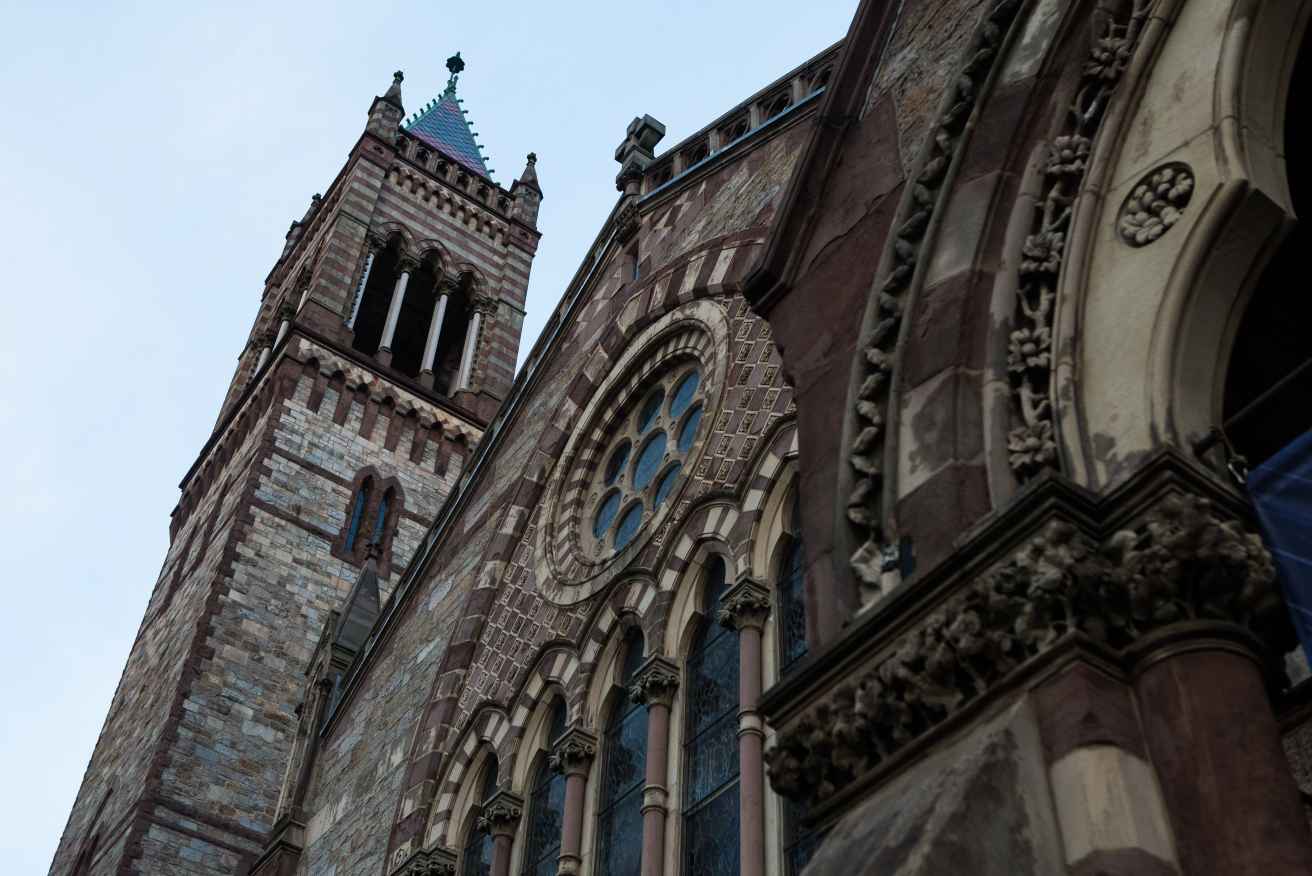
Old South Banner
Jerusalem from the Mount of Olives


Old South Sermons:

Jerusalem
a sermon

by Nancy S. Taylor, Senior Minister
and Quinn G. Caldwell, Associate Minister
upon their return from a pilgrimage to the Holy Land

3rd Sunday of Easter, April 6, 2008

Based on Luke 19: 41-42

Listen to this sermon


Pilgrimage, by Quinn G. Caldwell

“I give you the end of a golden string.

Only wind it into a ball.

It will lead you in at Heaven’s Gate,

Built in Jerusalem’s wall.”

With these four lines, poet William Blake captures the heart of the mystery, conundrum, and glory that is Jerusalem.  Again:

“I give you the end of a golden string.

Only wind it into a ball.

It will lead you in at Heaven’s Gate,

Built in Jerusalem’s wall.”

In Jerusalem, the golden string of God’s love is wound into a ball that takes in the whole city.  It leads down narrow alleys and up minarets.  It burrows through layers upon layers of white limestone pavement and old houses, through doorways of third-century churches and ancient tombs.  It runs through convents and synagogues, across valleys, along sacred ways, and up to high places.  It leads past archeological digs, through thirty-nine different destructions of the city—and thirty-nine different rebuildings.  It snakes its way through tradition and history, past the places where Abraham heard God’s call to sacrifice Isaac, where the great Temples of Judaism stood, where the prophet Muhammed (peace be upon him) took his famous night journey through the heavens.  The golden cord winds and knots and spirals and doubles back on itself endlessly among the white stones of the city, touching sacred place after sacred place.  From a distance, the whole place seems to be wound around and shining with God’s love; up close, it seems to be nothing but God’s love all tied up in knots.

And all along this thread: pilgrims, Christians and Jews and Muslims, seeking to follow the golden thread down paths their forebears have followed to the deep and ancient places.  Pilgrims make the trips they do and follow the threads they follow for many reasons.  But in a way, every pilgrim journey is about the same thing: acting out the journey from creation, through life and death to heaven and an encounter with God, and on to new creation.  The journey on which the pilgrim sets out is an attempt to crystallize his or her own, larger life journey in the smaller pilgrim journey, and to meet God and form oneself for the larger journey through the taking of the smaller one.

And there is no place, no place anywhere, that crystallizes the experiences of the peoples of our God more than the city of Jerusalem, the third holiest city of Islam and the holiest city for Christians and Jews.  As most of you know, Nancy and I, along with church members Elaine Huber and Nancy Richardson, have just returned from a pilgrimage to that place.  An important part of any pilgrimage—perhaps the most important part—is the return, the coming back to normal life and the telling what you what seen and heard.  So today, Nancy and I want to share with you some of what we have seen and heard, a few of the moments or places that captured for us the deepest truths of what that place is like, and what it has to teach us about life with God.  Be warned: it is very early to have discerned all that these things mean, and so we will not do too much meaning-making in what we have to say today.  Rather, we offer some simple snapshots, and will trust time and the Holy Spirit to do the rest.


Walls, by Nancy S. Taylor

The pilgrim approaching Jerusalem is met by walls: ancient, immense, golden walls of limestone. Ten feet thick and rising to heights of 50 feet, these walls enclose the Old City of Jerusalem.

Entering through one of its noble gates, the pilgrim is confronted by yet more walls. Springing from the outer walls, like a great river’s tributaries, are numerous secondary walls … walls that define and separate the city’s quarters: separating the Jewish Quarter from the Muslim Quarter from the Christian Quarter from the Armenian Quarter.

These tributary walls contain each Quarter’s neighborhood with its signature music, smells, cuisine, houses of faith, shrines, shops, religious costumes and customs. The pilgrim, embarked upon a journey of discovery, burrows deeply into each Quarter in turn … there to smell, taste, touch, listen and look for the different faces of God.

Sooner or later, the pilgrim makes his or her way to the greatest wall, the Western Wall. Ancient and immense, it humbles all who approach it.  Gathered from the four corners of the earth, pilgrims swarm beneath it. We form a colorful, chaotic, wild, cacophonous assortment of humanity: from the ultra-orthodox to the ultra-modern. We, who have nothing else in common but our hunger for God, gather here to pray, to sing and dance, to read quietly, to chant loudly, to sway and to wail. Then, with bare fingers, each works into a crevice, cranny or crack a tiny bit of paper… entrusting to this wall our solemn intercessions.

For, in fact, the secret of this wall is that it is not a wall at all. It is a window, a door, a gate, a mail slot … a postal route to heaven. This wall is a place of access, a bridge between earth and heaven, human and divine, longing and assurance, supplication and fulfillment.

Outside of the Old City, the pilgrim confronts a quite different wall … a recent wall. Guarded by heavily armed Israeli soldiers, it is over 400 miles in length and 32 feet high. It is all concrete and barbed wire, studded with surveillance towers and the occasional checkpoint. Like so many places in Jerusalem it has more than one name. The Israelis call it “the Security Fence.” To the Palestinians it is the “Segregation Wall.” Whether you see it as a wall or as a fence, as protection or as degradation, as a peace-keeping enterprise or as a foot on the neck of the Palestinians depends on who you are, who you know, whose stories you believe, and on your own experiences of fear and safety.


The Church of the Resurrection by Quinn G. Caldwell

The Church of the Resurrection (sometimes called the Church of the Holy Sepulchre) stands near the center of the oldest part of the city.  The entrance is tucked in a quiet courtyard, almost impossible to find unless you know where to look.  It stands on a site that many, maybe even most, theologians and archeologists believe is very likely the place of Jesus’ death and burial.  It is the most important site in all of Christianity, and it is a complete…train wreck.  One walks through the low, ancient door and is immediately overwhelmed by a sense of disorder, confusion, tackiness, and a distinct lack of holiness despite the heavily incensed air and the overabundance of religious images and accoutrement.

Beneath hundreds and hundreds of golden and silver lanterns (which may sound pretty but are not), tour groups rove madly, snapping pictures and only half-listening to their group leaders rattling off dates and facts.  If you wander around long enough to find it, you will discover that the original tomb of Jesus was destroyed centuries ago and has since been replaced by a hideous masonry kiosk kept from falling over on one side by steel I-beams.  If you find it, you will discover that the traditional rock of Golgotha is encased in glass and dramatically lit from below; it looks like a diorama in a natural history museum.  Nevertheless, if you wait in line long enough, you can have the opportunity to kneel down on the floor, crawl under an altar, and stick your hand blindly through a gilt-edged hole to touch the top of what might or might not be the place where Jesus was crucified—and you will then be allotted ten seconds to pray before a grumpy monk yells at you to make room for the next person.  The church is shared by seven different world and local denominations, who pretty much sort-of get along with each other most of the time, but whose internal bickerings occasionally break out in fisticuffs among the monks and clergy, and are bad enough that to avert trouble, the keys to the building have been held by a local Muslim family since the days of Ottoman rule.

It is a train wreck, and it is perfect.  You cannot walk into that place without recalling the words of the angel on Easter morning: “He is not here.”  You cannot walk into that place and not long and long deeply for the grace of God to transform this world.  You cannot walk into that place and not be reminded that even our best, most faithful strivings fall short of our best intentions and the glory of God.

I walked in and was shocked, and offended, and confused.  I wanted beauty, simplicity, nobility, serenity, joy—not darkness, smelliness, crowds, rudeness, and tackiness.  Then a friend reminded me that when God came to us, God came to the human world, which is layered, imperfect, crowded, smelly, complex, and ultimately unsatisfying, and it is in that world, not a perfect world, it is using the stuff of that world, not a perfect world, it is by loving that world, not a perfect world, that God saves us all from both our best and our worst strivings.  So as a reflection of the heaven we all hope to one day attain, the Church of the Resurrection, the holiest church in the holiest city in the world, is a complete train wreck.  But as a reflection of the real world God loves beyond all reason, loved enough to enter into even though she could have chosen to turn her nose up at it, as a reflection of the locus of God’s most powerful act in history, it is perfect.


The Galilee by Nancy S. Taylor

Our pilgrim band departed from Jerusalem and headed north for the Sea of Galilee. It was here and in the surrounding villages – in Capernaum, Magdala, Tiberias and Nazareth – that Jesus was formed, grew up and exercised his ministry. It was here that Jesus walked on water, stilled a storm, taught from a boat, preached the Sermon on the Mount, uttered the Beatitudes, fed 5000, and, in a tender post-resurrection appearance to his disciples, grilled their breakfast on the Sea’s shore.

In contrast to the sun-scorched limestone of Jerusalem, in contrast to the forbidding Judean wilderness through which we had just traveled, the Sea of Galilee is framed by a verdant apron of brightly colored flowers, as well as groves of olive, almond, lemon and date palm trees.

As we approached Galilee we were greeted with a riot of perfumes and colors: lavender, rosemary, jasmine, cistus, oleander and tamarisk, and blossoms of reds, pinks, yellows and oranges. The Sea itself is blue and shimmering under the bright sun. The entire area is alive with song birds, parrots and wading birds.

Sitting on the Mount of the Beatitudes, a gentle hill overlooking the Sea of Galilee, we read aloud the Beatitudes and reflected on the natural beauty with which Jesus was accustomed. This was his playground and workshop. Here were the scented air, the thriving sea, the fertile soil, the song birds and jumping fish, the quiet places that fed his soul … and, which at that magical moment, were feeding ours.


The Church of the Nutrition by Quinn G. Caldwell

In the middle of all the fertility of the Galilee is Nazareth, Jesus’ hometown.  In the middle of Nazareth is the Basilica of the Annunciation, a gorgeous modern church built over the cave traditionally venerated as Mary’s childhood home and the place her task was announced to her.  And next to the Basilica stands the house of worship with the best name ever: the Church of the Nutrition.  It’s also known as the Church of St. Joseph, because it marks one of the traditional sites of Joseph’s house.  But I like the other name better.  The Church of the Nutrition is so called because it marks the place of Jesus’ growing up, and therefore where he ate each day: the place where Mary breastfed him, where he ate his breakfast each morning, and where his parents argued with him about finishing his vegetables.  There is nowhere else in the world where a church with such a name would make sense.  But in Nazareth, it does.  Now, it could have been given a different, less silly, name: the Church of the Nurturing of our Lord, perhaps, or the Sanctuary of the Blessed Domicile, something much nobler and less earthy sounding.

But no: the Church of the Nutrition.  It reminds me that while the last three years of Jesus’ life were the most important, he spent three times that long living a normal life, like yours and mine, full of parents and work and small tragedies and small triumphs.  It reminds me that in the stories we tell, God got a body just like ours, one that needed to be cared for and cleaned and nurtured, that was susceptible to starvation and cravings, that had to be fed each day or it would die.  The Church of the Nutrition reminds me, as did every moment we spent in Israel, that our faith is not a theoretical one, not one about right ideas or right beliefs; our faith is an embodied one, with bodily needs and bodily functions, messiness and complexity, mothers and fathers and families and hunger.  The Church of the Nutrition reminds me that I am to be—and to feed—the Body of Christ.


The Pilgrim’s Song, by Nancy S. Taylor

Pilgrimage is a form of worship, and one cannot worship the central mystery of life – the divine essence, the Holy One – without regularly breaking into song.

We experienced this first hand our very first morning in Jerusalem. Weary, jet-lagged and sleep-deprived, we were awoken at 4:00 a.m. by song … by the muezzin’s prayer chanted from the nearby minaret. Every morning he calls Muslims from sleep to prayer, (and, by the way, anyone else within hearing). Here, in translation, is a portion of his 4:00 a.m. song:

“God is most great. God is most great. God is most great.

There is no god but God … Prayer is better than sleep.”

In the Jewish Quarter of the Old City we encountered families singing and dancing their way to the Western Wall for a young person’s bar mitzvah. Joyful and costumed, they serenaded God with instruments, song and dance.

On the Via Dolorosa, a street in the Old City that is held to be the path upon which Jesus walked to his crucifixion, singing pilgrims are abundant. Bearing large, heavy crosses, somber-faced and in slow, stately, memorial procession, they sing their way through the winding streets to visit the sites associated with Jesus’ final hours.

Visitors to Jerusalem are warned against renting a room in the Armenian Quarter because the Armenian Christians have a habit of assembling without warning, for noisy, song-filled religious processionals.  At inexplicable hours of the day and night, black-robed, long-bearded Armenian priests snake through the streets of the Quarter, banging, clanging and chanting their way to their ancient place of worship.

One day our pilgrimage group gathered at the Jordan: the river in which Jesus was baptized by John. Barefooted, trousers rolled up, knee-deep in the Jordan, we anointed each other’s foreheads’ in remembrance of our own baptismal vows. Then, dripping, still standing in the Jordon we broke out into song. We sang “Down to the River to Pray,” (a traditional American sacred folksong, which you may know from the film, “O Brother, Where Art Thou?”) Our pilgrim group was blessed with many skilled singers. They led us as we lifted this song into the air. We were full-throated, absorbed, joyful … until a pilgrim group near us, eager to renew their baptismal vows, asked us to quiet down.

Like all pilgrims, we sang our way through the confounding and wondrous Holy Land. Sacred song is a means of taking hold of the golden string of God’s love … a love that winds through the labyrinth of the ages, binding us to one another despite ancient resentments. The Golden string of God’s love is long … it stretches deep and high and wide enough to be experienced and expressed in myriad ways. It stretches to embrace and accommodate the whole human family.  It is a love that beckons us, each in our own time and way, toward Heaven’s Gate.

So, pilgrims – for we are all of us pilgrims – let us join in taking hold of that golden string. Let us, in this time and in this, our sacred space, lift our voices to the God who calls us each by name.


Copyright © 2008, Old South Church and by author.
Excerpts are permitted as long as full accreditation is made
to Old South Church and to the author.

Old South Church
645 Boylston St. Boston, MA 02116
(617)536-1970 Tel (617)536-8061 Fax

You can E-mail us by clicking here: OSC Communications

Copyright © 2008, Old South Church