Old South Banner
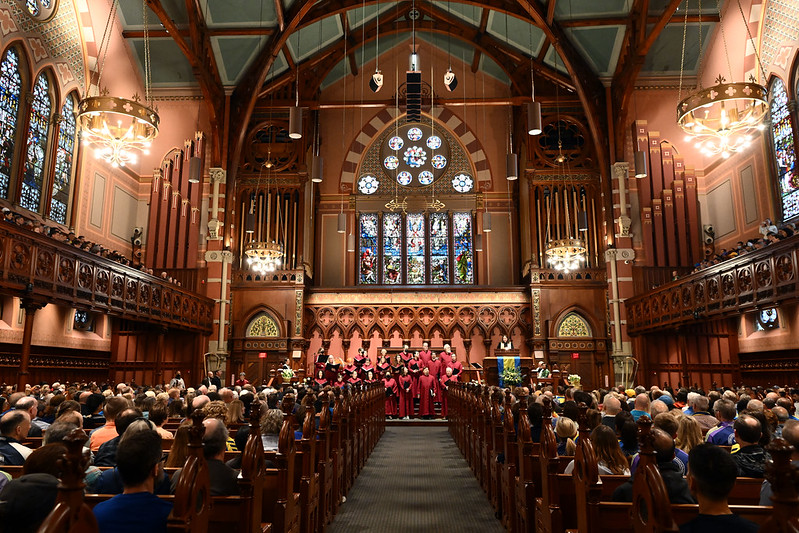
Old South Sanctuary (photo by Sarah Musemuci)


Copyright © 2009, Old South Church and by author.
Excerpts are permitted as long as full accreditation is made
to Old South Church and to the author.


Old South Sermons:

Emerge

by Rev. Nancy S. Taylor, Senior Minister & CEO

Based on John 3: 1-12 (Nicodemus comes to Jesus by night)

Trinity Sunday

June 7, 2009

Listen to this sermon


He was a young professional. Clean shaven. Neatly cropped black hair. Business attire: a European-cut suit, stripped shirt, trendy tie.

We were seatmates en route from Madrid to Malaga. He was Spanish but had identified me as an English speaker. Partway through the flight he lifted his head out of his book, turned and, in a hesitant English, asked:

"May I trouble you with a question? What does the word perks mean?"

"Bonus. Advantage. Something extra, but good," I said.

"Ah," he said and he returned to his reading.

A little later he asked a second question: "What does disadvantages mean?"

"Shortcoming. Weakness. Drawback. Nuisance," I said.

My seatmate, a young, Spanish professional was reading a book entitled: How to Choose a Religion. He was in a chapter in which the author was taking pains to present the good and the bad (the perks and the disadvantages) of the various religions under consideration. He grew up in and continues to live in a country that is predominantly Roman Catholic. Nearly 80% of Spaniards self-identify as Catholics. But - and here's the thing - most Spaniards do not participate in religious services and many, like my seatmate, have only the barest acquaintance with even the rudiments of the faith.

Upon returning home to the U.S. I looked up the book that my Spanish friend was reading. I learned that an entire industry of books and Websites has grown up around this How-To topic: how to shop for a religion.

Admittedly, some of these products are tongue-in-cheek. For instance, there is a slim paperback entitled, The Savvy Converts Guide to Choosing a Religion. On the back cover of this little volume it asks:

"Are you a searcher? Disappointed with your religion of birth? Or, never had one? This guide is for you! Here you will find apples-to-apples breakdowns of 99 world religions. You can comparison shop from the privacy of your living room where you can base your decision on things that really matter: what you'll wear, whether you can have sex, how often you must fast, where you'll go when you die. We highly recommend choosing a religion that guarantees salvation. There are many."

We laugh. I laugh. But the fact is that the young professional with whom I recently shared a plane ride was in dead-earnest.

He genuinely wants to know: is there is a religion out there that might add value to his life? Is there a religion that can assist him to deepen his spiritual side (a dimension of himself he knows is there, but which remains dormant, untapped, undeveloped)? Is there a religion willing and able to coach or assist him in becoming a better person. Is there a religion to help him to frame, if not answer, some of the most perplexing of life's questions? Is there a religion that will place his life, and his death, in a larger context?

This young, earnest, urbane, professional is not an aberration. On the contrary, he is the tip of an iceberg. He represents a generation of people around the globe, who were neither born into nor formed by any faith whatsoever… but who suspect there is more to life than work and leisure. They are using the resources of the world as they knows them - print and electronic media - to explore, test, compare and, yes, shop for a religion.

He and those whom he represents are not only found flying over Europe. They live in Jamaica Plain and West Roxbury, in the Back Bay and the South End. They are here, all around us. They are studying and teaching in schools and universities. They work in biotech firms, healthcare and in government … in law firms and ad agencies. They are bankers, hedge fund managers, IT professionals and members of labor unions.

All of which is to say, there is mission field out there composed of thoughtful, seeking young people. What an opportunity for a church like Old South!

My Spanish seatmate and others like him, are the Nicodemus' of the 21st century. They are the probers, the inquirers, the seekers, the questioners. They are the hungry ones, the empty ones, the lost ones. Stirred by a restlessness of the spirit, like Nicodemus they come by night, under the cover of darkness: reading books, lurking on church websites, testing worship services. They probe the internet and they discuss religion on electronically-generated dates. Like Nicodemus, they have seen signs and caught glimpses of something precious, something shining and provocative. They sidle near to see with their own eyes, hear with their own ears and experience with their own lives what it is that has captured their attention.

It is because of this young man and others like him that the 25 members of Old South's Church Council are currently reading together a newly published book. It is a book that speaks into this moment of inquiry and opportunity. The book is entitled, The Great Emergence: How Christianity Is Changing and Why, by Phyllis Tickle.

The author argues that every 500 years Christianity undergoes a phenomenal transformation - a sort of seismic shift - and that we are in the midst of just such a shift right now. Moreover, she argues that with each 500-year great upheaval, Christianity has emerged stronger and better, but different.

Counting 500 years backwards from today, Tickle points to the Great Reformation. Five hundred years back from that there occurred the Great Schism which rent asunder the Eastern and Western churches. Five hundred years earlier, Gregory the Great blessed and encouraged the monastic orders which preserved the Christian faith through the Dark Ages. Five hundred years before that takes us back to the time of Jesus and the Apostles as Christianity emerged from Judaism in its own right. It is this moment that is captured and symbolized in the nocturnal conversation between Nicodemus and Jesus.

Her argument is fulsome and nuanced … and I cannot here do it justice. Suffice it to say, the book argues that the church is in the throes of what she calls The Great Emergence. Something is happening, something is being born … and other things are dying. While she cannot and does not say what will emerge, she argues that we have arrived at a decisive time … that we are in the very midst of a seismic shift. This shift is religious, to be sure, but also cultural, technological, economic, sociological and political. It is an upheaval touching upon every aspect of our lives.

In this moment of upheaval and promise, the spoils will go to those practiced in agility, facing toward the future, eager to discern the signs of God's own activity. Others, clinging to the past, will be among that which dies away.

The young professional, Spaniard I met two weeks ago traveling between Madrid and Malaga is a part of this Great Emergence. Indeed, he is helping to direct it and form it. How? Why? Because in his quest for a religion he will not settle for anything less than authentic religious experience. He will see through us if our spirituality is shallow and if our faith is empty words. He comes to us with a hungry heart, an open mind, a willing and restless spirit. He is looking for the real thing.

If we fail him - if we fail this new generation of earnest seekers - we will have failed God.

A part of the purpose of this sermon is to report to you, to inform you, that Old South Church - through its leaders, its Council, its clergy, all led ably by our Moderator Vard Johnson - is positioning itself to emerge from this Great Emergence, stronger, deeper, broader, more faithful. Although, like Nicodemus, we will be faced with letting some things die, so that others can be born.

As we learn together to face into God's future … as we become more and more adept at addressing ourselves to my young Spanish friend and all whom he represents: is for us to communicate to him that in the presence of bread and cup we stand before a mystery; that in the gentle winds of a new day his own Mediterranean skin is caressed by the very breath of the living God; that in the baptism of a child - as water touches a new forehead - our own sins are erased and we are ourselves are made new; that in the story of Jesus, God's own heart is broken open and is on display for all the world to see; that here in this house, although we practice an ancient faith, it is nevertheless a new and living thing: dynamic, evolving, reforming, renewing eager to participate in God's unfolding future.

Our friend may come to us curious about perks and wary of disadvantages, but it will be up to us to absorb him into a community, to graft him into a family of persons with an aptitude for deep joy, a love affair with mystery, steeped in ritual, formed by the Word, measured by righteousness, amazed by grace, undaunted by the challenges of a new day … a people who love God so much, we love nothing else too much and who fear God just enough that we need fear nothing else at all.


_________________

John 3: 1-12    Now there was a Pharisee named Nicodemus, a leader of the Jews. He came to Jesus by night and said to him, "Rabbi, we know that you are a teacher who has come from God; for no one can do these signs that you do apart from the presence of God." Jesus answered him, "Very truly, I tell you, no one can see the kingdom of God without being born from above." Nicodemus said to him, "How can anyone be born after having grown old? Can one enter a second time into the mother's womb and be born?" Jesus answered, "Very truly, I tell you, no one can enter the kingdom of God without being born of water and Spirit. What is born of the flesh is flesh, and what is born of the Spirit is spirit. Do not be astonished that I said to you, 'You must be born from above.' The wind blows where it chooses, and you hear the sound of it, but you do not know where it comes from or where it goes. So it is with everyone who is born of the Spirit." Nicodemus said to him, "How can these things be?" Jesus answered him, "Are you a teacher of Israel, and yet you do not understand these things? Very truly, I tell you, we speak of what we know and testify to what we have seen; yet you do not receive our testimony. If I have told you about earthly things and you do not believe, how can you believe if I tell you about heavenly things?


Copyright © 2009, Old South Church and by author.
Excerpts are permitted as long as full accreditation is made
to Old South Church and to the author.

Old South Church
645 Boylston St. Boston, MA 02116
(617)536-1970 Tel (617)536-8061 Fax

You can E-mail us by clicking here: OSC Communications

Copyright © 2009, Old South Church