The Old South Church in Boston

Easter Sunday Reflection

A Sermon by Rev. Nancy S. Taylor

Based on Luke 23: 50-56, 24:1-12

April 8, 2007

Listen to this Sermonmp3 file


Imagine this: Easter Sunrise Service on the rim of the Grand Canyon. How many of you have been to the Grand Canyon? (ask for show of hands) What words would you use to describe it? (Majestic. Awesome. Wow! Steep. Breathtaking.)

Even if you have not been there, perhaps you can imagine it. I invite you now, in your imagination, to place yourself there. It is Easter morning, before dawn, on the rim of the Grand Canyon. As the sun rises, the Canyon’s pre-dawn gray explodes into a rainbow of colors: browns, pinks, purples, yellows, reds, oranges, blues and greens … hues and tints so fresh and beautiful it is as if God invented them there and then. You and the hundreds of tourists gathered for this annual sunrise service, are enraptured, so much so that you barely even notice the drone of the officiating clergy. It is the Canyon that claims your full attention. Your eyes, ears, nose, skin, heart, mind and soul are saturated with the experience of being in one of the most majestic places on God’s earth.

Then, when you thought it couldn’t get any better, the Sunrise Service reaches its climax. On cue, a massive boulder is pried off the rim of the Canyon. As the boulder plummets downward, it crashes and bounces spectacularly against the Canyon wall. The Canyon shudders, the ground pulses and quakes and the sound reverberates for miles and miles.

Now, freeze that picture. In your mind’s eye, press the pause button and leave that boulder right there in mid-plummet.

Christianity is not a spectator sport. On the contrary, it is something that requires our participation. So, right now, I invite you to participate in this Easter Reflection by turning to those near you to respond to two questions: 1) What is wrong with this picture? And 2) What is right with this picture? (The congregation shares their responses.)

I am glad to report that the practice of prying a massive boulder off the rim of the Grand Canyon during the Annual Easter Sunrise Service was terminated years ago. It was judged to be an environmental disaster, an irresponsible, indulgence. Rightly so.

Nevertheless, those who planned it, whose idea it was, who prepared for it and orchestrated this ecologically reckless display did have something right. They were at pains to communicate the thrilling, earth-shattering, immensity of what it is we are reaching to celebrate on Easter morning.

The plummeting boulder came as close as they could manage to expressing the mind-bending, death-defying claim of Easter: the claim that even mortality, even death, has its limits.

Tucked into each of your Sunday bulletins is our Memorial Easter Flower list. It is the list of those members and friends of Old South who gave Easter flowers this year. Most of these flowers – not all, but most – are given in memory of loved ones. The list tells of tender memories of cherished loved ones who now reside on the other side of the tomb.

The Easter story carries us in our imaginations to a sacred place where loved ones dwell, where death is not the end, where new life is possible, where sorrow and joy, defeat and hope mingle and exist within us, side by side.

But there is something else about Easter. Today is the forty-fourth anniversary of the memorable Easter Sunday in 1939 when Marian Anderson sang at the Lincoln Memorial and 75,000 people came out to hear her.

Marian Anderson was born in the late 1800’s in Philadelphia. As child it was obvious that she possessed an usual gift for singing. The members of her church called her “the baby contralto” and at age six she joined the church choir. As she grew and developed as a singer, she toured nationally and internationally. Over time she came to be considered one of the great classically trained singers of the 20th century. In 1939, however, the Daughters of the American Revolution refused to open Constitution Hall to Marian Anderson. Why? The D.A.R. held to a “white artists only” policy. Anderson was African American.

Appalled by this stunning act of bigotry, supporters of Marian Anderson quickly manufactured another venue … an even finer venue. On Easter Sunday in 1939, Anderson gave a triumphant performance outdoors at the Lincoln Memorial before 75,000 people.  The performance was broadcast nationwide reaching millions more.

This, too, is what Easter Sunday is about. It is not merely about victory over death (which, by the way, God could do with one hand tied behind her back). Easter is also about social resurrection: the human capacity to transcend our limitations, both mortal and parochial.

The claim of Easter, therefore, is both personal and political. First, it is profoundly, achingly personal. Today we remember loved ones who have passed on … even as we contemplate our own mortality. We gather to proclaim our Easter hope that death is not the end and, indeed, the best is yet to come.

But Easter is also profoundly communal, even political. Easter is the women running from the tomb to tell their closest friends and family that the One whom God had sent to challenge the powers and principalities lives on. He, who loved the unlovely, who lifted the oppressed, lives on. He, who overcame the divisions between Jew and Gentile, male and female, slave and free, lives on. He, who lives on in this way, continues to challenge human divisions. In the defiant, triumphant concert on Easter Sunday at Lincoln Memorial in 1939, Jesus lives on.

The fact that this concert was held outdoors on Easter Sunday is symbolically significant. For the claim of Easter is as big as all outdoors. It is grand and wild … grander even than the grandest canyon on earth.

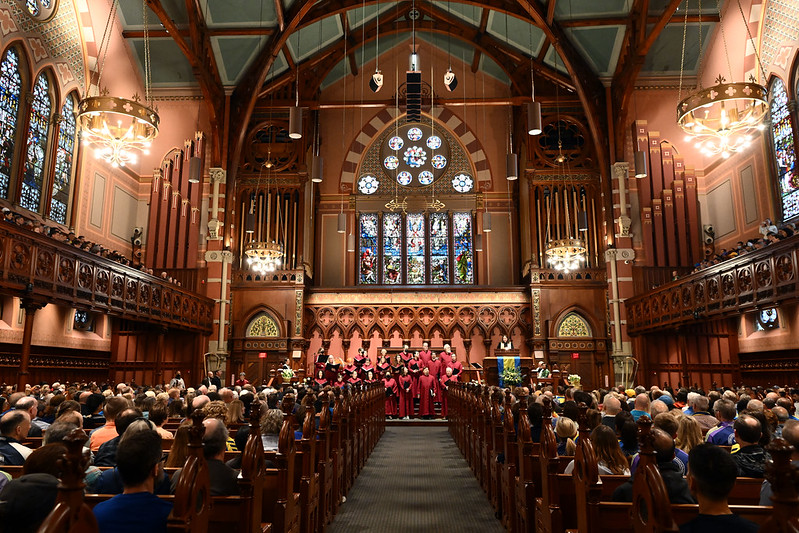
We don’t have a boulder here this morning, but we do have brass and timpani. We have flowers and alleluia ribbons. We have the Old South Choir and a very large Skinner organ. We have the cherished memories of loved ones who have gone before us. We have the memory of Marian Anderson challenging an entire nation to rise from a tomb of bigotry.

In other words, we have all and more than we need to celebrate God’s Easter victory. And, because this is not a spectator sport, we are invited to be among those who tell the Easter story, and who pass it on, person to person, parent to child, to new generations.

Alleluia! Christ is risen!


Copyright © 2007, Old South Church and by author.
Excerpts are permitted as long as full accreditation is made
to Old South Church and to the author.

Back to Sermon Page

The Old South Church in Boston
645 Boylston Street
Boston, MA 02116
(617) 536-1970