Mark
12: 41-44 Jesus sat down opposite the treasury, and
watched the crowd putting money into the treasury. Many rich people put
in large sums. A poor widow came and put in two small copper coins,
which are worth a penny. Then he called his disciples and said to them,
"Truly I tell you, this poor widow has put in more than all those who
are contributing to the treasury. For all of them have contributed out
of their abundance; but she out of her poverty has put in everything
she had, all she had to live on."
_________________
He is people-watching. Jesus is people-watching in one of the great
people-watching capitals of the world: Jerusalem. He is resting from
his teaching and preaching, from his healing and feeding. He is on a
break. He is hanging and he is people-watching.
Something catches his attention. He does a double-take. He stares. You
know how it is when you see something surprising, some eye-popping
curiosity: you want to share it. It is too good, or too weird, or too
wonderful to keep to yourself.
Jesus calls to his friends. "Hey, Peter, James, John, Matthew, Phillip,
Thomas! Guys, come over here. Hurry! You've got to see this! You're not
going to believe this!"
The guys come over and Jesus points toward the Temple. He points in the
direction of the collection boxes. The collection boxes are for the
running of the Temple . . .for sacrifices and the daily operations.
"Watch," says Jesus. "It's the darnedest thing." Jesus and the
disciples watch. What they observe is that the rich contribute to the
Temple painlessly out of their abundance. Jesus tells the disciples
about the poor widow who put in two small copper coins . . . two
mites . . ."everything she had, her whole living."
Jesus and the disciples marvel at the poor, who give with exceeding
generosity. They've seen this before. They've noted this curiosity:
that rich are so careful about their giving, so calculating . . . and
that the poor are so uncalculating, so inexplicably extravagant. They
find it amazing the way the poor give … not out of a comfortable
cushion of wealth, but out of their poverty.
It is remarkable that over the course of the 2000 years between then
and now, that pattern hasn't changed. It's still the same. It's
predictable.
Two weeks ago while walking across Boston Common I ran into a man I
know. Let's call him Frederick. Frederick is unhoused. He sleeps
outside most nights. During the day he panhandles. When I ran into him
we exchanged greetings. He invited me for a cup of coffee. He insisted
on paying.
While Frederick and I were sipping hot coffee at the Burger King on
Tremont Street, a man came in whom Frederick knows. Frederick leaned
over the table and informed me in confidential tones that this guy was
in rough shape, that he was down on his luck. Frederick took out a
dollar from his pocket, purchased a 99-cent Whopper Jr, and handed it
to his friend.
When we entered that Burger King, Frederick had on his person his
entire net worth: the clothes on his back and a little over $11.00. By
the time he had purchased two cups of coffee and a burger for his
friend, he was down to a little over $8.00. And, here's the
thing: when he purchased two cups of coffee and handed me one, he was
beaming. When he handed his friend a burger, he was shining … he looked
dazzling. When I said goodbye to Frederick and thanked him for his
generosity, he was grinning ear to ear. His net worth had decreased by
almost 30% in the space of fifteen minutes, and he was grinning ear to
ear.
Here are some facts … representing truths that have not changed for
2000 years.
Fact
1 : Women are more generous
givers than men.
Fact: Older people give more generously than younger
people with the same income.
Fact: People who give generously to their church or
to charity are happier than those who do not.
Fact: The largest givers - as a percentage of income
- are the lowest income earners.
Fact: The working poor, disproportionate numbers of
whom are recent immigrants, are America's most generous givers.
Fact: The poor typically don't earn enough to
itemize their giving. They still give.
Giving a dollar to charity costs me around 65-cents. Giving a dollar to
charity costs the poor a dollar. They still give.
Fact: Much of the giving of the poor, unlike the
giving of the rich, goes under the radar. It is unreported and
unrecorded.
Such is the giving of the working grandmother in Roxbury, Charlene.
Charlene was about to retire … ready to retire … she so much wanted to
retire … when along came a remarkable grandchild …a child she was
determined to salvage from the streets … a child with potential … a
child to invest in. So she didn't retire. She kept working. She works
and works to pay for this grandchild's music lessons and special
after-school programs and a summer science camp. She invests in this
child everything she has … her whole living.
Such is the giving of the Brazilian immigrant who works two jobs. Pedro
has two jobs. He lives in the meanest of conditions. He sends home to
his family in Brazil every dollar he can spare … and ones he cannot
spare. He sends home to his family everything he has … his whole living.
Fact: Herbert Smith is 31 years-old. He is a
Seventh-day Adventist and he is on disability. He receives a monthly
disability check for $1,010. He is a tithing man. He gives away 10% of
his monthly income of $1,010. "The poor worry less about their money,"
says Herbert."We're not scared of poverty the way rich people are," he
said.
Now, I have to pause here and ask you a favor. I have to plead with
you: don't shoot the messenger. I'm just the messenger. What I am about
to say is in the text, it's in the story, it's in the Gospel. It's not
my fault what I am about to say. It's in my contract to preach the
Gospel. You can try to have my contract changed … but for now I'm
required to preach the Gospel. Don't shoot the messenger.
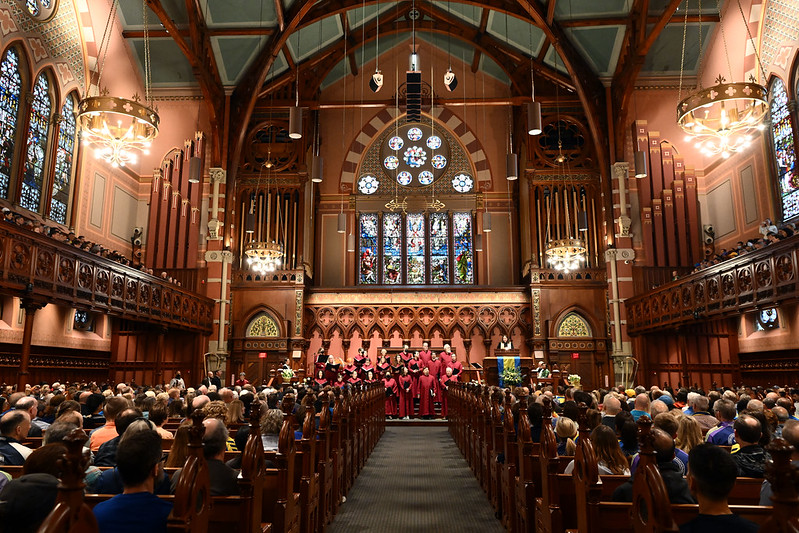
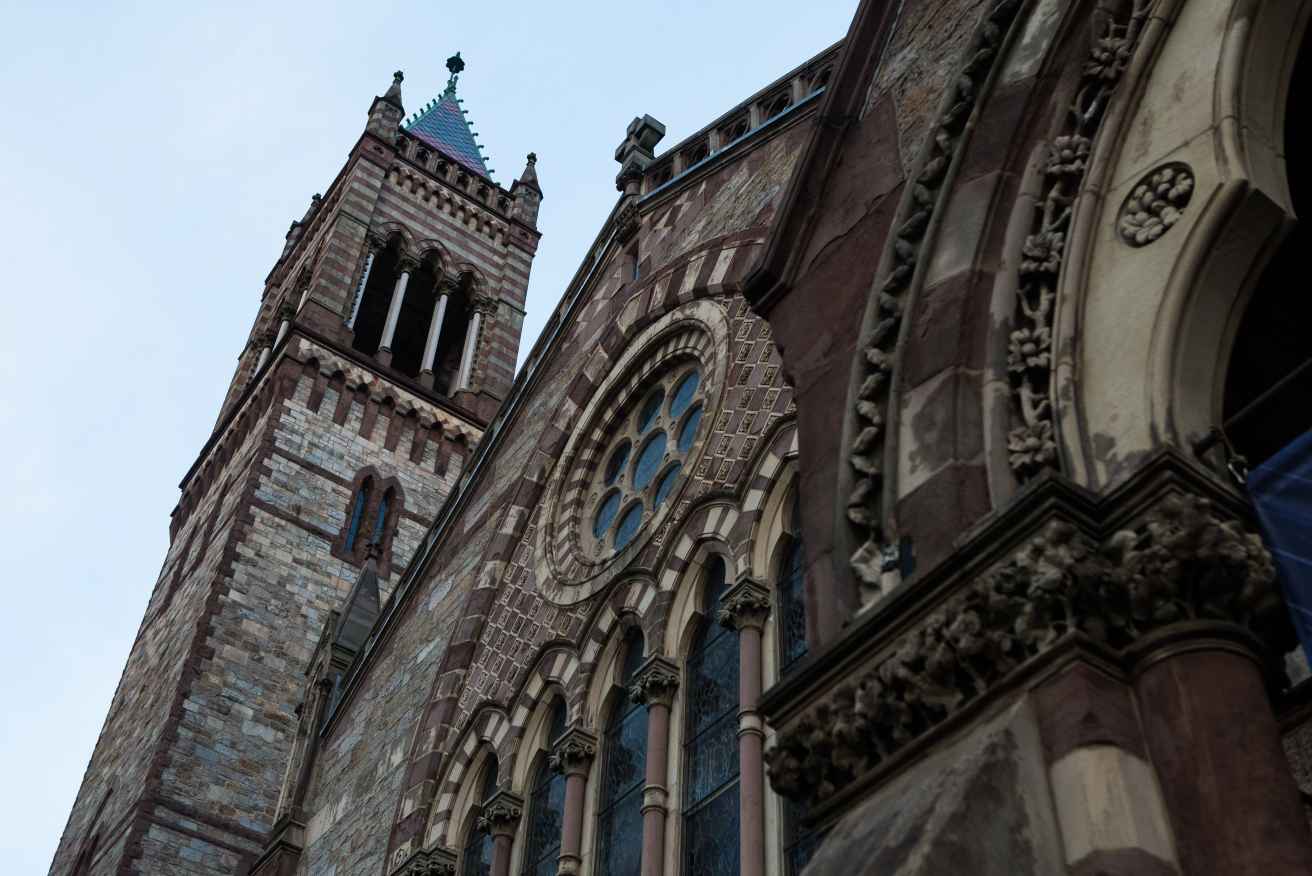
The truth is that we are a church -- Old South is a church -- composed
both the widow's-miters and of the rich. We are a church of the poor
who give extravagantly and of the rich who give carefully, who give
with calculation …. who give, but before they give, they make darn sure
of what will be left. In a church like that, I'm in the latter camp,
the rich and calculating camp … so if what you are going to hear makes
you wince… know this: I am wincing too.
Back to Herbert, the Seventh Day Adventist. Where do you think Herbert
learned this generosity, this extravagance of giving 10% of so little?
Here's where: Herbert looked around him, he opened his eyes, and he
noticed that God is extravagant … that God doesn't hold back. God
didn't and doesn't hold back from Herbert … and Herbert doesn't intend
to hold back from God.
God doesn't hold back.
What if God had said about the Peacock - while it was still in its
design phase - what if God had said, we need to cut back. This is just
too extravagant. It's over the top. It's a waste of feathers and
iridescent color. It's entirely unnecessary. Let's forego the Peacock.
They won't miss it. They won't even know.
What if God had said about the Giraffe that upon further consideration
the length of the neck is excessive . . .pointless really . . . a
misuse of materials. We can cut back on that. We can chop off a good
seven feet and still have something quite wonderful.
What if God had said about the Aurora Borealis: "It's a stupid idea.
When you weigh in the balance how many people will see it compared with
its grandeur, it just can't be justified. Let's make do without the
Aurora Borealis."
What if God had said about the choirs of angels: "Really, any more than
a single choir seems immoderate, excessive. Surely one choir will do.
Or, come to think of it, even a competent soloist or two. (Can you see
God punching the numbers on a calculator?) Perhaps we can cut back on
the orchestra. Surely we can save there. Let's make do with a single
harp. We don't need choirs of angels. The full plan for Seraphim and
Cherubim is unnecessary. One or two soloists and one harp will do fine.
It will give those humans an
impression
of glory. They'll get the idea. That way we won't overwhelm them.
Less is more . . .
What if Jesus had said about the feeding of the 5000: "It's too much.
It's too much of a production … too much food. It's unnecessary. It's
over the top. Anyway, how will they ever learn the value of a dollar?
Or, we could charge on a sliding scale."
About the raising of Lazarus, what if God had said to Jesus, "Don't do
it, Jesus. Don't go there. You'll set a precedent. If you do it for
one, they'll all want it."
What if God had said to Jesus, "Hold back, Son. Don't overdo it.
There's no need to go all the way to Jerusalem. It's dangerous in
Jerusalem. You'll call attention to yourself. You can always stay in
Nazareth and teach and heal from there. Jerusalem is unnecessary.
You'll just get yourself killed."
So, here's what I am wondering. I am haunted by this. I can't help but
wonder: If Jesus were sitting outside this Temple . . .if he were to
call to the disciples . . ."Hey, Peter, James, John, Matthew, Philip,
Thomas . . .Hey, guys, come over here. Hurry. Hurry! You've got to see
this! You're not going to believe this!" I am wondering. I am haunted
by this question: What would he see? (Don't shoot the messenger! I'm
just standing on the Gospel here. It's in my contract!)
What would Jesus observe? Would he see the same predictable behaviors?
Would he observe widow-miters giving extravagantly, imprudently,
recklessly … giving with abandon and with joy? Would he observe the
rich giving as they - as we - have always given: with grave and studied
calculation … computing what will be left … carefully counting the cost?
I admit it: I am haunted by this. If Jesus were sitting outside this
Temple, what would he see? I can't help but wonder . . .
1.The
following statistics
come from America’s Poor are its Most
Generous Donors, by Frank Greve, 2009