The Old South Church in Boston

Plumb?

A Sermon by Rev. Nancy S. Taylor

December 9, 2007

Isaiah 11: 1-10

Listen to this Sermonmp3 file


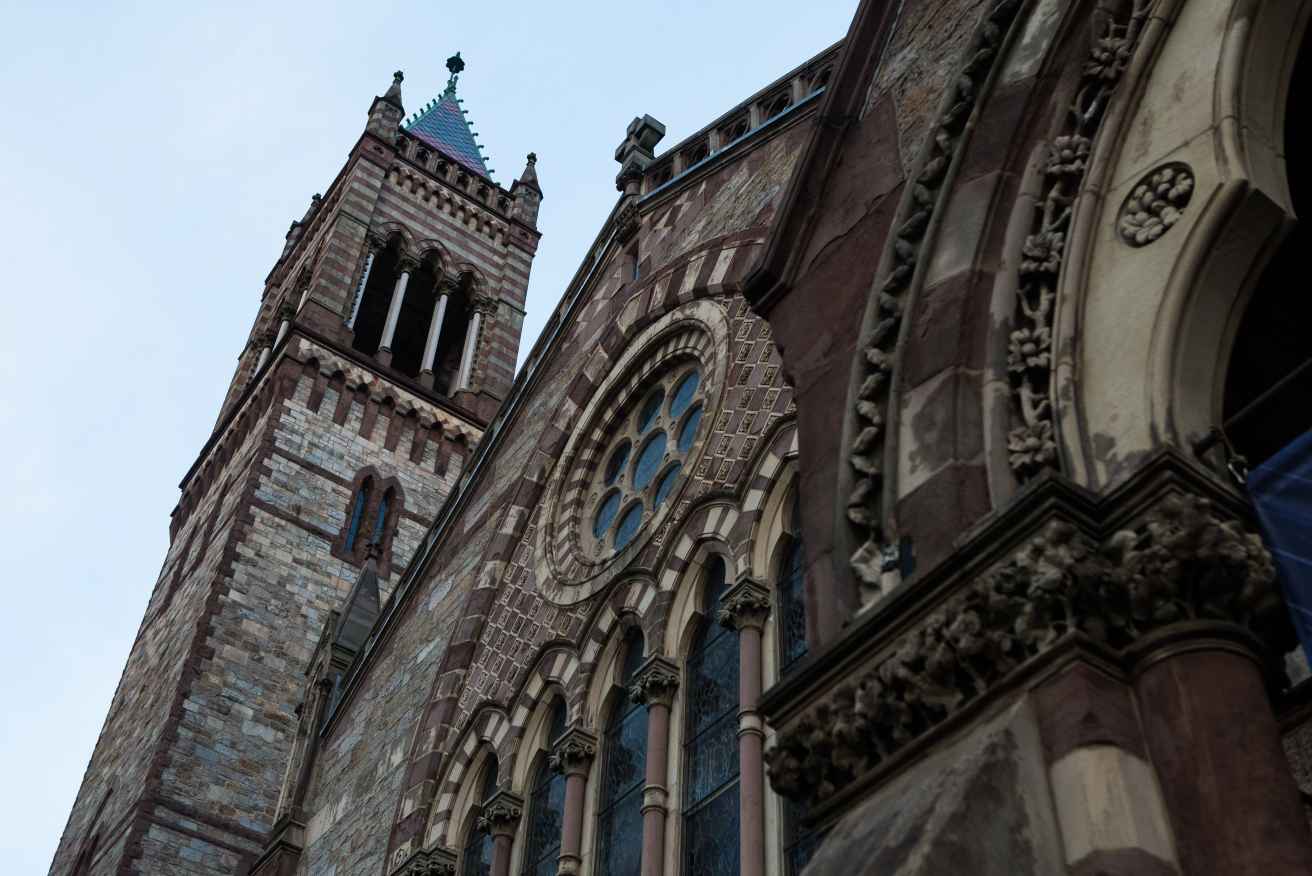
Within your Sunday bulletin you will find an architectural puzzler. Beneath side-by-side photos of our first tower and our current tower, there is a photograph of a lone stone circle surrounded by gothic arches and columns.

Imagine you are Harry Potter and you swallowed a special diminishment potion – a potion that reduces you to the size of a cat. Now, cat-sized and deft of foot, you climb through that stone circle. When you do, you find yourself inside the office of the Minister of Music.

As you look directly up from this porthole you see in the ceiling of that office another hole, covered by a metal plate. When you climb up through that, you find yourself in Old South’s third floor Copy Room … a work room housing the copy machine, Risograph machine, paper-cutter and paper supplies.

Directly above you, in the ceiling of the Copy Room you see yet another hole, covered by a metal plate. When you climb through that hole, you find yourself in the fourth floor Tower Room.

Directly above you in the ceiling of the Tower Room you see yet another hole covered by a metal plate. When you climb through that hole, you find yourself inside a large, unfinished room, with stone walls and a few narrow windows. There you see our two bell ropes: a slim one by which the bell is tolled and a thicker one by which the bell is swung from its wheel and pealed.

Directly above you in the ceiling of that room you see yet another hole. And once you have climbed through that hole, you see still another hole in the next ceiling. And once you have climbed through that one, you find yourself standing beside the bell itself, in the part of the Tower that is open to the air.

Looking up from there, you see in the ceiling of the Tower’s roof, yet another hole. Bravely and carefully, you climb through that into the highest point of the Tower, the Tower’s cap.

From there, you let down a rope, a plumb-line through the holes by which you have just climbed up. The rope falls down through ceiling and floor, ceiling and floor, ceiling and floor, until the rope slithers through that round stone circle in the photo.

That circle is located in the Tower entryway above the door that leads to the portico. That hole and all the holes in the ceilings and floors directly above it, were built into the Tower to enable us to determine if the Tower is plumb or off-plumb.

This is not an idle question for Old South.

The first Tower was completed in 1875. It was in 1931 that the members of the Old South Standing Committee and the Building Committee, accompanied by engineers and architects, agreed that the Tower leaned at a perilous angle. The inclination was deemed perilous for the main church, as the massive 5000 ton weight of the Tower was pulling the building (this part of the building) with it as it leaned … and perilous for passersby should the Tower come tumbling down. In 1931 the Tower leaned so steeply that the ridge of the Tower roof was over 3 feet to the southwest of its true position.

To read the accounts of the meeting at which it was voted to tear down the Tower is to read of men whose hearts broke at the prospect of its demolition. The majestic Tower had soared over Copley Square for generations, a distinguished and distinguishing architectural feature. But being so badly off-plumb the Tower was a danger to itself and to others.

It was no small effort to demolish the Tower … and a far greater effort to rebuild it. The original Tower was demolished in 1931. A new Tower, fifteen feet shorter than the first, was completed in 1937 … largely due to the generosity of one man. But that is a story for another day.

The story for this day, this second Sunday of Advent, hails from 700 BCE as the prophet Isaiah proclaims a peaceable kingdom. Isaiah’s vision imagines a time and a place devoid of the besetting miseries humans are inclined to inflict upon each other. Isaiah describes God’s ideal leader who rules with wisdom and understanding, who judges with righteousness, who looks out for the poor and the meek. Isaiah describes a time and a place wherein the wolf and the lamb lie down together, and no one learns to hurt or destroy.

Isaiah’s vision is a decisive component of that which defines the Judeo-Christian ethic. His vision forms a plumb-line, a way of measuring ourselves against what God most hopes for us and what God hopes from us.

Fifty-nine years ago tomorrow, on December 10, 1948, the United Nations General Assembly adopted a secular, international plumb-line by which to measure ourselves: the UN Universal Declaration of Human Rights. In the wake of a world war that had witnessed some of the most barbarous crimes in human history, this Universal Declaration of Human Rights marked the first international recognition that human rights and fundamental freedoms are applicable to every person, everywhere.

Upon adoption by the General Assembly, the Member States of the UN presented this document to the world as a common statement of mutual aspirations … a shared vision of a more equitable and just world. They understood it as a plumb-line by which we would measure ourselves and each other.

Human beings are fallen, tilting creatures. We live on a perilous incline. We are inclined to settle disagreements by sending young people to kill each other. We are inclined to question the definition of torture when we ourselves are the perpetrators. We are inclined to allow the powerful to grow more and more greedy and the weak and vulnerable to become grist in the rich man’s mill. We are inclined to tolerate the misery of others when we ourselves are comfortable. We are inclined to blame persons with mental illness for their lot in life while even as we dismantle social support systems that leave them out in the cold. We inclined to witness the extinction of species and the warming of the earth, rather than curb our prodigal ways.

It is easy to get used to these inclinations, to accommodate them as normal or irreversible. Until we hear Isaiah. Isaiah reminds us that these are abnormalities. These are dangerous inclinations … perilous to ourselves and others.

In the same manner one could grow accustomed to hearing our leaders discussing the definition of torture, until we read the UN Universal Declaration of Human Rights. This document reminds us that the international community deems torture a dangerous inclination … perilous to ourselves and to others.

The season of Advent is a season to measure ourselves against what God hopes for us and what God expects from us:

We grow accustomed to turning to presidents and kings for leadership until God surprises us by sending an infant – the child of peasants – and we learn to call him Sovereign.

We are inclined to accept that might makes right, that the world of tooth and claw is the natural order of things, until God’s own best prophet speaks of lions and lambs lying down together … and our eyes are opened to a different possibility.

We are inclined to accommodate to the ways of war and violence … until we measure ourselves against God’s highest and best hopes for us … God’s peaceable kingdom.

In Isaiah’s vision, we have been invited to climb up to the top, the roof cap, to see the world as God sees it … and, with courage, uncoil the rope by which we are measured.


Copyright © 2007, Old South Church and by author.
Excerpts are permitted as long as full accreditation is made
to Old South Church and to the author.

Back to Sermon Page

The Old South Church in Boston
645 Boylston Street
Boston, MA 02116
(617) 536-1970