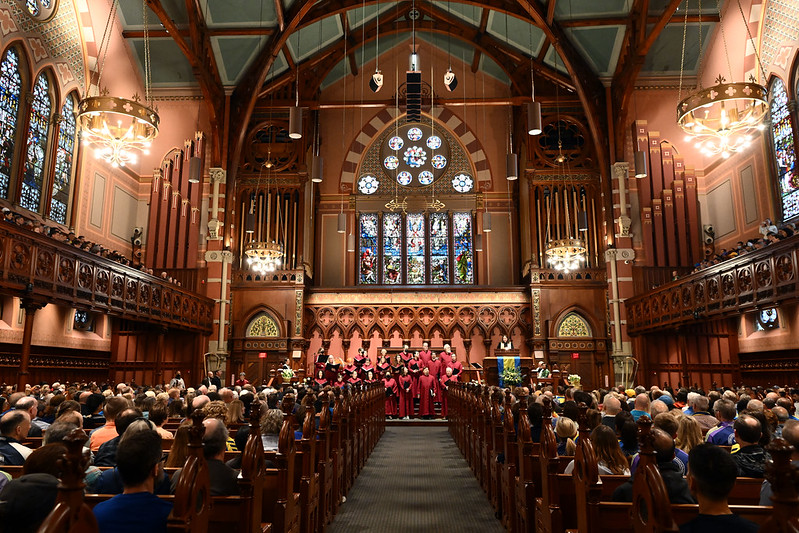
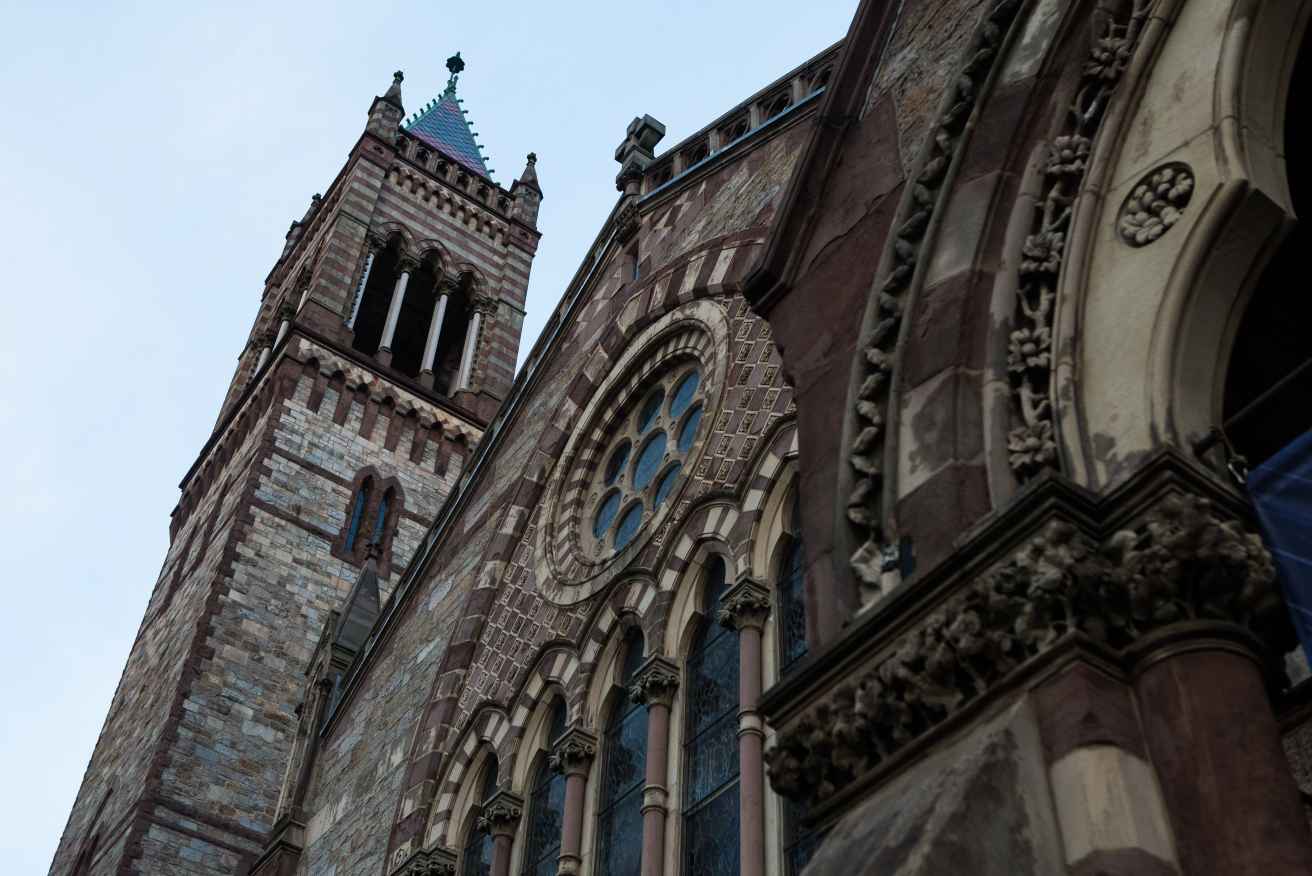
The Old South Church in Boston

Jesus of Nazareth: Muse

a Reflection [1],

by the Rev. Nancy S. Taylor, Senior Minister

March 9, 2008 - The Ffth Sunday In Lent

Lenten Music Sunday

Listen to this Sermonmp3 file


It was in the tenth century that Prince Vladimir of Kiev decided that his nation needed a religion. To that end, the Prince sent his ambassadors out to investigate the religious landscape of the time. He instructed them to come back with recommendations as to which religion was the best religion. He sent some ambassadors to the Muslims, some to the Byzantines, some to the Catholics and others to the Jews. Upon return each ambassador reported his findings to the Prince.

It was the ambassadors who visited the basilica of Hagia Sophia[2] in Constantinople who returned with the most fabulous story. They reported that when they were within the basilica, it was so splendidly beautiful, they did not know if they were in Heaven or on Earth.

Upon hearing this report, Prince Vladimir concluded that God surely dwells with the Orthodox, since God and beauty are one. Prince Vladimir promptly converted and Russia has been Orthodox ever since.[3][u1] 

Beauty is of God and beauty is God … and God is beautiful.

In your mind’s eye imagine Leonardo da Vinci’s The Last Supper. A fresco, painted on the wall of a monastic refectory in Milan, it depicts Jesus sharing his last meal with the disciples. The colors are soft grays, blues, greens and reds. Leonardo captures the moment just after Christ tells his apostles that one of them will betray him. The effect of his words causes a visible wave of emotion among his followers at the table. Despite the dramatic reaction of his followers, Christ remains serene: a self-composed figure alone in the middle, his head framed by a halo-like window behind him.

It was the beauty of Jesus – of his life and witness – that inspired Leonardo to achieve one of the great masterpieces of the high Renaissance.

Now, in your mind’s eye visualize Michelangelo’s Pieta. Housed in St. Peter’s Basilica in Vatican City, the marble statue depicts Mary holding in her arms and draped across her lap the limp body of Jesus just after he has been taken down from the cross. The mother’s anguish is every mother’s nightmare.

The tilt of her head, the folds of the cloth, the draped body … all combine to form a stunningly wrought piece of art … a block of marble through which are glimpsed both the human condition and the munificence of God.

Now, conjure in your mind’s eye illuminated pages from the medieval Book of Kells (brilliant reds and blues, shining gold)  … now imagine the vivid images of hell, of pilgrimage and of paradise painted in words and poetry in the pages of Dante’s Divine Comedy … now ,with the ears of your memory, summon  the stirring music of Handel’s Messiah. 

None who has ever walked the earth has inspired more art – and more sublime art – than Jesus of Nazareth, a Galilean peasant. Why? What it is about Jesus that has inspired the greatest art the world has known?

Christians claim that in Jesus we can actually see and discern something of God. We claim that in and through Jesus we glimpse the beauty of holiness, the grandeur of deep serenity, the loveliness of truth, the bonds of love, the magnificence of mercy, the excellence of humility, the grace of pure generosity.

In Jesus, God sends us a muse so powerful and so evocative he has inspired men and women across the centuries to pour themselves out … authoring beauty in art and music, in literature and in life, in courage and passion, in mercy and love.

The beauty Jesus inspires is more than skin-or canvas- deep. In those who fall under his spell, he inspires a beauty that is soul-deep … the kind of soul-deep, self-emptying beauty of St. Francis of Assisi responding to Christ’s call to a life of poverty … or the soul-deep majesty of Dr. King’s dream of justice … or the soul-deep grandeur of Archbishop Oscar Romero’s passion for the poor of San Salvador.

Two years ago we were stunned to learn of a murderous rampage visited upon an Amish community in rural Pennsylvania. A gunman entered the community’s one-room schoolhouse. Execution style, he gunned down students. The horror of the murders was widely reported.

But what reverberated around the world – what captured our attention because of its sublime beauty -- was the Amish community’s act of forgiveness. They defied the ways of a retributive world. They refused to meet violence with violence.

The Amish are a people apprenticed to Jesus, tutored in the life of Christ. Onto a canvas stained with blood and anguish, the Amish painted with sure and deft strokes the colors of God’s deepest beauty.

The Christian community is a community of artists: under the spell of Christ we sculpt and mold ourselves into God’s works of art.

I promise you this: if we let Christ have his way with us he will stir us from our grogginess. He will awaken us to the wonder and heart of God. He will lift us – even us – to the beauty of holiness.


[1] This is the second of a two-part sermon. Last Sunday I preached part 1, “Jesus of Nazareth: Mime and Mirror.”

[2] Famous in particular for its massive dome, it is considered the epitome of Byzantine architecture. It was the largest cathedral in the world for nearly a thousand years, until the completion of the Medieval Seville Cathedral in 1520.

[3] Hill, Jonathan, What Has Christianity Ever Don for Us? Its role in shaping the world today, Lion Hudson Press, London, 2005), p. 31


 [u1]


Copyright © 2008, Old South Church and by author.
Excerpts are permitted as long as full accreditation is made
to Old South Church and to the author.

Back to Sermon Page

The Old South Church in Boston
645 Boylston Street
Boston, MA 02116
(617) 536-1970