Old South Banner
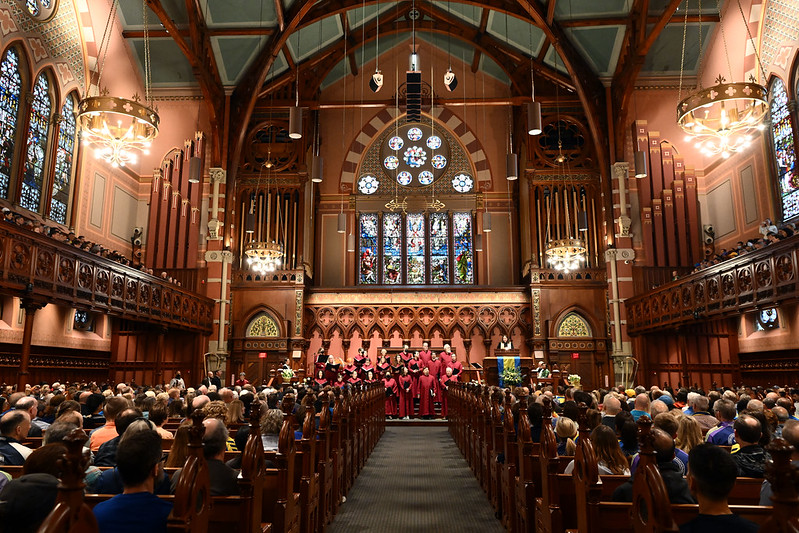
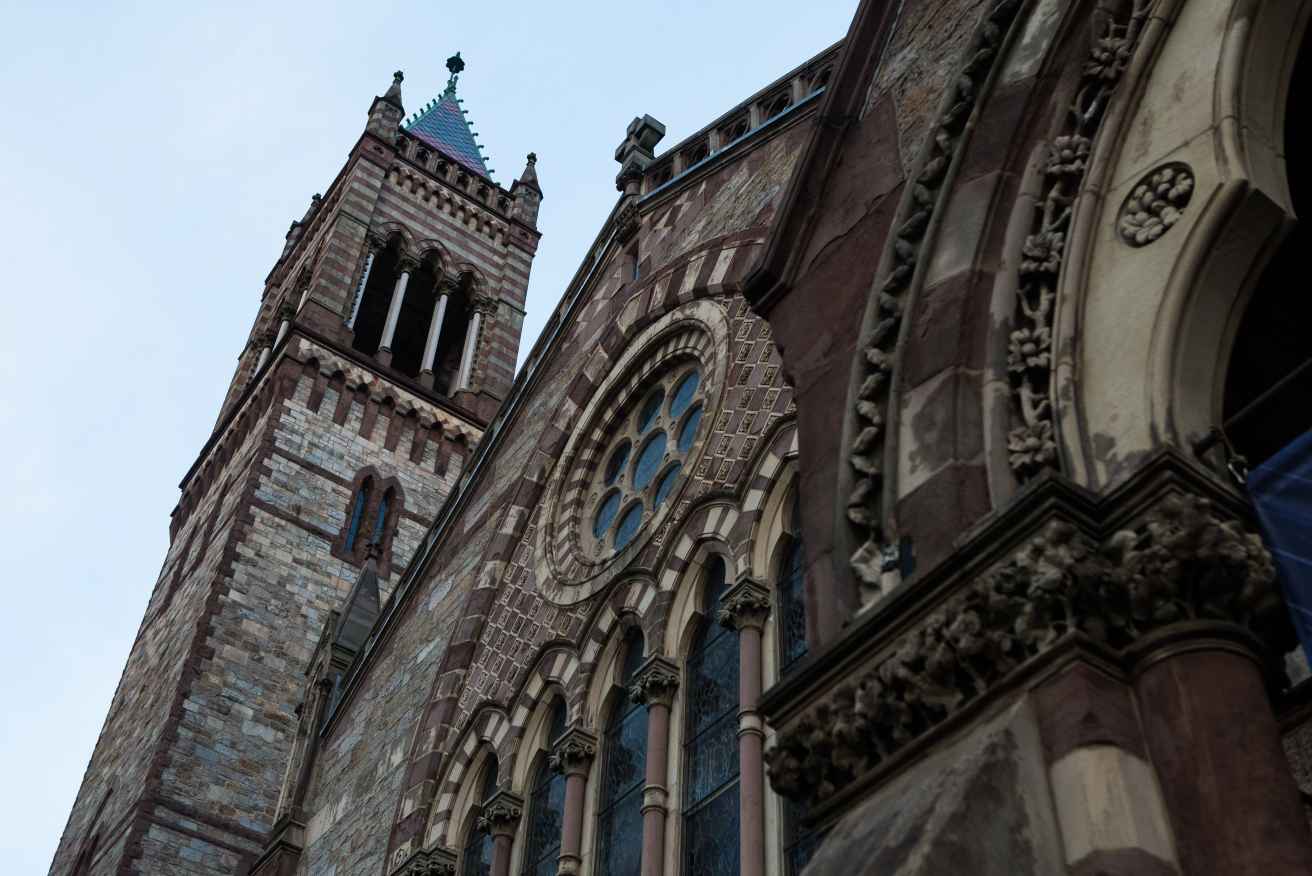
Old South Sanctuary (photo by Sarah Musemuci)


Copyright © 2008, Old South Church and by author.
Excerpts are permitted as long as full accreditation is made
to Old South Church and to the author.


Old South Sermons:

The Shepherd's Psalm
 

by Nancy S. Taylor, Senior Minister

Sunday, April 13, 2008

Based on Psalm 23

Listen to this sermon


There once was a time and there once was a place when the Twenty-third Psalm was contraband.

There once was a time (not so very long ago) and there once was a place (not so very far away) when the Twenty-third Psalm, forced underground, was recited furtively, some would say, recklessly, for to do so was to invite upon oneself a swift and deadly wrath.

The time was 1933. The place was Germany. It was not, however, the Nazi’s who banned the Twenty-third Psalm and forced it underground. The truth is rather worse. Those who banned it were a handful of German Christian theologians. Seeking to curry favor with the Nazis, they decreed that there were whole portions of our sacred writings with which we Christians could easily dispense.

Which portions? Genesis, Exodus, Leviticu, Numbers and Deuteronomy. But, not just those, also the historical books: Joshua, Judges, Chronicles, the Samuels, Kings. Also the prophets: Isaiah and Jeremiah, Jonah, Amos, Micah. Also the wisdom materials: Job and Ecclesiastes and Proverbs. Also, the entire collection of the Psalms … all 150 of them.

It was determined that we could easily dispense with these sacred writings – indeed, with the entire canon of the Hebrew scriptures – because they are, in a word, Jewish.

How do you live in a dangerous world? How do you cherish a small, warm flame of faith when violent storms rage about you? You join your voice to that of the psalmist, defiantly claiming: Yea, though I walk through the valley of the shadow of death, I fear no evil. For thou art with me. Thy rod and thy staff, they comfort me.

At least one German Christian theologian defied the ban on the Twenty-third Psalm. Dietrich Bonhoeffer defied the ban and took the Twenty-third Psalm underground. He took it underground and with it, the other 149 psalms and all the books of the Hebrew Scriptures. Bonhoeffer founded an illegal, underground seminary: a place to train Christian leaders who refused to contort their faith to fit the twisted program of the Nazis and their collaborators.

In Bonhoeffer’s underground seminary praying the psalms was a daily, vital meditative practice of his community. In a dangerous world, the psalms provided both comfort and courage. But more than that, to read them was to stand in a defiant and courageous act of solidarity with Jews.

At his underground seminary, and later from prison, Bonhoeffer argued that the Psalms were the prayer-book of Christ and that they are the prayer-book of Christians. Against a revisionist program that sought to expunge from Christianity its Jewishness, Bonhoeffer made a point of the Jewishness of Jesus and of the profound indebtedness of the church to its Jewish heritage.

For his defiance of the Nazis and his refual to contort the Christian faith to fit an evil and distorted program, Dietrich Bonhoeffer was imprisoned and later executed.

How do you live in a dangerous world? How do you cherish a small, warm flame of faith
when violent storms rage about you? You join your voice to that of the psalmist, defiantly claiming: Thou preparest a table before me in the presence of my enemies. Thou anointest my head with oil. My cup runneth over.

About ten days ago, Quinn and I were in Israel standing at the Shepherds’ Fields just outside of Bethlehem. These are the fields, supposedly, where our Christmas shepherds were abiding the night of Christ’s birth. Today there are three possible fields in which the shepherds may have watched their flocks by night: one for the Roman Catholics, one for the Orthodox and a third for Protestants.

The pilgrim approaches all three down a single wooded path, but then arrives at the point in which it is necessary to choose. Will the pilgrim choose Field #1, Field #2 or Field #3?

Having made our fateful decision, we stood together on the top of a gently rolling hill, and overlooked a landscape that once yielded fields for grazing. Today the Shepherd’s Field is lacerated by barbed wire fences and a road upon which only Israeli’s may travel.

Directly across from us, taking over an entire hillside, we stared at an enormous, modern, upscale, illegal settlement … an Israeli settlement that has erased Bethlehem’s last green wooded hill.

Today the road and fences dividing Israelis from Palestinians prevent sheep from accessing sufficient grazing land and water.

How do you live in a dangerous world? How do you cherish a small, warm flame of faith when violent storms rage about you? You join your voice to that of the psalmist, defiantly claiming: The Lord is my shepherd, I shall not want. He maketh me to lie down in green pastures. He leadeth me beside the still waters. He restoreth my soul.

The whole point of the psalms – of reading them, praying them, singing them and allowing them to get inside of you: under your skin, in your heart and on your lips – is that they speak such raw truths, such honest truths, truths we recognize from the raw and honest places of our own lives.

Even this gentlest of psalms names the hard truths of death, shadow, valleys, fear, evil and enemies. You don’t have to be in a Nazi death camp, in an underground Christian in Nazi Germany or a Palestinian shepherd to understand this. Indeed, the Twenty-third psalm is recited hundreds of times every day in hospital rooms, at the scene of car accidents, by immigrants crossing the boarder, in refuge camps, by soldiers in war zones, by airplane passengers and at funerals. It is at once a prayer and a mantra. It soothes even as it empowers. But more than that: the words of the ancient psalm bind us to one another. They remind us that here is the faith of a community of believers that reaches back thousands of years and stretches around the globe. Here is a faith that has survived wars and genocide, pandemic and disaster.

The psalmist understands that life is not fair, or easy, or kind, or safe. The psalmist accepts that we will have enemies. What the psalmist insists on is this: that God is with us through it all … on our side (not on the side of the illness, or the oppressor).

Don’t look to God to explain the world’s evil, or defend it or justify it. And don’t beat yourself up trying to explain it either Evil persists. Unfairness exists. These are not to be denied.  On the other hand, God will walk with you as you confront these, holding your hand, accompanying you until you are out of the valley of the shadow of death.

And more than that: the psalmist proclaims that on the other side of the valley – beyond the darkness and fear of it, beyond the evil and pain of it – God is there, preparing a feast, a table, to welcome you with open arms.

This is God’s promise!

How do you live in a dangerous world? How do you cherish a small, warm flame of faith when violent storms rage about you? Start with these words: The Lord is my shepherd I shall not want …

One more thing. Sometimes you cannot pray. You cannot sing. You know that. I know that. I lost my ability to pray after my husband died. I lost my praying voice. I lost the God to whom all prayers are addressed. I also lost my ability to sing. I could not sing without opening a floodgate of tears. It was then that the community stepped in: friends and colleagues prayed for me, and prayed in my stead. The community of faith sang for me, when I could not sing.

Surely there are among us this morning those who cannot pray, who cannot sing. Ones who are right now in the middle of a raging storm, who know the world to be a dangerous place. Ones who are afraid, who have lost hope, whose grief is inconsolable. Ones who have dragged themselves here hoping that the community of faith might pray the prayers and sing the songs they cannot pray or sing themselves.

This, too, is the ministry of these psalms, for these are profoundly communal prayers: prayed in Auschwitz and Buchenwald, prayed in an underground seminary in Germany, prayed by Palestinian shepherds, both ancient and modern, prayed by the victims and the survivors of 9-11, prayed by soldiers in Iraq and Afghanistan, prayed by the ill, the dying and those who grieve.

You have heard God’s promise. Here is the church’s promise: if you cannot pray, we will pray for you. If you cannot sing, we will sing in your stead. We will carry you in the embrace of these ancient psalms, until, by God’s grace, you are through the valley and into sunlight and your voice has returned.

How do you live in a dangerous world? How do you cherish a small, warm flame of faith when violent storms rage about you? Sing or pray these psalms and feel the embrace of the whole community of faith. And if, by chance, you are in no condition to sing or pray for yourself, we will do it for you.


Copyright © 2008, Old South Church and by author.
Excerpts are permitted as long as full accreditation is made
to Old South Church and to the author.

Old South Church
645 Boylston St. Boston, MA 02116
(617)536-1970 Tel (617)536-8061 Fax

You can E-mail us by clicking here: OSC Communications

Copyright © 2008, Old South Church