Copyright © 2009, Old
South Church and by author.
Excerpts are permitted as long as full accreditation is made
to Old South Church and to the author.
|
Old South Sermons:
The City
a sermon by
Rev. Nancy S. Taylor, Senior Minister
September 13,
2009, 15th Sunday after Pentecost
Listen
to
this sermon 
Based on Revelation 21: 1-7
Then I saw a new heaven and a new earth;
for the first heaven and the first earth had passed away, and the sea
was no more. And I saw the holy city, the new Jerusalem, coming down
out of heaven from God, prepared as a bride adorned for her husband.
And I heard a loud voice from the throne saying, "See, the home of God
is among mortals. He will dwell with them as their God; they will be
his peoples, and God himself will be with them; he will wipe every tear
from their eyes. Death will be no more; mourning and crying and pain
will be no more, for the first things have passed away." And the one
who was seated on the throne said, "See, I am making all things new."
Also he said, "Write this, for these words are trustworthy and true."
Then he said to me, "It is done! I am the Alpha and the Omega, the
beginning and the end. To the thirsty I will give water as a gift from
the spring of the water of life. Those who conquer will inherit these
things, and I will be their God and they will be my children.
It begins in a garden,
but it culminates in a city. The Bible opens in a garden. Eden is
beautiful and bountiful: enormous banana leaves, great yellow
trumpet flowers, Chinese hibiscus blossoms as large as dinner plates,
passion flowers in electric purple.
The Bible opens into this splendid, riotous, perfect garden of God's
own planting.
You could be forgiven, therefore, if you supposed that the destiny of
humanity might entail a return to a garden paradise: something like the
Elysian fields of the Greeks, or the green pastures of Psalm 23, or the
Garden of Eden reprised.
Instead, the Bible's the final scene, the denouement, takes us to a
city, an immense, urban metropolis: "the holy city, the new Jerusalem,
coming down out of heaven from God …"
John imagines that this whole enterprise - this epic, multi-millennia
human project, this scheme from Adam and Eve to the end of time as we
know it … this relationship that opened in the story-scape of a Garden
- will come to fruition in an enormous, urban cityscape, a metropolis …
one, we are told, large enough to accommodate whole nations and peoples.
Perhaps we should not be surprised. After all, in its early centuries
Christianity was an urban phenomenon. To be sure, Jesus started off in
small towns: he was born in Bethlehem and grew up in Nazareth. On the
other hand, his entire, three-year public ministry was one, long
pilgrimage toward the city, toward Jerusalem.
After Jesus' death, it was in the city that his followers
gathered. They were in the city when the Spirit came upon them.
It was in the city that the church was born. The most telling
expression of that urban birth: the moment that men and women, hailing
from different nations and speaking different languages, understood
each other, comprehended each other.
In the years that followed, St. Peter presided over the mother church
in Jerusalem, while Paul carried the faith to urban centers across the
Mediterranean.
In this final, strange, chaotic, visionary book of the Bible, the Book
of Revelation, John is not writing to ones who have withdrawn from the
world or turned their backs on it. He does not address himself to
cloistered monks, or to ones gathered at rustic, lakeside retreat
centers.
John writes to urban Christians. He writes, in fact, to Christians
whose context for ministry is remarkably like our own. He writes to
Christians gathered in seven large Mediterranean cities. He writes to
Christians who are deeply engaged in the world… in all its materiality.
He writes to Christians who witness to the ways of God, the ethics of
God, in the midst of the secular market place. He writes to Christians
who, while caring tenderly for widows and orphans, for the enslaved and
the poor, for the ill and the ill-equipped, have something serious to
say about the distribution of resources, such as food, healthcare and
housing.
Despite the appeal to the imagination of bucolic settings conjured by
Elysian fields, green pastures, or a garden paradise regained,
Christian faith claims that we realize our destiny not in isolation,
but in interdependence, not in solitude but in community, not in
homogeneity but in variety, not in tribalism but in multi-nationalism,
not in retreat but in engagement, not in solo endeavor but in symphonic
expression … and not, finally, in a garden but in the city.
John describes this future holy city as beautiful. Its pillars, walls,
gates and buildings are golden and bejeweled.
The city he sees in his vision is massive. It measures twelve thousand
furlongs (1,500 miles).
This is not, therefore, a miserly city limited to accommodating the
faithful few, the elect, the perfect. (You remember all those books
about those who are left behind?) The city John sees is so large, so
spacious that no one need be left behind. It is a city, he says, whose
redeemed are uncountable.
There are no lights in this city: no candles or oil lamp. Nor is
there need for moon, or sun, or stars. All such lights are rendered
irrelevant. The holy city is illumined from within by the dazzling
presence and being of God.
There are no tears in this city … no death, no sorrow, no pain.
And there is something else about this city. There is no temple, no
church or cathedral, no mosque or synagogue, no shrine or sanctuary.
(Imagine Jerusalem without any of these!) There are no sanctuaries in
the City seen of John, because the City itself is the holy of holies.
The divine being is omnipresent.
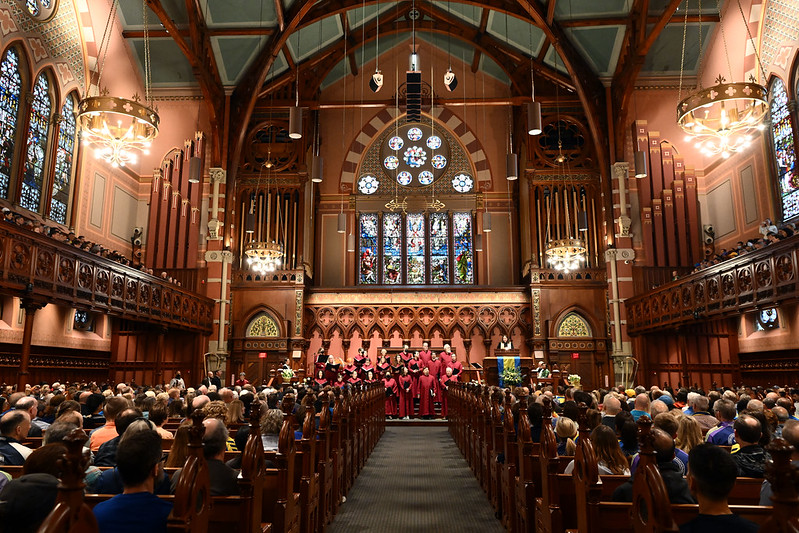
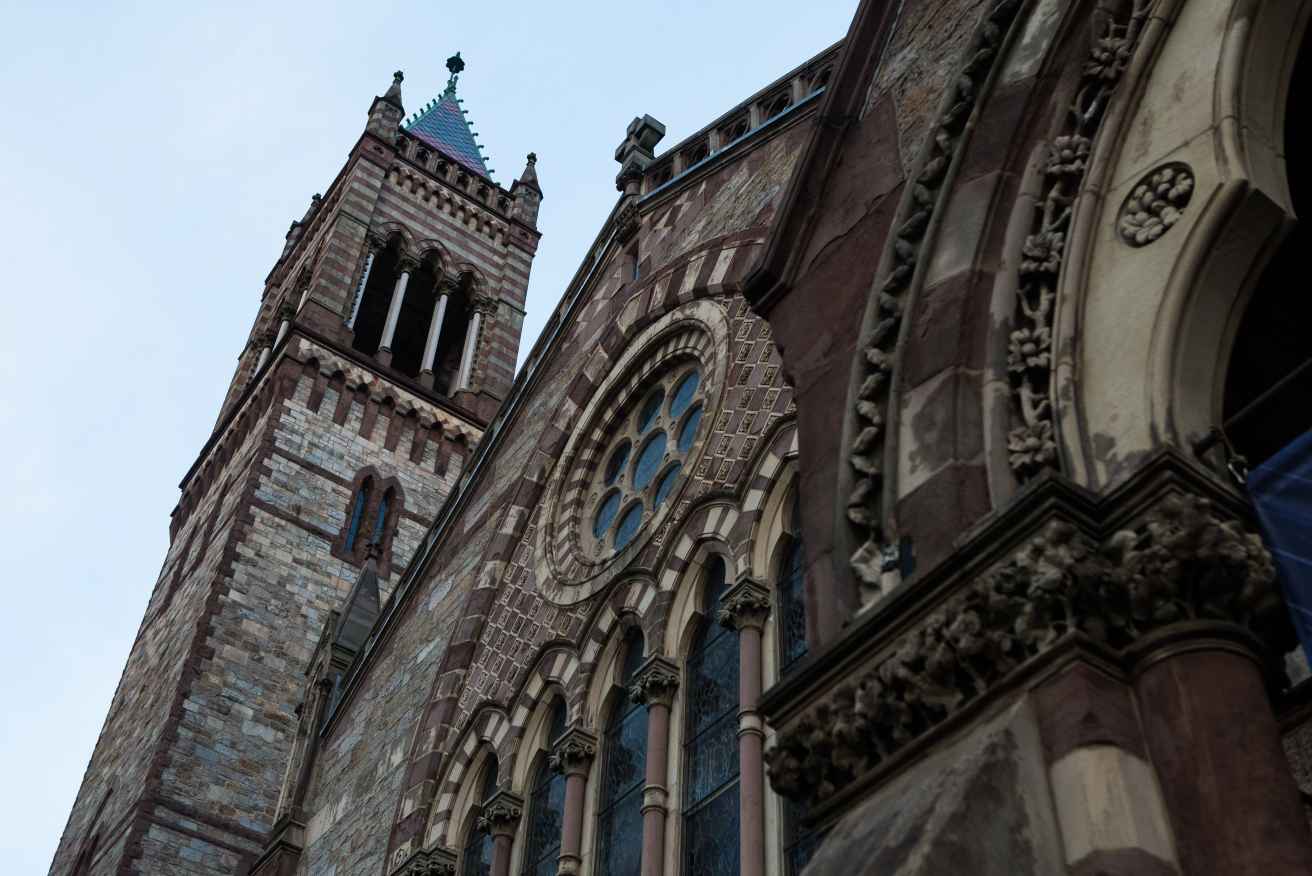
Christian tradition has understood the church, each church - this very
church in which we are here gathered - to be a symbol-in-miniature of
the Holy City seen of John. Christian tradition claims that it is the
responsibility and privilege of each church to hint at, to point
toward, to incarnate and thereby anticipate the Holy City.
Like the Holy City, the church (this church) broods over the life of
the community it serves. It attracts divers people and invites them
into harmonious relationship. It is gathered around God by whose light
alone we make our way.
If the church is to be a convincing symbol of the Holy City such a
church must be filled by high and low, rich and poor, weak and strong,
one with another.
Like the Holy City it must be well tended, lovingly cared for,
comfortable and beautiful.
It must be hospitable so that all who enter it experience being
well-received, awaited and wanted.
It must bring out the best in those who come for worship and education,
fellowship and service … until they know themselves to be "members one
of another," so precious to each other that when one grieves, all
grieve; when one rejoices, all rejoice; when one baby is baptized, we
all become godparents; when twelve among us travel to Appalachia on a
mission trip, all the rest keep vigil and then rejoice with them upon
their return; when one committee is determined to fund Habitat housing
in Dorchester, the rest of us rally to help.
By a remarkable and happy coincidence, just like the Bible, Old South
began in a garden! Our first meeting house, built in 1670, was planted
in, or erected on, the site of what had been Governor John Winthrop's
garden.
But today, while we have brought our love for gardens with us, we find
ourselves in the heart of the city. We are, therefore, exactly where we
need to be.
If we do our work well, this church will bear witness to what John has
seen and heard of the future God intends.
God help us.
Copyright © 2009, Old
South Church and by author.
Excerpts are permitted as long as full accreditation is made
to Old South Church and to the author.
Old
South
Church
645
Boylston St. Boston, MA 02116
(617)536-1970
Tel (617)536-8061 Fax
You
can E-mail us by clicking here: OSC Communications
Copyright
© 2009, Old South
Church
|