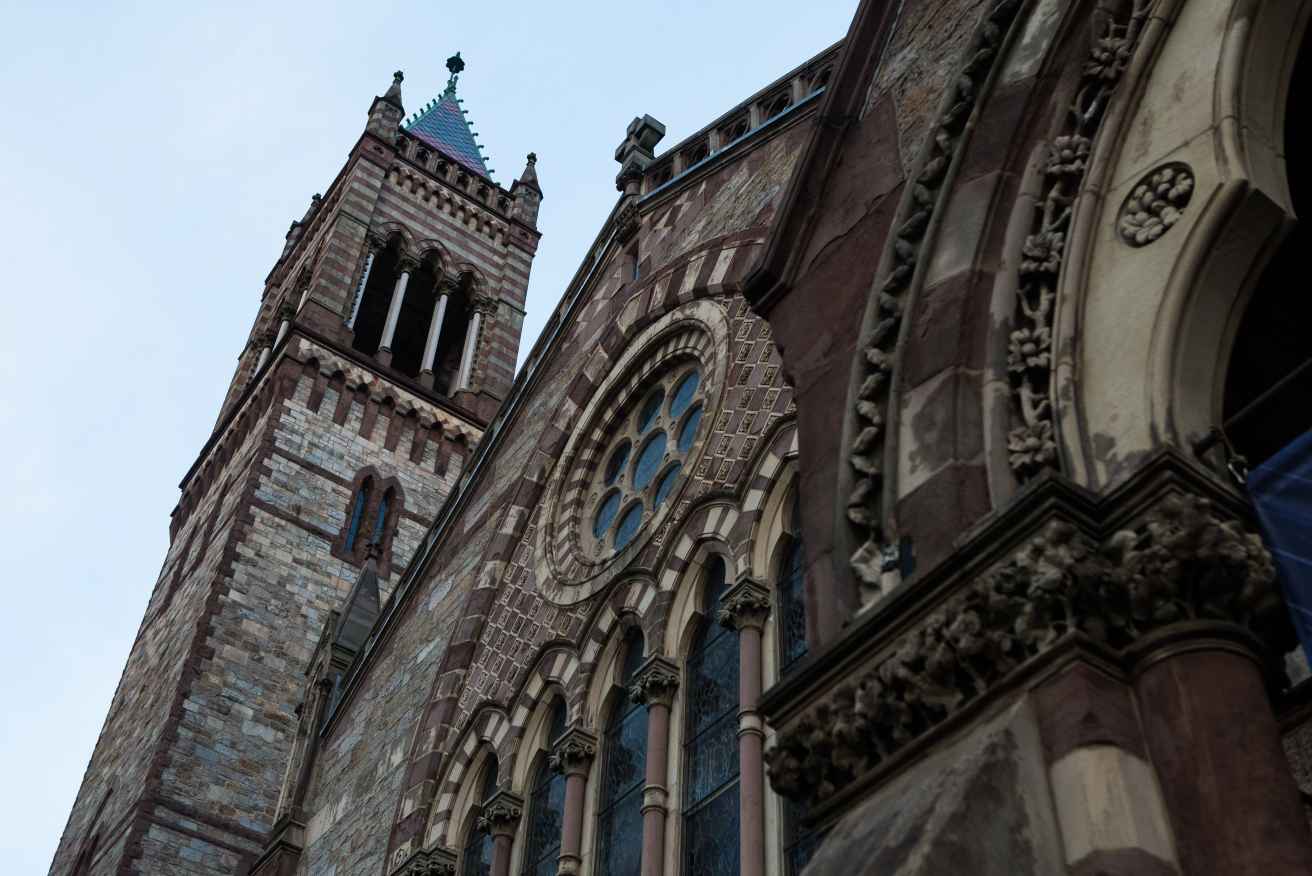
Old South Banner
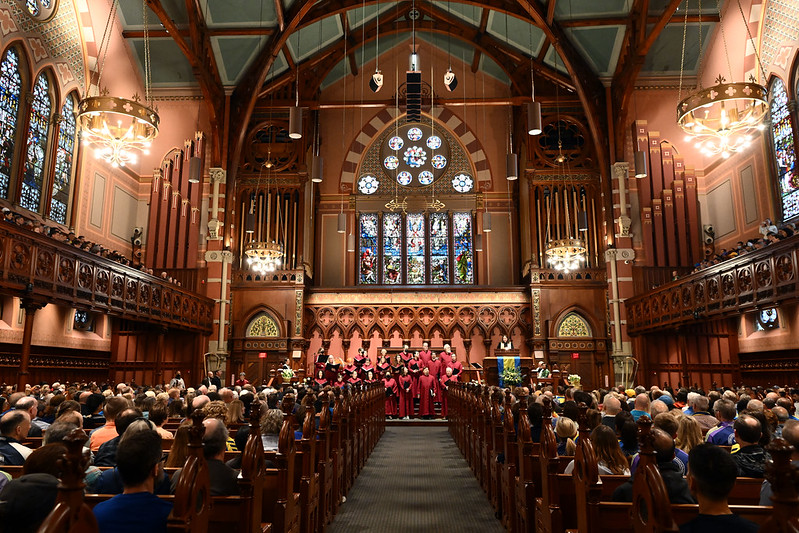
Old South Sanctuary (photo by Sarah Musemuci)


Copyright © 2009, Old South Church and by author.
Excerpts are permitted as long as full accreditation is made
to Old South Church and to the author.


Old South Sermons:

Such Grace

by the Rev. Dr. Nancy S. Taylor, Senior Minister

Based on Luke 4: 16-22a

Sunday, February 15, 2009

Listen to this sermon


There are some ways in which walking through life is a little like walking on a beach. You stroll along, looking, listening, feeling, smelling and every now and again something catches your eye and you reach down, pick it up and turn it over and hold on to it, and carry it with you.

One of the things I have picked up, hold onto and carry with me is a brief sentence from a theologian and writer that some of you know: Frederick Buechner. What I picked up and keep with me is a single, sharp, painfully true thing: “In every small town there is enough grief to freeze your blood.”

An airplane crashes in a New York neighborhood, 50 lives perish and there is grief in 50 small towns ... enough to freeze your blood. There enough grief to freeze your blood whenever there is a fatal car accident, or a college student falls from a dormitory balcony, or a teenager is shot in Roxbury, or a factory full of workers are laid off. And those are just the large, public griefs ... the one’s we read about.

There are also the silent, private, griefs: the wife who submits to being beaten by a beaten down husband; the adolescent who can’t stop eating and eating and eating; the one whose life savings evaporates in the blink of an eye; the family whose home is foreclosed; the one who suddenly finds himself in a hospital gown, stripped of identity and authority, shivering, afraid and for the first time since becoming an adult, no longer in control of his own life.

In every small town there is enough grief to freeze your blood.

In my walk through this life there is something else I picked up along the way. It is equally as true as the sentence about grief freezing our blood. It is a sentence from a poem by Elizabeth Barrett Browning. “Earth’s crammed with heaven, and every common bush alive with God.”

Earth is crammed with heaven. I carry this with me along with the sentence about grief, because without that reminder – that invitation to look for God – I sometimes fail notice God. I sometimes fail to see that God has crammed God’s self into every corner of this world.

Earth’s crammed with heaven.

This sanctuary is crammed with heaven. Karen Hand who just read scripture is crammed with heaven. The members of the choir, every one of them – on their good days and on their not so good days – everyone one of them is crammed with heaven. David Clark is crammed with heaven.

You, out there, you who walked into this place for the first time in your life, you are crammed with heaven. Those of you who have been around for a while, you, too, are crammed with heaven.Those of you having a good day, those of you having a bad day … those of you who are young parents, and also those of you who are struggling, failing, afraid, sick, ill at ease, laid off … you are crammed with heaven.

That earth is crammed with heaven is a profoundly theological claim. It means that God’s grace permeates and infuses everything, everyone, at all times and in all places. Heaven is inescapable.

Listen again to the story from Luke’s gospel. Listen to it, if you will, with those two lenses, those two sentences: the one about grief freezing one’s blood and the one about earth being crammed with heaven … and see if you can hear both – the grief and the heaven – in this one story.

“When Jesus came to Nazareth, where he had been brought up, he went to the synagogue on the Sabbath day, as was his custom. He stood up to read, and the scroll of the prophet Isaiah was given to him. He unrolled the scroll and found the place where it was written: ‘The Spirit of the Lord is upon me, because he has anointed me to bring good news to the poor. He has sent me to proclaim release to the captives and recovery of sight to the blind, to let the oppressed go free, to proclaim the year of the Lord’s favor.’ And he rolled up the scroll, gave it back to the attendant, and sat down. The eyes of all in the synagogue were fixed on him. Then he began to say to them, ‘Today this scripture has been fulfilled in your hearing.’ All spoke well of him and were amazed at the gracious words that came from his mouth.” (Luke 4: 16-22a)

Can you feel the chill in the small town synagogue … a chill cold enough to freeze your blood because Jesus invokes the poor … with their empty eyes and their children with large bellies and skinny limbs? He invokes the captives: those behind bars, languishing in jails, prisons and refugee camps. He invokes the oppressed: the beaten and humiliated, the crushed and coursing masses. All crammed into that synagogue and with them their families and a multiplication of blood-freezing griefs.

But at the same time the synagogue was crammed with heaven … crammed with worshippers who had a heart for God … crammed with the beautiful, powerful, defiant words of Isaiah, words of heaven … words of Good news! Release! Recovery! Freedom! Favor! Gracious words … Words of amnesty for we guilty ones. Words of freedom, for we bound ones. Words of security, for we anxious and afraid ones. Godly words.

And, of course, that synagogue was crammed with Jesus … who is, for Christians, among the more obvious ways that God has crammed earth with heaven.

So, I have picked up along the way these two true things, these sentences, these lenses:

the one that is sharp and painful and cold … and everywhere apparent. It is everywhere apparent because we are in the habit of taking the temperature of the world – or the media is taking it for us – and we know how cold it is … bone-chilling, blood-freezing, airplane-crashing cold.

But I have also picked up and carry with me this other true thing … a truth that bespeaks a grace and comfort that are warm and lovely beyond words … and just as real.

For Christians claim that wherever Jesus walks the ice thaws, hearts melt, doors open, healing happens, the blind see, the hungry eat and things are warmed up by grace. And we see what is true but hard to remember: that earth’s crammed with heaven.  

If you are looking for an excellent working definition of God’s grace, there is it: earth’s crammed with heaven.

This past week I looked up the concept of “grace” in the Great Books of the Western World. This fifty-four volume set begins with Homer’s Iliad and concludes with the major works of Sigmund Freud. The first two volumes are entitled: the Great Ideas: A Syntopicon. The Syntopicon is a brave if brash attempt to foster conversation among all the writers included in the Great Books, by tracing individual ideas throughout the fifty-four volumes.

Some of the great ideas you can trace this way, from Homer to Freud, include ideas like Aristocracy, Art, Beauty, Cause, Citizen, Desire, Duty and Education.

I looked up “Grace” to see how these great hearts and minds treated the idea of grace. I looked it up only to discover it is not listed in the Syntopicon. Upon reflection I realized that it is not there for a very good reason … it is not there because grace is not an idea of the Western world. Grace is not a human idea at all. Grace was God’s idea.

The Western world is a world interested in getting back what you put in, where scales measure the worth of things … a world of quid pro quo, a world where everything has a price.

Grace? Grace operates by different principles. It’s free. Christians claim that we are saved by grace … not by good works, or good looks, or high achievement or because we can afford the entrance free. Grace is a great idea … maybe the best idea, the most beautiful of ideas, but it is Gods’ idea: prodigal, illogical, extravagant, marvelous … free.

Some of you remember when in 1968 Apollo 8 broke through the gravitational field of this planet and entered the gravitational field of the moon. We watched and waited …  anxious for the pictures that would be relayed back to us … anxious to peer into space.  But what startled and amazed us –  what we had no way of anticipating or preparing for –  were the photos of ourselves: the glance backwards across thousands of miles of dark, cold
space …

the view of ourselves on this achingly lovely, blue and green, slowly turning earth.

Before that moment, we had no idea how beautiful we were. For the first time we saw ourselves as God sees us: staggeringly, astonishingly beautiful.

We traveled out there to peer into the heavens. It was there that we understood that earth – this earth, our lives, you, me, the planet – we are crammed with heaven.

That is grace. Grace is to see what we resist seeing: we are beautiful … we are lovely in God’s eyes. We are crammed with heaven.

For Christians Jesus functions like those images from space. In Jesus, God shows us an image of how God sees us: we are lovely and loved. We are beautiful … crammed with heaven.

The problem with grace is not whether we have it; it’s whether we believe it.

The grace of our Lord Jesus Christ, the love of God and the fellowship of the Holy Spirit be with you all. Amen.

________________

Note: I am beholden in this sermon to my friend, Brian Baker, for the juxtaposition and complimentarily of the Browning and Buechner quotations from his March 19, 2000 sermon preached in St. Thomas Episcopal Church, Ketchum, Idaho. 


Copyright © 2009, Old South Church and by author.
Excerpts are permitted as long as full accreditation is made
to Old South Church and to the author.

Old South Church
645 Boylston St. Boston, MA 02116
(617)536-1970 Tel (617)536-8061 Fax

You can E-mail us by clicking here: OSC Communications

Copyright © 2009, Old South Church