Old South Banner
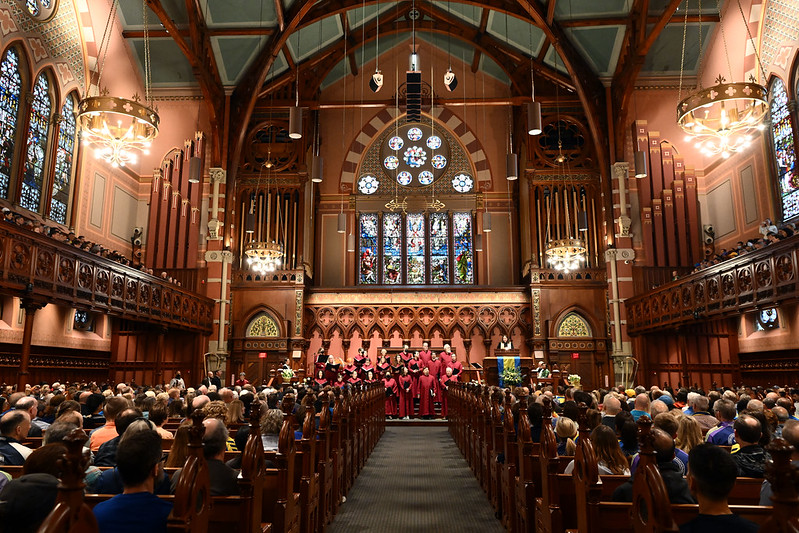
Old South Sanctuary (photo by Sarah Musemuci)


Copyright © 2009, Old South Church and by author.
Excerpts are permitted as long as full accreditation is made
to Old South Church and to the author.


Old South Sermons:

Follow

by the Rev. Dr. Nancy S. Taylor, Senior Minister

Based on Mark 8:31-38

The Third Sunday in Lent, March 15, 2009

Listen to this sermon


INTRODUCTION

Until this point – until this exchange – following Jesus had been something of an escapade, an adventure: exciting, grace-filled, edgy.

They had been there (and maybe even taken a little credit) as Jesus healed the ill, the lame, the troubled of head and heart and soul. When he turned a few loaves of bread and a handful of dried fish into a mass feeding project, they did their best not to show surprise and they relished their nearness to this man of miracles. The time he had walked on water they elbowed each other and kept repeating: Did you see that? When he took it upon himself to converse openly with women and Gentiles, they had whispered excitedly among themselves, wondering what it was he was up to.

It was an escapade they’d stumbled into, a grand adventure. Day after day they woke up, pinching themselves, delighted and amazed were they with their proximity to this man around whom the crowds gathered and who spoke in stories and parables that compelled attention. Following Jesus had meant they were carried along on his coattails, swept up in the healing. They had a front row seat for the miracles, and when he stood up to the authorities, both secular and religious, they thrilled to see it.

There comes a point in the story of these followers of Jesus – it happens in all four Gospel accounts: in Matthew, Mark, Luke and John – there comes a point, a turning point, a hinge where the stakes are raised and the escapade begins to feel and smell like catastrophe.

It is the point, the moment, in which Jesus – the healer, teacher, miracle-worker and parable-spinner – starts talking of rejection, suffering, self-denial, shame, execution and death.

The followers of Jesus had been riding high. They believed they had caught hold of the golden ring. They had  made assumptions about this descendant of David’s throne … assumptions about glory, and power, and prestige. Suddenly, without having seen it coming, they find that the crown – the prize upon which they had fixed their eyes – has been switched for a cross.

A cross!

There is one of them – at least one – in almost every Christian church around the world.

Many are simple: made of tree branches, or bare planks of wood. Some are ornate, fashioned from precious metals: gold or silver … or twisted iron, or polished brass, or hammered copper. Some are inlaid with jewels, others carved from stone or wood, or expressed in stained glass.

No matter how we dress up our crosses, non-Christians are right to wonder at this strange,

dark symbol that is at the heart and center of our lives: this symbol of execution and death.

What sort of religion is this, they wonder? What sort of people willingly gather under such a symbol?

The purpose of the cross is to point beyond itself – and beyond ourselves – to the nature of the God we are gathered here to know, to serve, to worship and to love.

Here we meet a God who submits to death, who chooses to be known in weakness, who refuses to defend himself against mortal enemies, who appears to prefer the company of the poor to that of the rich, whose commitments to justice and mercy know no limits. Here we are introduced to a God who understands human suffering, who mourns it and who joins us in it. Here we meet a God whose heart is trained on bridging the gulf between human sin and God’s goodness, and whose dying brings life.

“If any want to become my followers, let them deny themselves and take up their cross and follow me.”

With that, the lark, the escapade, the adventure … takes a decided turn.

“If any want to become my followers, let them deny themselves and take up their cross and follow me.”

What Jesus means by this is not so different for us today than it was for his disciples …
although for them the stakes were immeasurably higher. What he means, I think, is this:

The imperial forces – forces of death – are everywhere around us: always have been and always will be. These forces are bent on luring us into indulging ourselves, not denying ourselves; into taking care of Number One, rather than living for others. They would woo us, these forces, into an easy reliance upon weapons and might, violence and power as normative… rather than to the work of peace and reconciliation. They entice in us an amnesia that inures itself to the reality of extreme poverty … instead of a tender, conscious pathos for the sufferings of our brothers and sisters … and an anger at the sinful and indefensible distribution of resources on this bountiful earth. They persuade us into conspicuous consumption, rather than living simply … that other might simply live.

“If any want to become my followers, let them deny themselves and take up their cross and follow me.”

It was from this turning point, this hinge, this challenge that the stakes were raised and the prospect of following Jesus took a turn toward a way of life that would be as perilous as it would be profound.

It was at this juncture that each follower of Jesus – we know some of them by name: Peter, Andrew, James, John, Philip, Bartholomew, Matthew, Thomas, James, Simon, Thaddeus, Judas—had to come to their own decision. Do I go on … do I follow to Jerusalem and to the danger Jesus anticipates?

Do I follow this thing out as it appears to be unfolding … no matter what? Or, is the escapade over? Has the time come to return home?

It was a searing question for them. In their day the cross conjured the cruelest, most painful and shameful death imaginable. It was a death met by those who threatened or challenged Caesar’s kingdom. Crucifixion was not a remote possibility. Every one of those gathered to hear Jesus that day had seen men hanging on Roman crosses: bleeding, suffering, dying.

Jesus asks his disciples: will you follow me, will you join me, in living and witnessing to a way that challenges Caesar …a way wherein right does not make right, and riches do not make you great and power is in weakness and justice is beloved?

Jesus further proclaimed that to be ashamed of him – and of his ways of non-violence, of poverty, of mercy –  if we are ashamed of these, God will be ashamed of us. Tough words. Sobering. Bracing.

It is remarkable that they did follow Jesus, all the way to Jerusalem. Remarkable that they screwed up their courage and followed the road to the end. They witnessed Jesus’ execution at the hands of the state. Eventually, some of them were executed as well.

To contemplate their willingness to follow him is to begin to imagine the kind of pull Jesus had on those around him: the force of his character, the gift of his spirit, the sense that in his presence one found oneself in the presence of God.

It is this same crisis of decision that confronts us – you and me – as we turn toward Holy Week. Will you, will I, commit to the life of the Christian: this marked life, this a risky life …a life dedicated to living in the presence of God? Will you take up this cross?

If you commit to this, you cannot know where it will carry you.

And why would you do this? Why become among those who gather under this strange, dark, perilous symbol?

Why? Because we can see what those first followers of Jesus could not see. We can see past the cross, through the cross, past the pain and the shame. We can see beyond the empty tomb.  We can see the hope Jesus brought to the suffering masses. We can see what his first followers could not possibly see: resurrection.

Why else? Because in Jesus – in following him, in encountering him – you will get as close a glimpse of God as you will ever know.

And here’s the final reason: God needs us. God needs those who refuse to accept the ways of the world. God needs us to give witness to God’s way. God needs reconcilers, builders of bridges, stewards of creation, missionaries of mercy, poets of beautiful deeds.

Following Jesus is the adventure of a life-time … exciting, grace-filled and edgy. An escapade like none other. But it is not without risk.

It is quite literally, a matter of life and death and life.

______________

Mark 8:31-38

31Then he began to teach them that the Son of Man must undergo great suffering, and be rejected by the elders, the chief priests, and the scribes, and be killed, and after three days rise again. 32He said all this quite openly. And Peter took him aside and began to rebuke him. 33But turning and looking at his disciples, he rebuked Peter and said, “Get behind me, Satan! For you are setting your mind not on divine things but on human things.”

34He called the crowd with his disciples, and said to them, “If any want to become my followers, let them deny themselves and take up their cross and follow me. 35For those who want to save their life will lose it, and those who lose their life for my sake, and for the sake of the gospel, will save it. 36For what will it profit them to gain the whole world and forfeit their life? 37Indeed, what can they give in return for their life? 38Those who are ashamed of me and of my words in this adulterous and sinful generation, of them the Son of Man will also be ashamed when he comes in the glory of his Father with the holy angels.”


Copyright © 2009, Old South Church and by author.
Excerpts are permitted as long as full accreditation is made
to Old South Church and to the author.

Old South Church
645 Boylston St. Boston, MA 02116
(617)536-1970 Tel (617)536-8061 Fax

You can E-mail us by clicking here: OSC Communications

Copyright © 2009, Old South Church