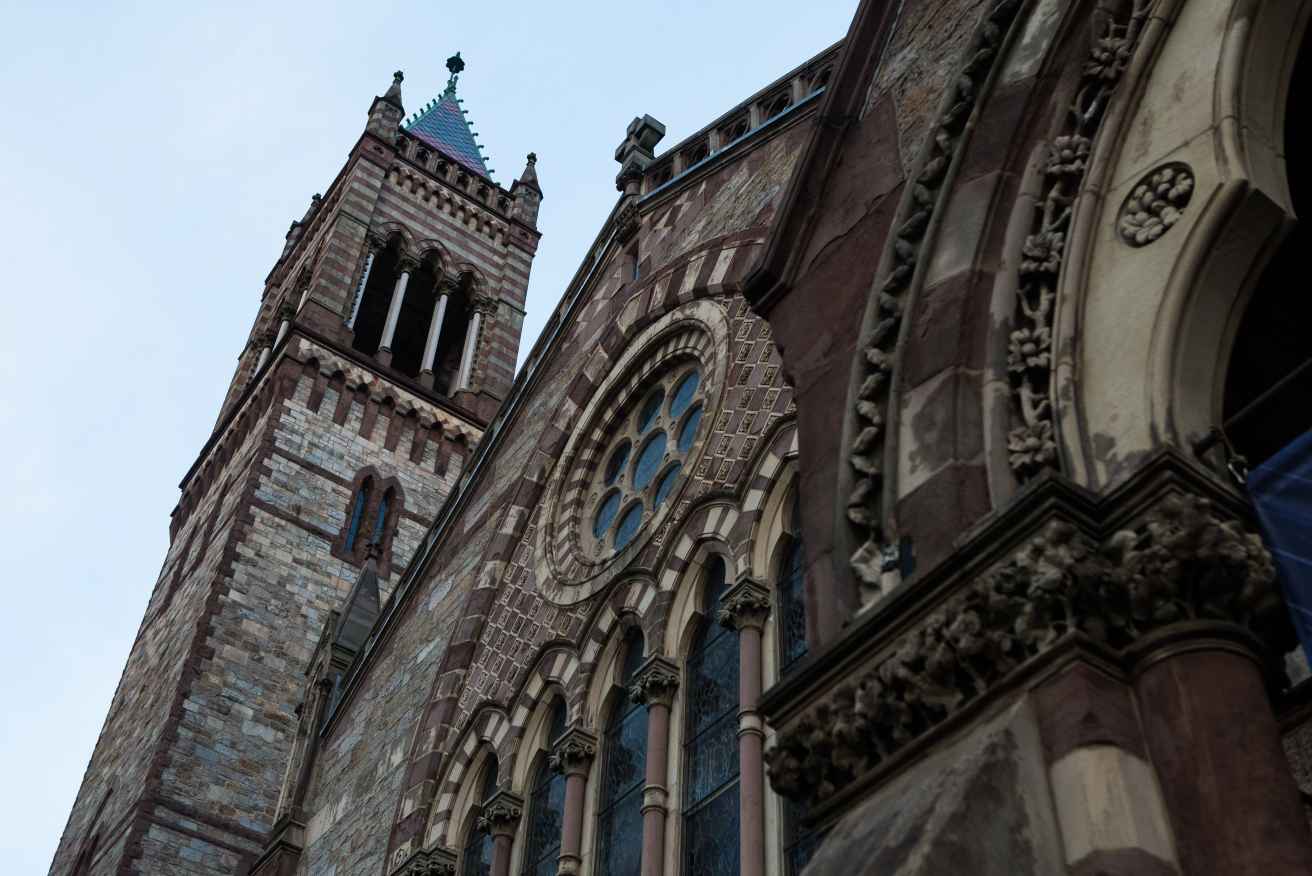
The Old South Church in Boston

God Save the Commonwealth

A Sermon by Rev. Nancy S. Taylor

at the Old South Meeting House

Preached on the occasion of the 52nd annual return of the congregation of Old South Church in
Boston
at  its  ancestral home the Old South Meetinghouse, for a Service of Thanksgiving.

November 18, 2007

Based on Isaiah 65:17-25

Listen to this Sermonmp3 file


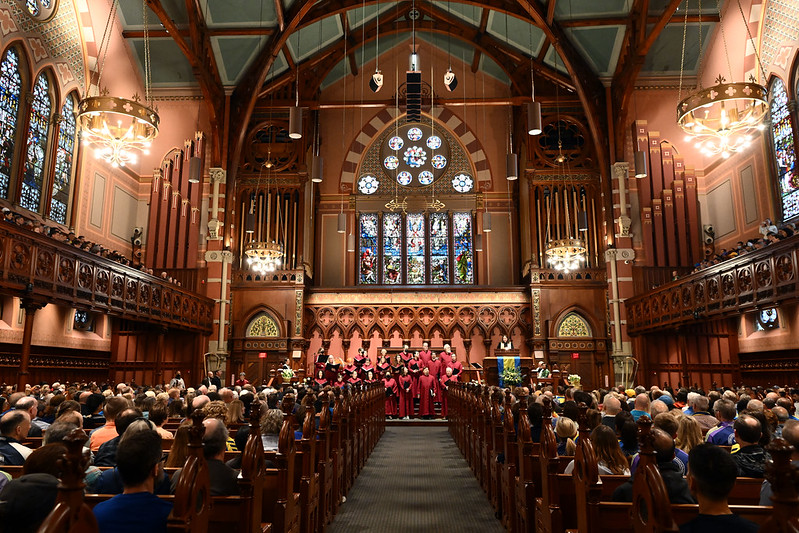
Greetings, grace and peace to you! It is a great pleasure to find ourselves back here in this historic meetinghouse. This building is of singular importance with regard to the American experiment in religious freedom, democracy, freedom of assembly and free speech. Mindful then of our forebears whose spirits surely surround us here, let us in our day, as they did in their day, turn hearts, minds, souls and strength to the Author of the Universe, the Divine Source from which we have come and to which we shall return.

This is the day which God hath made.

Let us rejoice and be glad in it. (Psalm 118:24)

There is an old story about a man from the city who was out driving one day, in the country. The signs on the road weren’t very good – after all, he was in New England – and he got lost. He stopped at a farmhouse to ask directions.

“Can you tell me how far it is to the Mill Pond?” he asked. The farmer took off his hat, scratched his head, calculated. “Well, the way you’re goin’ I reckon it’s near ‘bout 25,000 miles. But if you turn around, it’s about four.”

This hallowed ground holds the memory of one of the most remarkable stories of turn-around in American history. It holds the memory of a man who underwent a heroic inner struggle, a man who wrestled with God and with his own conscience … until he turned himself around and found his way. In so doing, he helped a young nation to find its way.

Samuel Sewell was one of the most prominent and distinguished men of Colonial Boston. He was a graduate of Harvard, a deacon of this church, a captain in the Ancient and Honorable Artillery Company and a judge of the General Court of Massachusetts. He was a merchant, a public intellectual, a civic leader, a pious Christian, and a devoted and anxious father.

When the hysteria arose around so called witches, the authorities turned to the wisest and most trusted among them, to sort through the fears and chaos. Samuel Sewall was among those to whom they turned. He was appointed to serve as judge in the so-called witch trials. In response, and like so many others of his day, he started out in the wrong direction.

In the course of a few months in the year 1692, Samuel Sewall and his justice colleagues presided over hundreds of trials in Massachusetts. The court convicted over thirty people. Twenty were put to death. 

Sewall was not the only Old South member involved in the trials. Two other members of this congregation served with Sewall as judges in the proceedings: Peter Sergeant and Wait Still Winthrop.

Old South members were also among the accused. John Alden, one of the founders of Old South (son of John and Priscilla who arrived here on the Mayflower), was accused and imprisoned. He only narrowly escaped with his life. Mrs. Thacher, the widow of Old South’s first minister, was also among the accused.

Last but by no means least, there was the singularly courageous voice of Old South’s minister. Rev. Willard was one of the most determined and influential voices to speak out in opposition to the proceedings and to speak with compassion and concern for the accused.

Five years after having presided over the deaths of 20 individuals, Samuel Sewell, stopped, turned and headed in the opposite direction.

Samuel Sewall’s dramatic and public “about face” occurred on a cold winter’s morning in January of 1697. The congregation was gathered for worship. Reverend Willard entered the meetinghouse. As he walked up the aisle to lead worship, Samuel Sewall delivered to him a hand-written letter: a statement of confession, contrition and apology.

Following the singing of a psalm and a brief prayer, Rev. Willard took out Judge Sewall’s note, unfolded it and prepared to read. Judge Sewall rose to his feet, bowed his head, and remained in that posture as Rev. Willard read the confession. In his confession Judge Sewall took responsibility for the “blame and shame” of the trials. He asked pardon of God and his brothers and sisters.

I imagine it was among the most stunning moments any of those congregants had ever witnessed.

Judge Sewall’s apology did not end there in that public service of worship. Every year there after for the remainder of his life – that is, every year for over three decades – Sewall observed a personal day of fasting and penitence for the egregious mistakes he had made, for the lives that had been lost, and for his part in the trials.

Sewall’s public apology and recantation is all the more remarkable because not one of the other justices who served with Sewall ever publicly recanted of their part in the hysteria.

A mural in the Massachusetts Statehouse commemorates this extraordinary act of public penitence. What’s more, it places Sewall’s confession among five of the most significant events in the shaping of this nation. Why? Because in making this public confession, in “taking the shame and blame of it” upon himself Sewall not only spoke for himself, he spoke for and to every person of his day. Although his was a personal apology, it served to lance a festering wound whose poison had had infected virtually everyone.

The title of the mural in the Statehouse, Dawn of Tolerance in Massachusetts, indicates that this personal act was simultaneously a public event. It served as a turning point, a turning around … not only with respect to the hysteria surrounding so-called witches… but also stretched and reached to speak to other kinds of societal and religious judgments … for instance, those against women, people who had been carried here from Africa and Native Americans.

Having made a spiritual about face, Sewell went on to write the first anti-slavery tract on this soil: The Selling of Joseph, published in 1700. He paid the tuition for numerous American Indians to attend Harvard and he penned an essay asserting that Indians are among those who possess the grace of God. He wrote another essay asserting and defending the equality of the sexes.

One of Sewall’s biographers claims that it was Sewall’s confession that led both to the creation of an independent judiciary and to the separation of church and state[i]. His apology opened the way to an appreciation of religious tolerance and the affirmation of pluralism.

A few moments ago we joined the children of Old South in calling out a public and communal prayer: God save the Commonwealth of Massachusetts! Not “God save the Queen!” or “God save the King!” but rather “God save the Commonwealth!”

The word “commonwealth” dates from the fifteenth century. The term literally meant "common well-being" … and was meant to describe an economic, social and political system that refused to favor an aristocracy or any other elite over the common people and the common good.

“God save the commonwealth!” is a prayer and a plea for an economic, political and social system that is gracious and compassionate … that echoes Isaiah’s vision of a new heaven and a new earth … a place of safety and justice, food and shelter … where none are excluded.

Perhaps you are familiar with the verse by American poet, Edwin Markham.

He drew a circle that shut me out

Heretic, rebel, a thing to flout

But love and I had the wit to win;

We drew a circle that took him in.

In the wake of Judge Sewall’s apology there dawned a kind of collective understanding that the Puritans had drawn a circle that was impossibly, indeed, unChristianly small. With Judge Sewell’s apology Colonial New Englanders began to draw a larger circle.

It remains the challenge and privilege of the spiritual descendants of Samuel Sewell and of Rev. Willard to work to expand that circle … to work for the common good, the well-being of all.

In a few moments we will take time to remember and, in our day and time, echo the truth-telling and confessional nature of Sewall’s act. We shall name aloud together in this historic meetinghouse some of the shame and blame for which our nation, our forebears and we ourselves bear responsibility … the occasions in which circles have been drawn too small … with shameful, tragic and often deadly consequences.

In the meantime, it is our great joy and delight in this historic home, on this Thanksgiving Sunday, to proclaim in song and prayer, in word and deed, our thanksgiving to a gracious God …

a God whose embrace is wider and higher than we can dream or imagine.

Gathered together in the company of the saints and in the presence of our good and gracious God

let us sing of our faith!

BIBLIOGRAPHY

Francis, Richard. Judge Sewall’s Apology: The story of a good man and an evil event: the Salem witch trials and the forming of an American Conscience. Harper Collins, New York (2005).

Hill, Hamilton A. History of the Old South Church, Boston. Volume I, Houghton, Mifflin & Company, Boston and New York (1890)

LaPlante, Eve. Salem Witch Judge: the Life and Repentance of Samuel Sewall, Harper Collins, New York (2007).


[i] Salem Witch Judge, by Eve LaPlante, p. 5


Copyright © 2007, Old South Church and by author.
Excerpts are permitted as long as full accreditation is made
to Old South Church and to the author.

Back to Sermon Page

The Old South Church in Boston
645 Boylston Street
Boston, MA 02116
(617) 536-1970