Old South Banner
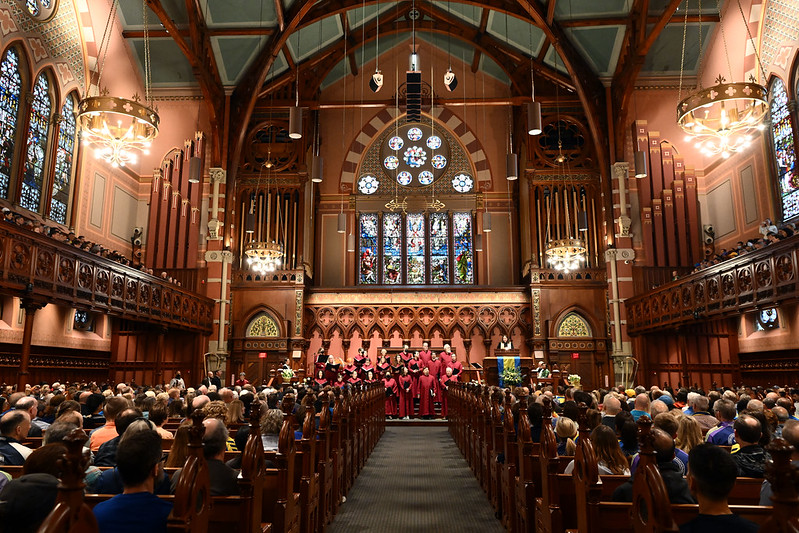
Old South Sanctuary (photo by Sarah Musemuci)


Copyright © 2009, Old South Church and by author.
Excerpts are permitted as long as full accreditation is made
to Old South Church and to the author.


Old South Sermons:

Embodied

by Rev. Nancy S. Taylor, Senior Minister

Based on John 20: 19-31 (Jesus appears to the disciples and Thomas)

Marathon Sunday and Blessing of the Athletes
April 19, 2009

Listen to this sermon


She stepped onto the stage and the audience instantly sized her up. She was frumpy and silly. She was unsophisticated in movement and in her appearance. She hailed from an insignificant Scottish village. Can anything good come from such a village, we wondered?

She was going to bomb. Big time.

The cynical, nay, snide hosts of the show, Britain’s Got Talent, rolled their eyes and guffawed. The audiences –  the live U.K. audience and those of us who watched her performance on YouTube – pitied her and feared for her.

And, then, well, you know what happened. Google reports that “Susan Boyle” is the fastest-rising search term in the Boston area and the second fastest-rising search term in the world.

How many of you have watched this video? (most of the congregation raises hands)

So you know what happened. The music started up and Susan Boyle (a frumpy, silly, unsophisticated church lady) launched into “I Dream a Dream” from Les Misérables. She transported us. She blew the roof off the house.

In the process, we shamed ourselves. Shame on us for presuming to pity her, for presuming to judge her, for presuming to fear for her because we thought we knew what sort of package was required for that sort of performance. We presumed that she didn’t have it in her. We were wrong.

It is precisely because we so easily surrender to this temptation to render hasty judgment, to pigeon-hole people, to size them up … that every Thursday evening, here at Old South, at the beginning of our Jazz Worship Service, we bend over backwards to offer a wide, specific welcome to everyone. Week after week, Thursday after Thursday, in our candle-lit, jazz-infused stone chapel, this is what we say:


Welcome to those with no church home, to old friends of Old South Church, and to you who have traveled far.  Welcome to casual observers and committed Christians. Welcome to believers, questioning believers and disbelievers. Welcome to seekers after meaning, music or retreat. Welcome to people of all ages, hues, origins, abilities, and social locations no matter who you love, or what kind of body you have.

My colleagues and I spent considerable time discussing this greeting and, in particular, the final phrase (no matter what kind of body you have). We tweaked it and massaged it, trying to get it right. We may or may not have gotten it right, but we do know it communicates an unblinking welcome to persons with disabilities, to persons whose bodies are not likely to make the cover of Vogue, Glamour or Elle, to persons who eat too much and those who eat too little, to persons who drink too much, to persons wracked by illness or pursued by pain, to persons who have not had the benefit of training in etiquette and poise, and to transgender persons who bodies may defy conventional definitions of male and female.

“Welcome … no matter what kind of body you have.”

When we devised this greeting, we were not thinking of Susan Boyle and her frumpy, middle-aged, church lady’s body. Though we might have been.

Nor were we thinking of Marathon Sunday. Though we might have been. We were not thinking of the 22,000 runners who annually descend         upon Boston …a great many of whom are instantly recognizable by their bodies – bodies that cut a strikingly different profile than do many of ours – for they are long and lean and exceedingly fit.

The Marathon is all about bodies, the human body. The rare beauty of this contest is its bare, spare human simplicity. There are no balls or pucks, sticks or bats, hoops or nets, rackets or pads, helmets or shin guards. Just lungs and legs, muscles and hydration, calories … fuel.

But the truth is that among the 22,000 who will start tomorrow’s race, there are all kinds of bodies: old ones and young ones, tall ones and short ones, lean ones and generous ones, blind ones and sighted ones, frumpy ones and elegant ones. Among tomorrow’s runners will be those whose bodies carry cancer and veterans who have lost limbs. Among those who manage to propel their bodies all the way from Hopkinton to Boston, some will run, others wheel, others walk, some will be pushed, others carried, still others accompanied … and there will be some who will crawl across the finish-line tomorrow on their knees.

There are people who, without giving it too much thought, assume that marathoners have perfect bodies. You, who are runners, know otherwise. Marathoners do not have in common perfect bodies. What marathoners do have in common is an unusually high tolerance for pain. What marathoners have in common is will-power and grit, tenacity and fortitude. Also common to marathoners: a ravenous interest in vast quantities of carbohydrates … and a curious and near universal fascination with black tights.

Speaking of bodies, today’s story from the Gospel According to John paints an image of a surprising, astonishing body. John paints for us a picture of Christ’s body, Christ’s resurrected body. What is astonishing is that it is a broken body: wounded, impaired, imperfect. Not what one was expecting in a Savior!

Having suffered beating and crucifixion, death and burial, Jesus appears to his disciples embodied … inhabiting the same body they know and recognize. But here’s the thing: his resurrected body is damaged. The wounds are still there. There are holes in his hands and a gaping gash in his side.

You might have thought that resurrection would have fixed these things! You might have thought the resurrected body would be a perfect body: glorious, shining, flawless … blemishes erased, wounds healed and scars eliminated. But that’s not what John tells us. That is not what the disciples experienced.

To the disciple named Thomas – the one who doubted that Jesus had been raised from the dead – Jesus appears and says: “Put your finger here and see my hands. Reach out your hand and put it in my side.”

And so it is that Christians hold on to an astonishing claim: that God deigned to put on the self-same flesh we wear … and to experience the limitations of this flesh: pain, hunger, blisters, cramping, brokenness, mortality.

And not only that, it looks as if we will carry in our bodies into eternity our blemishes and imperfections. But that’s okay … these are, after all, how we know each other … and how we know ourselves.

It is a coincidence, but not an unhappy one, that the trinity of today’s assigned text, and the Boston Marathon, and Susan’s Boyle’s unlikely triumph all shine a bright light on the human body. We are, after all, embodied. That is the most elemental thing we know about ourselves. It is, of course, precisely why Christ came clothed in flesh.

The particular, peculiar bodies we each inhabit, the space which our bodies occupy in the world, the way we move, the way we feel … these are as personal and intimate to each of us as the skin upon our hand, and color of our skin and the way we are a woman and the way we are a man. These are our way of being … effecting what we know, what we believe, whom we love, what we can and cannot do.

The particular, peculiar bodies we inhabit will shape and influence the various ways some 22,000 runners will power themselves from Hopkinton to Boston. But more than that, it is these bodies – the particular configurations of flesh and bone, muscle and organ – that shape and influence the way we live, the way we minister, the good we do, the lives we lead, the individuality we each embody.

On Thursday evenings we say to one another: “Welcome … no matter what kind of body you have.”

We say this to one another, because we learned this kindness, this compassion, this openness, this generosity of spirit (not from the world, not from contemporary culture, not from TV or Hollywood or Madison Avenue) ... we learned it here, in church, with each other, among the members of this broken body of Christ. We learned it from our God whose greatest act of compassion was to put on this flesh and wear it … even into eternity.

_____________________

Note: I am indebted in this sermon to theologian and author Nancy L. Eiesland, The Disabled God: Toward a Liberatory Theology of Disability: Abingdon Press, 1994. Eiesland claims that the resurrected Christ – this disabled, embodied God who returns to us complete with wounds – represents “a divine affirmation of the wholeness of non-conventional bodies.” (p.87) “Our bodies participate in the imago Dei,” Eiesland wrote, “not in spite of our impairments and contingencies, but through them (p.101)


Copyright © 2009, Old South Church and by author.
Excerpts are permitted as long as full accreditation is made
to Old South Church and to the author.

Old South Church
645 Boylston St. Boston, MA 02116
(617)536-1970 Tel (617)536-8061 Fax

You can E-mail us by clicking here: OSC Communications

Copyright © 2009, Old South Church