The Old South Church in Boston

Blessing

Sermon by the Rev. Dr. Nancy S. Taylor

February 20, 2005
Second Sunday in Lent
Genesis 12. 1-9 and John 3.16
 
I invite you to come with me on a journey. We begin our journey, in this church on the third floor, in my study, this past Friday. All week I have worked to save this time: to guard and defend it from an inexorable encroachment of meetings and administration. I have saved this day, for reading, reflection and sermon preparation.

The door is closed and I am reading the Rule of Benedict. I am reading Benedict’s chapter on the Porter of the monastery. It is a marvel that one of the great documents of Western Christendom has an entire chapter devoted to answering the door.  Benedict describes the qualities required of the monk who might be assigned this most important post. As we are renewing our own efforts at hospitality and welcome at Old South, this is an excellent resource.

Visitors, says Benedict, should always find the porter there to greet them, no matter what time of day or night. When a visitor arrives at a Benedictine monastery, whether a nobleman or a pauper, it is the Porter’s job to warmly greet the visitor, saying: “Your blessing, please.”

In the Rule of Benedict, the visitor is a blessing, no matter who the visitor is, no matter when the visitor arrives, no matter what the visitor’s business or need.

Moreover, there is no inopportune time to visit a Benedictine monastery. It is just fine to arrive in the middle of lunch; to arrive in the middle of prayer; to arrive in the middle of the night. There is never an inconvenient time to bother a Benedictine monastery with the blessing the stranger inevitably brings.

My reading is interrupted by a knock on my door. Assuming it is a member of staff, I open the door, but find myself face to face with two strangers. They introduce themselves, explaining that they represent the Poor People’s United Fund, with an office in Old South. They wonder: can they come in to meet me and introduce themselves?

I am about to say no. I am starting to excuse myself and explain that I cannot meet with them right now, when one of them notices I am reading the Rule of Benedict and she tells me that she is a former nun. I am caught … caught red-handed trying to close the door on the very kind of blessing that Benedict describes. Reluctantly, I let them in.

As I listen to and learn from these two unexpected visitors from the Poor People’s United Fund, it dawns on me that they – and through them, we – are a blessing to others. Through their ministries with some of the most needy people in Boston – people who have been left behind and left out –  they are doing God’s work, bestowing the blessings of goods and services to those whom Jesus called, the least among us. They open my eyes to another facet of the community of Old South … and I see again with new eyes how this community is and can be a blessing to others.

Come with me now as our journey takes us to a Boston hospital. A Christian medical doctor from Tanzania is on a ten-week visit to the United States. He is hosted by Boston-area congregations. As a part of his tour he visits a hospital. As he enters the first unit, his eyes visibly widen as sees that each patient area is bristling with outlets, equipment and supplies, and bustling with personnel. In his mind’s eye, he contrasts what he is seeing here with the hospital in which he works in Tanzania: a 200-bed facility, which has too few supplies, too little equipment (none of it state-of-the-art), and too few trained personnel.

As he stands there, amazed and, frankly, envious of these life-saving and pain reducing facilities, he hears what has become for him an odd but familiar litany since arriving in this country. From a patient’s television, someone intones, God bless America. Puzzled, the doctor turns to his American hosts and asks, “God has already blessed you so much. Do you want more?” A Boston MD, a member of one of our churches in Massachusetts, looks quizzically at this doctor from Tanzania, not quite taking in his question.

The visiting doctor patiently explains the biblical concept of blessing. In the Bible, he says, a blessing is not merely a polite wish or a good idea. Biblically, a blessing is an act of transferring power – the power for life.  To say, “God bless you” is not merely to wish you well, it is an act by which I transfer some of my own material well-being to you … for the purpose of enhancing your life and maybe even saving it.

Come with me now, as we follow that Boston MD to his church in the suburbs. On a Sunday morning, he is leading a Bible study class. He is teaching the story of God’s call of Abram. Abram, he says, is called for a very specific purpose: to be a blessing to all the families of the earth. He then explains that the biblical concept of blessing comes from three observations.

The first observation is that God’s world teems with life. The earth is fruitful. It is alive with things that grow and eat and can be eaten. The air, too, flutters and buzzes and flaps with life and food. The waters swarm with the fruits of the sea. All around us there is fecundity and abundance.

The second observation, he explains, is that there is, in fact, enough to go around. There is enough for all … if only we summon the will to share it equitably with the others with whom we share this planet.

The third observation is that everyone has something to offer. We can all give, explains the MD, just as we all receive. We are each a blessing, just as each of us is blessed.
Turning to the story of the call of Abram, the MD explains that before Abram appears on the scene, things had gotten out of kilter.

In the beginning, God fashions things and people and then, more or less lets them run on their own. But almost immediately, things go awry. Adam and Eve disobey God and are expelled from the Garden; Cain kills his brother Abel; the peoples of the earth devolve into such sinfulness that God floods the earth to wash it clean; then, there is the sorry story of the Tower of Babel … a story about human pride. The peoples of the earth are divided, scattered and do not understand each other.

God, who called the world into being in the beginning of time, now calls again. This time, he calls to Abram. The purpose of this call is to try again, to start over, start afresh.  This time, God will try a partnership. They will work at it together. To mark this new beginning, this partnership, God gives to Abram and Sarai, a blessing, and through them, God promises to extend a blessing to all the peoples of the earth.

As a sign of this blessing, God gives Abram and Sarai new names. From now on, they will be Abraham and Sarah.

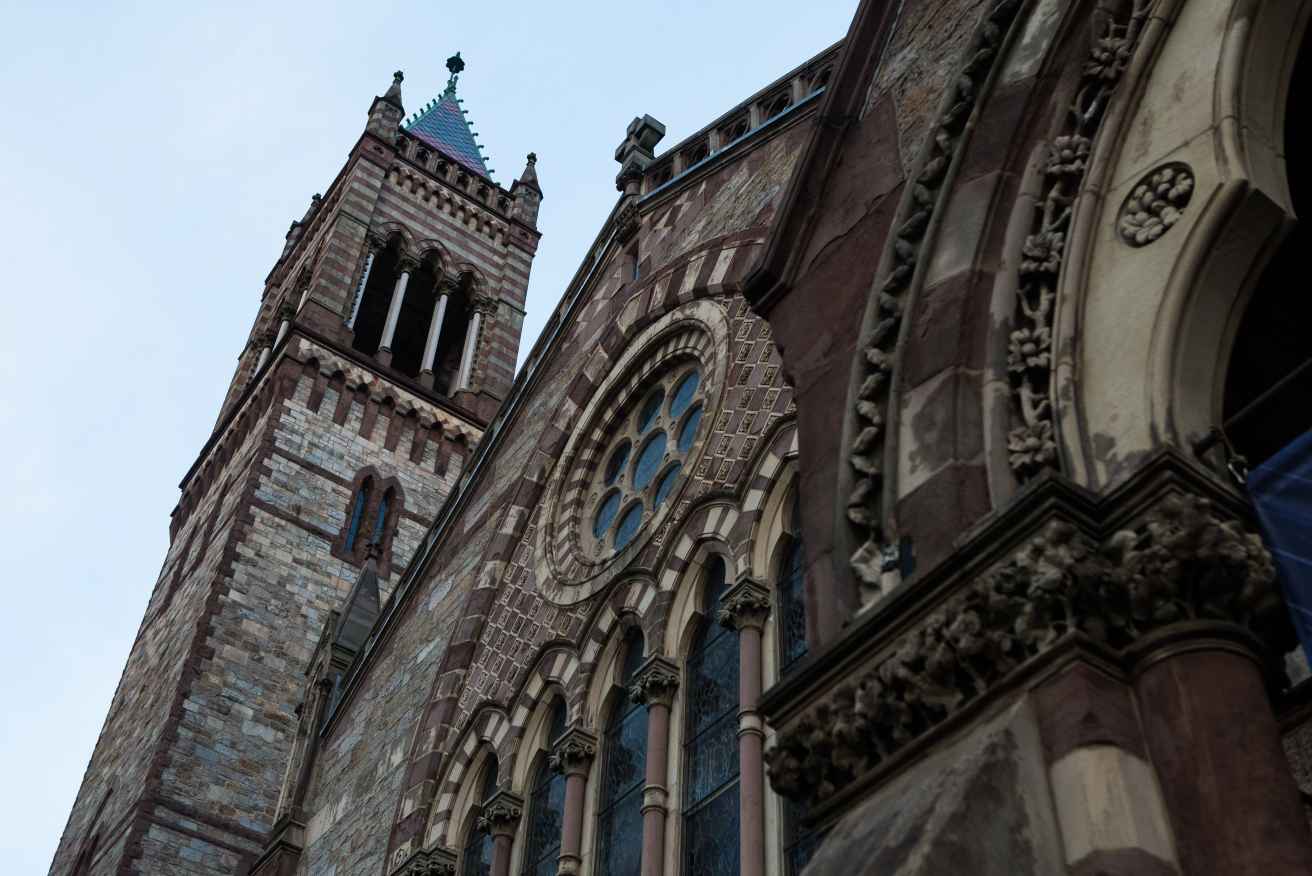
I invite you now to join me as we visit the last stop on our journey this morning. We are looking at a beautiful, tall tower – a steeple – in the midst of a city. This tower is a sign to strangers and visitors, to the least and lost, that the blessings of God – first given through Abraham and Sarah – still come through God’s people.

People enter this place seeking different kinds of blessing: the blessing of prayer, conversation, food, help, hope, direction, and comfort. They come to be married, buried, baptized, challenged and fed at the table. They come out of curiosity, out of despair, out of joy, out of need, out of grief, out of hope.

They also come asking that this people bring the blessing of God’s concern for all the peoples of the earth into our national and public life: to matters of housing and healthcare, to public education and civil rights, to questions of war, disease and famine. They come to us, begging that we weigh in on matters of life and death and wellness … that we do so in the name of the God who created an earth that has enough for all.

That is to say that the people who come to this place with the tall tower, sometimes come for things that are tangible: like food. And they sometimes come for things that are intangible: like hope. Both are necessary for the well-being that God intends for all God’s people. To be a true blessing in the biblical sense, we cannot but offer both.

Within the family that gathers here, all of us, in one way or another, are called to serve as Porters in the name of Christ who is our host. May those who come to visit find us at our posts, offering them a warm and ready welcome.

As the descendants of Abraham and Sarah, we are richly and wonderfully blessed by God. May we, in our turn, be a blessing to others.


Copyright © 2005, Old South Church and by author.
Excerpts are permitted as long as full accreditation is made
to Old South Church and to the author.

Back to Sermon Page

The Old South Church in Boston
645 Boylston Street
Boston, MA 02116
(617) 536-1970