A sermon by Nancy S. Taylor, senior minister, preached
at the Old South Meeting House
on the occasion of the 50th Anniversary of the congregation’s
return to their historic home.
November 20, 2005
Fifty years ago today, from this pulpit, Dr. Frederick Meek, then senior minister of the Old South Church, opened his sermon with these words: “A sermon in the conventional sense is almost impossible today, because of the circumstances under which we gather – the return of this congregation to its second church building for a service of divine worship, after an absence of eighty years.”What Dr. Meek then said to that congregation, I also want to say to you today on this fiftieth anniversary of our, now annual pilgrimage to, this meeting-house: “Here our fathers and mothers worshipped God. Here their children were baptized. Here were said the last rites for the dear and holy dead.”
If that were not enough, there is more. As a sign once fixed to this meeting-house proclaimed: “Here were held the town meetings that ushered in the Revolution. Here Samuel Adams, James Otis and Joseph Warren exhorted. Here the men of Boston proved themselves independent courageous freemen worthy to raise issues which were to concern the liberty and happiness of millions yet unborn.”
Yet, there is more. Here worshipped Elizabeth Vergoose, also known as Mother Goose, who imagined stories and rhymes that delighted generations of children. Here, were nurtured the literary aspirations of Phillis Wheatley – former slave, baptized in this church – who became the first published African American poet. Here, as a minister of this church, Thomas Prince collected one the greatest libraries of early New England. Here, on this site, Benjamin Franklin was baptized on the day of his birth. Here, Rev. Thatcher, penned “the first medical tract in British America” to help people to cope with measles and small pox. Here, a member of this church, Judge Samuel Sewall, wrote and published the first anti-slavery tract in America.
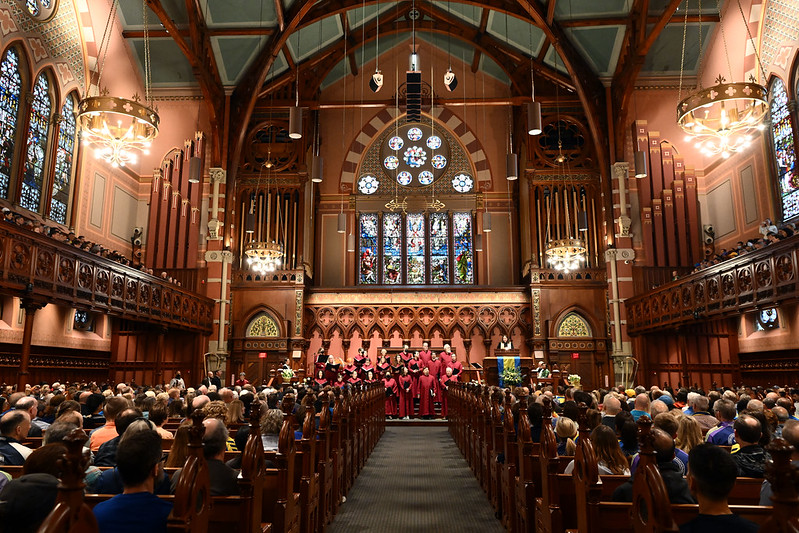
The Protestant Reformers described the congregation as a “mouth house”. “Mouth house” was a phrase Martin Luther coined to capture and express the importance Protestants placed on the living Word, on preaching and speaking. You can see that commitment expressed here in the architecture. There is neither altar nor communion table. Here the pulpit is high and large and central. Here the Word is given space to live and breathe, to come alive in each new day.
Indeed, it was from this mouth house – not only from the pulpit, but also from the floor and the galleries, from the pews and the aisles, from the windows and the doorways – that this place has given voice to common people as well as members of the aristocracy, to the learned and to the illiterate, to slaves and women and gays, to communists and socialists, to revolutionaries and patriots, to suffragettes and immigrants. Freedom of speech and freedom of the press, religious freedom and civil rights have all been debated, defended and pronounced from this pulpit and in this house.
Fifty years ago Dr. Meek averred, “no other meeting-house in America has witnessed as many significant patriotic gatherings in the formative days our history.” John Fiske, a distinguished historian of the 19th century proclaimed that in historical significance, Old South Meeting House has only one possible rival in America, and that is Independence Hall in Philadelphia.
It was from the meetings that were held here in the 1700’s that this reputation largely arises. As tension between British loyalists and patriots intensified, as the Colonialists felt increasingly oppressed by British taxes and threatened by armed regiments of redcoats in the streets, they began to meet together. The meetings that led to the Boston Tea Party began at Faneuil Hall, but quickly outgrew that space. The packed meetings were relocated to the largest building in Colonial Boston, the Old South meeting-house.
On the day of December 16, 1773, historians claim that between 5000 and 7000 men were packed into this building, or jammed in doorways, or climbing in through the windows. Imagine that if you will. Look around. There are perhaps 500 people here this morning. But there were 5000 to 7000 here at that open public meeting. Of course, the galleries were larger then, the pews differently configured and the people were smaller! The room was packed with royalists and patriots, people arguing both sides of the tea debate, many of them were armed and tensions were high. After hours of debate and attempted negotiations with the Governor, Samuel Adams gave the signal to dump the tea into Boston Harbor.
At its best, a “mouth house” is always more than that: as words inspire and impel action. The Boston Tea Party was America’s first act of civil disobedience, and act inspired and impelled by words.
Other kinds of public meetings were held here as well. Over the course of time, the ministers and congregation opened the doors of this meeting-house to the public for many occasions important to the aspirations and circumstances of the people.
For instance, when news reached Boston of the surrender at Appomattox in April of 1865, this meeting-house was opened for a public service of thanksgiving. The sermon that was preached and the doxologies that were sung, gave expression to the joyous feelings of the city.
The following Sunday, upon of the news of the assassination of Abraham Lincoln, the church was again opened to the public, this time for a memorial service. The pulpit was draped in black and the minister preached a sermon that gave expression to the grief of the whole city.
In the later 1800’s, however, the Old South congregation regretfully concluded that this place could no longer serve their needs. The building was too small, and the area surrounding it had grown noisy, dirty, unsafe, congested. And it was smelly: the stench of nearby taverns and fish-houses wafted in. Moreover, once a residential section of Boston, by the mid-1800’s, the area was almost entirely commercial, meaning that church members no longer lived in the vicinity.
It was extremely painful to contemplate leaving this historic building. In the end, however, after arguments and prayers, sermons and speeches, after litigation, remonstrations, protestations and demonstrations – the congregation finally relocated to our new home in Copley Square, the New Old South Church.
The decision to move was protracted, painful, litigious and public. The people of the city and region felt they had a say in where this congregation resided. Enormous outside pressures weighed on the congregation to remain here. But the congregation understood what others did not: that while this building was of unparalleled historical significance, the congregation needed new space to stretch its wings and to live, not for the past – glorious though it was – but for the future.
And so it was that when the congregation departed this place that had served them and the nation for over a century, they carried with them, to the Back Bay, the heritage of this meeting-house. They carried with them the names, the plaques, the portraits, the sermons, the histories, the records, the stories, the books, the silver and the clock. They carried the legacy of those worthies who had consecrated this place by their courage and vision.
The New Old South congregation is surely still a “mouth house” where we continue to debate, exhort and proclaim on the issues of the day. Over there, in their new home, the congregation and ministers wrestled with segregation, bussing, and the Vietnam War. There they advocated justice for janitors, supported the building of affordable housing, and advocated on behalf of excellent universal public education. From there the congregation continues to speak out on gay rights and equal marriage, on issues of poverty and racism, on war and peace. There in the Back Bay, we continue to find our voices as a living, lively, passionate, “mouth house” where issues of the day are given voice and where words continue to inspire action.
Today, we pause to give thanks for the saints of old whose courage was nurtured here by preaching and teaching; whose hope of heaven was kindled here by the sacraments of communion and baptism; and whose passion for justice was ignited here by the words of the prophets.
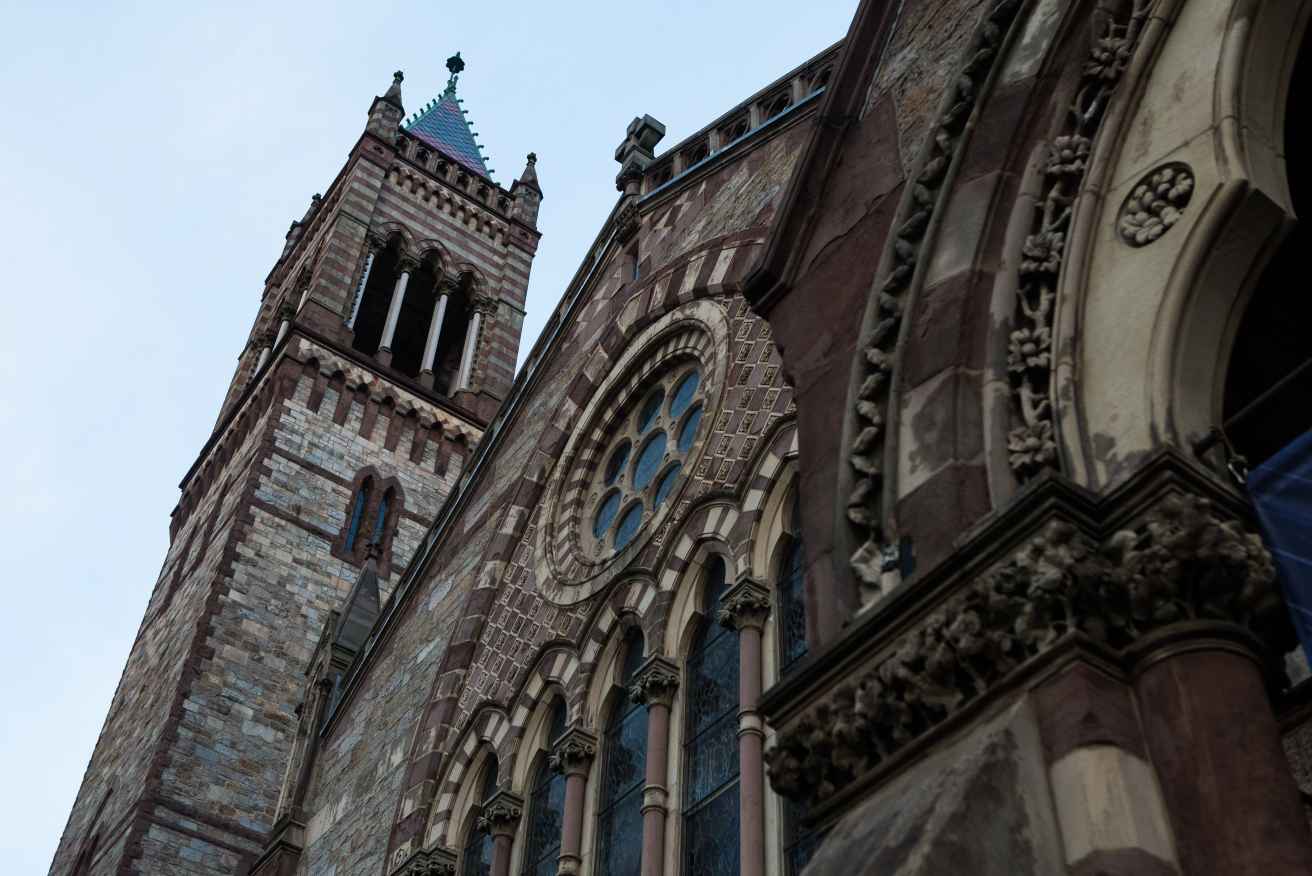
We give thanks, too, for our new meeting-house: larger, in a more advantageous location: with classrooms, meeting rooms, kitchens, offices, a library, a theatre, and not one, but three sanctuaries. We give thanks for those whose vision was claimed not by the past, not by what had been, but by the future, by what yet could be.
The sign that once hung here, described our patriot forebears as “worthy to raise issues.” But I have news for you: they felt no more worthy in their day than we feel in ours. Their letters and journals expose their questions, their lack of confidence, their uncertainty about the outcomes of the events they were setting in motion. Yet, look what they achieved!
They depended for their courage – not on any sense of their own worthiness – but on God, on each other and on the justice of their cause. And so it was, that their words were transformed into deeds, and their speeches, sermons, prayers, poems and tracts were translated into justice.
Inspired and measured by our forebears, may we take up their mantle: turning words into actions and ideals into justice for the sake of God’s future.
Sources
Hill, Hamilton A. History of the Old South Church. Boston, 1669-1884, vols. I, II.
Winslow, Ola Elizabeth. Old South Church in Boston, 1669-1969
“An Architectural History of the Old South Meeting House”, ed. Betlock, Curran, Schwerdtfeger, Weiner
“Tea is Brewing: A Guide for Teachers,” The Old South Meeting House
“Old South Church in Boston: A Special Place in History,” by S. T. Campbell and K. D. Campbell
Copyright © 2005, Old South Church and by author.
Excerpts are permitted as long as full accreditation is made
to Old South Church and to the author.