Old South Banner
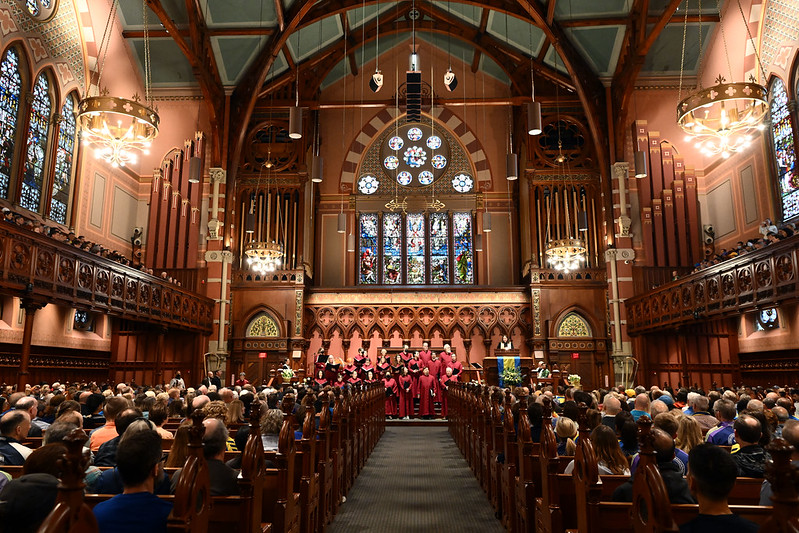
Old South Sanctuary (photo by Sarah Musemuci)


Copyright © 2009, Old South Church and by author.
Excerpts are permitted as long as full accreditation is made
to Old South Church and to the author.


Old South Sermons:

God Wills This Contest

by the Rev. Dr. Nancy S. Taylor, Senior Minister

Based on Mark 9:2-9, the story of the transfiguration of Jesus

Sunday, February 22, 2009

Listen to this sermon


There were thousands of people crowded into the make-shift shed … men, women and children. They shouted and cried, swayed and shook, in response to the words of the fiery pulpiteer … the evangelical preacher: Peter Cartwright.

Cartwright, a gifted, powerful, emotional preacher – who was also, by the way, running for Congress – had been preaching for some time. He could feel the power of his own words and knew he had all those quaking souls in the palm of his hand. Timing it perfectly, he shifted effortlessly toward his dénouement.

Cartwright invited all those who were bound for heaven to rise. A thunderous roar shook the shed as almost everyone rose. He then called upon those who were bound for hell to rise. A hushed silence fell upon the place … and there was scarcely any movement.

Cartwright fixed his gaze upon a lone, tall, gaunt, black-haired, black-clad man … a man who had remained seated, who had not given in to shouting or hallelujahs, to Amen’s or confessions … a man who had neither stood for heaven nor for hell. Cartwright fixed his eyes upon his opponent (the very man against whom Cartwright was running for Congress … a man whom Cartwright had publicly called an infidel). Cartwright fixed his gaze upon his opponent and singled him out:

“Mr. Lincoln, you have not expressed an interest in going either to heaven or hell. May I inquire as to where you do plan to go?”

Slowly unfolding his long limbs, rising to his full height and now looming above the hushed crowds, Lincoln replied:

“I did not come here with the idea of being singled out, but since you ask, Sir, ... I intend to go to Congress.”[1]

Religious historian, Martin Marty, has described Abraham Lincoln as “our most religiously profound president.”[2]

Mike McMannus, columnist for the Wall Street Journal, claims that Lincoln is “America’s most Biblical president.”[3]

These are remarkable statements given the fact that historians argue over Abraham Lincoln’s religious credentials. There is no agreement among historians as to whether the 16th president was a Christian, a deist, a Spiritualist, a skeptic, or, as his opponent in the race for Congress charged, an infidel.

Lincoln’s wife, Mary, posthumously claimed her husband was indeed a Christian,
while Lincoln’s closest male friends and colleagues suggested otherwise.

Close associates of Lincoln said of him that while he was not a “technical Christian”
(meaning: he had not formally joined a church or made a public confession of his faith) he was indeed a religious man.

Lincoln was never baptized. He did not join a church and he rarely, if ever, mentioned Jesus.

We do know that Lincoln was well-versed in the Bible and was able to quote from it and allude to it with a deft intelligence … allowing the resonance of familiar sacred texts to infuse his oratory and inspire a manifestly Christian nation.

We also know that while Lincoln never formally joined a church, his family did own a pew and thus supported their church … (a practice, by the way, with which I concur. While we would like it if you all were to formally join Old South as full members, we do not require that before you support our mission and our ministry. Let the good Mr. Lincoln be your model!)

At the same time as Mr. Lincoln was running for Congress in Illinois, a young woman, enslaved on a Virginia plantation, was secretly learning to read.

Like many enslaved persons, Selma had been instructed by her master in the Christian life. As texts for his biblical instruction, the slave master taught from selected passages in the letters and a few in the Gospels. Nearly all of these passages, Selma later wrote, were about submissiveness, humility, subordination, obedience, guilt and sin. She was taught that enslaved persons were to be obedient to their masters, that she was filled with evil, rotten to the core, and that only hard labor could save her soul and discipline her body against the wiles of the devil.

Over time, and with the aid of another enslaved person, Selma secretly learned to read.  The Bible was her primer: the only literature available to her.

She read at night, when the household was asleep. She would steal outside, the contraband Bible hidden in her skirts, and read when there was enough moon to fall upon the pages. In her furtive reading Selma came across those passages by which her master had instructed her: Slaves, be submissive to your masters! Men are the head of the house!

But then she happened upon other sentiments. She discovered Paul’s words about how in Christ there is neither Jew nor Greek, slave nor free, male nor female. She cried when she read that God in heaven had heard the groaning of the slaves in Egypt. She thrilled to follow the unfolding story of how Moses confronted Pharaoh, and the freeing of the slaves. She read the account of the creation story in Genesis and discovered that, contrary to what she had been taught by her master, she was made in the image and likeness of God … that she was good, very good.

Needless to say, Selma did not keep these revolutionary discoveries to herself. She shared this news, the good news, with others who were enslaved. Over time, it was these words, from this book, that prepared Selma and her fellow captives for the contests that were to come: the nation’s contest over abolition and union, but also the inner contests between fear and courage, enslavement and bondage, good and evil, life and death.

It was Lincoln’s deep knowledge of the Bible was among the things that enabled him to enter and face the contests – both personal and national – that so marked his life and the times in which he lived.

While others were busy claiming God was with them, on their side, it was Lincoln’s deft, intelligent reasoning that enabled him to allow that it was quite possible that God’s purpose was something different from the purpose of either party.

There is the famous conversation between a pious minister and Lincoln. The minster exclaimed that “he hoped the Lord is on our side,” to which the president responded: “I am not at all concerned about that… But it is my constant anxiety and prayer that I and this nation should be on the Lord’s side.”[4]

In his Second Inaugural Address (March 1865), Lincoln reminded the nation that “both North and South read the same Bible … both pray to the same God …”and then wondered how it is “that each invokes God’s aid against the other.”

He argued that God had it within God’s power to give victory to either side at any time,

but that it was entirely possible, even understandable, that God willed the human contest of the Civil War … willed that humans would come to their own conclusion about these matters of life and death and liberty.

This is a remarkable theological insight and commitment.

If Lincoln was right – if God willed the contest between north and south, slavery and abolition, union or disintegration – if God willed the contest, and wills that we in our day equip ourselves for and engage in the great contests of our time, then we will want to know God, to know our holy book, to become as fluent and at ease in its pages and stories as was Lincoln. We will want to enjoy a personal acquaintance with the likes of Priscilla and Aquila, with Lydia and the Mary’s, with the Sons of Thunder as with Blind Bartimaeus. We will want to familiarize ourselves with the contests between Peter and Paul, and the differences in Jesus presented by Mathew, Mark, Luke and John.

In the middle of Mark’s Gospel is the story we read today: the story of the transfiguration of Jesus. Jesus, on a mountain with Peter and James and John, is transfigured before them. His face shines, his clothes are dazzling and he is observed in conversation with Moses and Elijah.

We learn later that this moment, this vision or theophany, served to prepare Peter, James and John, as well as Jesus, for the contests that were ahead of them: for the arrest, humiliation and crucifixion of Jesus. It also prepared Peter, James and John for the personal contests they would undergo as they endeavored to carry on and grow the church in the absence of Jesus and, then, too the contests they would later face of oppression and martyrdom.

Next Sunday, March 1st, is the first Sunday in the Christian holy season of Lent. Lent is intended as a season of preparation and formation as Christians prepare for the events of Holy Week and, finally, for the celebration of Easter.

 
The season of Lent is intended to prepare us for the contests of the Christian life: for our own battles, whether we join the large public contests of our day, or whether our battles are intimate and lonely: contests with aging and grief, with illness or financial distress or the inner demons of the mind and heart.

We are inviting Old South members and friends (you need not own a pew to participate!) to embark upon journeys not unlike those of Selma and Lincoln … journeys with our holy texts, with the narratives of our faith, with the biblical saints and sinners who preceded us … so that like Selma in her situation and Lincoln in his, we are equipped to do battle with the forces of good and evil that are around and within us.

In our tradition, this non-hierarchical tradition, we cannot make you read the Good Book.

We cannot require it, or insist on it, or assign it. No, we in the UCC are limited to the use soft verbs … but we have many of them. We can ask, urge, beg, plead, exhort, implore, invite, recommend, advise and pray that you join us in this Lenten undertaking.

Liz Myer Boulton, Quinn Caldwell, Patricia Hazeltine, Harry Lynn Huff and Nancy Taylor, severally, collectively and publically, do hereby, from our knees, ask, urge, beg, plead, exhort, implore, invite, recommend, advise and pray that the members and friends of Old South Church in Boston take on the Lenten discipline of reading, in turn, the Gospel According to Matthew, the Gospel According to Mark, The Gospel According to Luke and the Gospel According to John.

We will have six weeks to read four Gospels. If Selma could do it furtively, at night, squinting by the light of the full moon, surely we can do it with 60 watt bulbs and warm homes. Not only will it do you good … it will do God good … and it will do the world good … equipping and preparing us for the contests ahead.


[1] Abraham Lincoln: the Prairie Years, by Carl Sandburg (1926)

[2] Martin E. Marty, “Sightings,” 2/16/09

[3] Wall Street Journal, February 4, 2009, “Lincoln at 200: America’s Most Spiritual President, column by Mike McMannus

[4] Six Months at the White House, but F. B. Carpenter, (p. 282)


Copyright © 2009, Old South Church and by author.
Excerpts are permitted as long as full accreditation is made
to Old South Church and to the author.

Old South Church
645 Boylston St. Boston, MA 02116
(617)536-1970 Tel (617)536-8061 Fax

You can E-mail us by clicking here: OSC Communications

Copyright © 2009, Old South Church