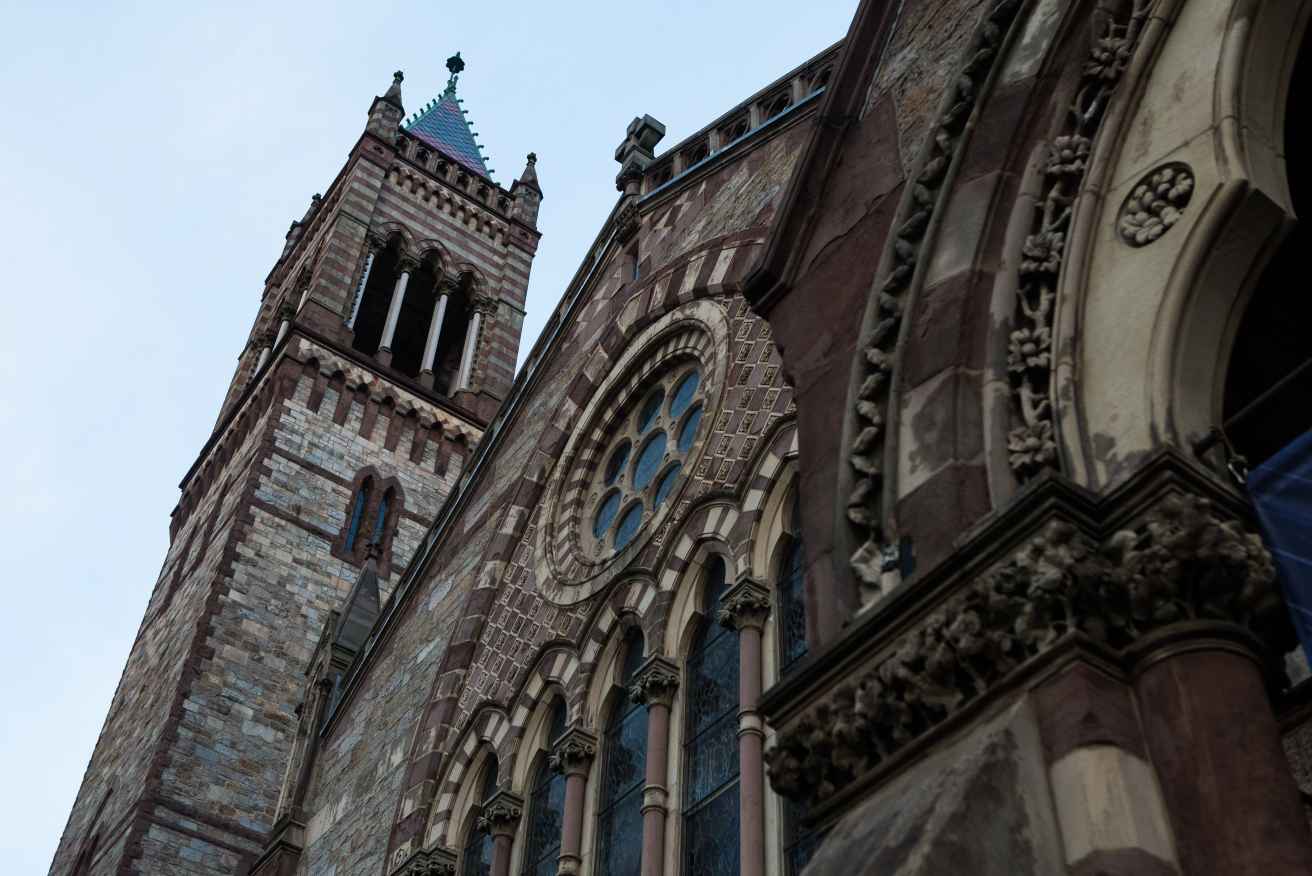
The Old South Church in Boston

A Dangerous Undertaking

A Sermon by Rev. Nancy S. Taylor

July 22, 2007

Based on Luke 10: 38-42

Listen to this Sermonmp3 file


Church historian Martin Marty tells of a time, early in his career, when he was assigned the job of raising money for the Divinity School for which he worked. Before doing so, he posed this question to one of his colleagues: Given all the ills in the world, on what grounds can I justify asking for money to fund the graduate study of religion? Without hesitation, his colleague answered in this way: On the same grounds as those for undertaking sex education. Sex, if you get it wrong, is very dangerous. So is religion.

The Buddha – founder of one of the great world religions – warned that understanding his teaching is like trying to handle a venomous snake. If you don’t know what you are doing, it can bite you or, worse yet, it can bite an innocent bystander.

Religion can be dangerous. Ask the so-called witches from Salem or the survivors of 9/11 or anybody in the Middle East.

In a recent book entitled Religious Literacy, author Steven Prothero claims that American’s are religiously illiterate. We are religiously illiterate, he claims, both about our own religions and about others.

Prothero, who is chair of the Religion Department at Boston University, reports that most Americans, even Christians, cannot name one of the four Gospels. Ten percent of Americans believe that Joan of Arc was Noah's wife. Such ignorance, while laughable, can also be perilous. Why? Because religion, writes Stephen Prothero, "is the most volatile constituent of culture" and, often "one of the greatest forces for evil" in the world.

The religiously illiterate are bound to get religion wrong.

If you get it wrong, religion can be very dangerous, indeed.

If we are as ignorant as Prothero claims, then what do we know about religion and were did we learn it? I cannot speak for you, but I know that I receive more information about religion from the news media than I would like to admit. I am something of a news junky so I listen to a lot of news and I read news.

What I hear and read is that Islamic extremists are violent. They use guns, bombs, cars, planes and their own bodies to wreak death and terror. I hear and read that Christians in America are in favor of prayer in public schools, are opposed to the theory of evolution and in favor of creationism.

I know better than to believe that all Muslims are violent ideologues. I know better than to believe that all Christians are biblical fundamentalists who read the first chapters of Genesis as history rather than story. I know better … nevertheless, the images of Islam and of Christianity with which I am daily saturated cannot help but to shape and inform my understanding.

I sometimes forget is that the news media are in the business of selling news. While kindness is not generally considered newsworthy, death and destruction are. The news media are, by definition and by design, disproportionately disposed to reporting on the extreme manifestations of religions.  They are not in the business of educating us about what is normative in each other’s traditions. They are not educational institutions.

If Steven Prothero is right, we cannot depend on what we think we know about each other, because we probably don’t know enough.

Similarly, we cannot depend on journalists to inform us about each other, because while journalists can be counted on to report on each others’ worst behaviors, they rarely report on each other’s best behaviors.

What is so wonderful about today’s story from Luke’s gospel is that Mary is determined to learn something about her religion … not from a book or from reporters or even from friends or family. Mary seeks first-hand information. She finds herself hosting a renowned rabbi and she is resolute in her commitment to learn from him everything she can. Like a sponge, she is soaking it in: every word, teaching and story. She will not waste this precious opportunity.

Did you notice the radicality of this little story? In this story Jesus is received into a woman’s home. It was not permissible in the first century for women to receive visiting men or, for that matter, to sit at the feet of rabbis. If Mary had been a good Jewish woman and Jesus a good Jewish man, this scene would never have occurred. Instead, Mary would have – should have – contented herself with hearing about Jesus second-hand from male family members … perhaps from her brother, Lazarus.

But you know what happens when you depend on others to inform you. It is like the game of telephone. Second hand information, passed from one to the other, has a tendency to get changed. Words get dropped, others added, emphasis is imposed, nuance is lost … and each messenger of the news has a hand, sometime unconscious, in editing, altering, tweaking, spinning, skewing or slanting the message.

That is what happens when you and I depend on others to inform us about Islam or Judaism. That is what happens when Jews, Muslims, atheists and others rely on journalists for information about Christianity.

Mary, on the other hand, gets it right when she insists on a first-hand, experiential acquaintance with both the message and the messenger. She wants to hear with her own ears, see with her own eyes and listen with her own heart to what the rabbi teaches. Thus informed, she can form her own best judgment.

Because first-hand knowledge is superior to second-hand information … because you and I probably don’t know as much about Islam, Judaism or even Christianity as we would like to or as we should … and because it matters desperately that we get religion right, Old South will host a selection of Christian, Jewish and Muslim leaders in the fall and winter: some to preach, others to speak and still others to teach.

Desmond Tutu will be here to reflect on the situation in Israel and Palestine. A high ranking Jewish leader, perhaps the Israeli Ambassador to the UN (we are still in negotiations) will present his perspective on that same region. I have invited Rabbi Jonah Pesner to preach during Advent. In addition, I have invited three women from the Daughters of Abraham – a Jew, A Christian and a Muslim – to reflect on the story of Abraham and Isaac, each from the perspective of her religion.

In this divisive, fragmented and dangerous world, such opportunities are urgently needed. It is imperative that we follow Mary’s lead: take time to sit in the same room, learn at each other’s feet, listen with our own ears and hearts, and meet and greet each one another – not as news items or stereo-types or statistics – but as God’s children.

Some of you may have heard National Public Radio’s new advertising campaign: I think, therefore I listen. As Mary teaches us in this marvelous little glimpse into a first century household, good listening precedes good thinking.

Which is why it was so distressing and so puzzling to read the recent pronouncement from the Vatican’s Congregation for the Doctrine of the Faith. On July 10 the Congregation for the Doctrine of the Faith issued a pronouncement asserting that Protestantism is intrinsically defective; that while Protestants might qualify as Christian communities, we do not qualify as churches in the proper sense; that the one Church of Christ subsists in the Catholic Church alone;  that, unlike the Roman Catholic Church we are deficient and do not possess the means of salvation.

Fortunately, I do not rely on the news to inform me of Roman Catholicism. On the contrary, I have a personal acquaintance with many, many Catholics. I can say with certainty, therefore, that a great many Catholics were mortified and angered by this latest pronouncement from Rome. They have told me that this pronouncement does not represent their views.

These words from the Vatican are dangerous words. They are precisely the sort of words over which wars are fought. Muslim extremists make just such exclusivist claims for Islam and therein find inspiration for mass murder. During a time of social fragmentation and holy wars, such words are irresponsible and insupportable. They are at once archaic and dangerous.

But I have no intention of allowing the Pope the last word this morning!

Let the last word be our commitment to overcoming our ignorance about religion. Let the last word be a commitment to building bridges between religions traditions, rather than burning bridges by making exclusivist claims. Let the last word be our determination to build a world in which Emily Paige does not know that religion was once a force of division and evil. Let the last word be our commitment to Emily Paige to fashion a world in which religion is experienced as healing, peace-making and love-begetting.

Do I hear an “Amen”?


Luke 10:38-42    Now as they went on their way, he entered a certain village, where a woman named Martha welcomed him into her home. She had a sister named Mary, who sat at the Lord's feet and listened to what he was saying. But Martha was distracted by her many tasks; so she came to him and asked, 'Lord, do you not care that my sister has left me to do all the work by myself? Tell her then to help me.' But the Lord answered her, 'Martha, Martha, you are worried and distracted by many things; there is need of only one thing. Mary has chosen the better part, which will not be taken away from her.'


Copyright © 2007, Old South Church and by author.
Excerpts are permitted as long as full accreditation is made
to Old South Church and to the author.

Back to Sermon Page

The Old South Church in Boston
645 Boylston Street
Boston, MA 02116
(617) 536-1970