Each year on this Sunday before
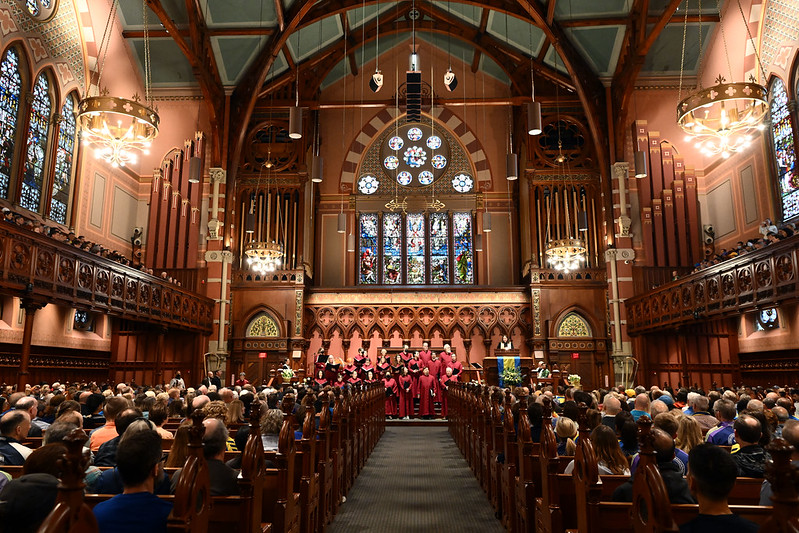
Thanksgiving, the congregation of the Old South Church in Boston
returns to our
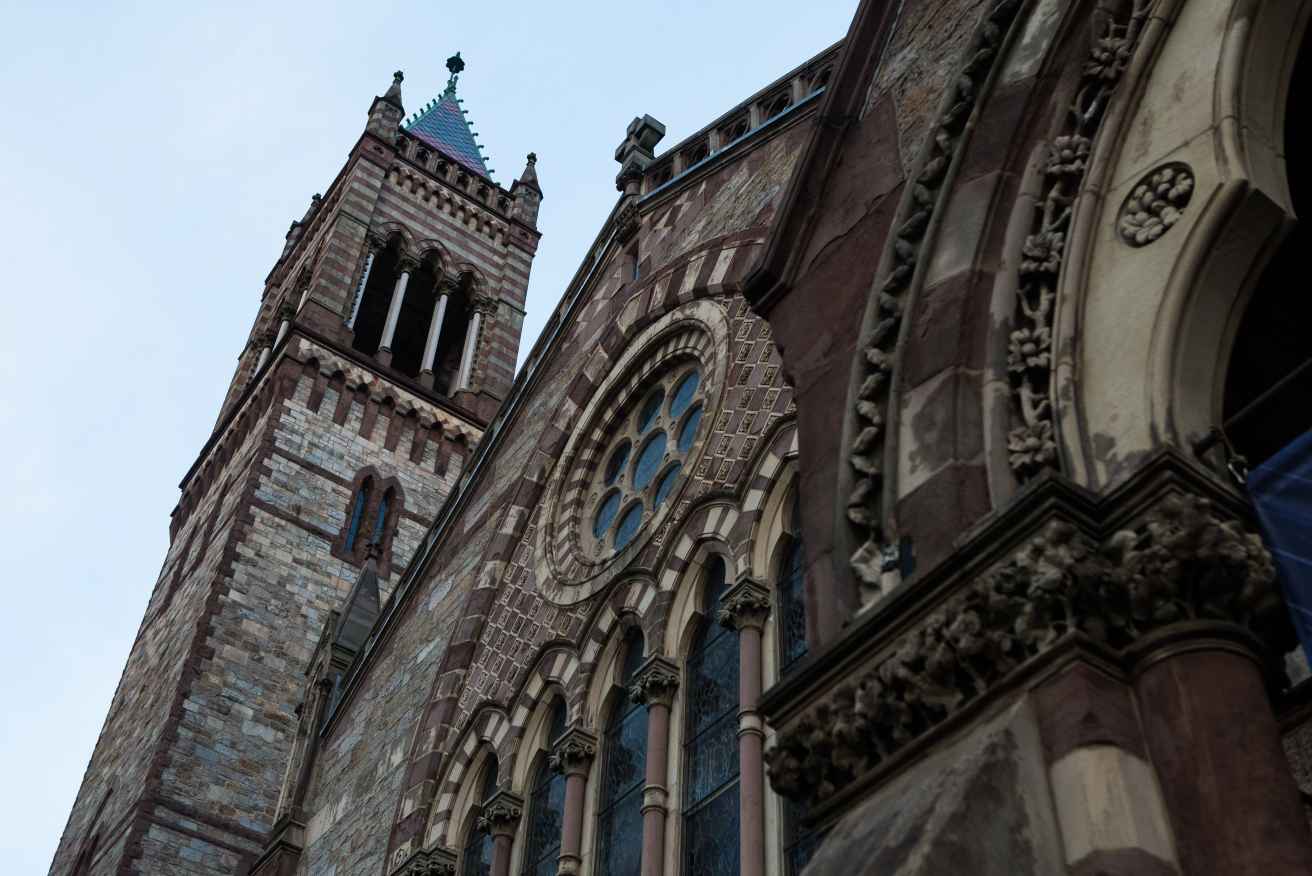
ancestral home, the Old South Meetinghouse.
Here we turn our attention and thanksgiving
to God for the beauty and
bounty of the earth, as well as for God's guidance and providence.
Here, too, we recall our
storied past and give thanks for our forebears on whose shoulders we
stand.
__________________________
Oh, it was a painful and difficult decision. Meeting after meeting they
discussed it, hour after hour, year after year. They deliberated and
debated, they calculated and cogitated, they opined and orated, they
harangued and harrumphed. They prayed about it and their ministers
preached about it. Should they or shouldn't they? Oh, it was a
difficult, painful and fraught decision.
In fact, it was so difficult and painful and fraught that it took over
ten years to decide to bring it to a vote, and even then the vote was
anything but unanimous.
Twenty voted against. Forty voted for. Twenty of the brethren voted
against this meetinghouse, this new-fangled, meetinghouse, this
over-the-top meetinghouse (this very building we are in). Twenty
of them were adamant that the old one, the first one, the Cedar
Meetinghouse was more than adequate.
To be sure, it needed to be expanded to accommodate a burgeoning
congregation. Everyone agreed about that! After all, it was a fact that
the aisles were strewn with stools, chairs and extra benches to
accommodate the growing congregation. In the early 1700's the place was
bursting at the seams.
Twenty voted against. But forty voted in favor of building a new
meetinghouse. And so they would.
That decision, as long and hard as it was in coming, was just the
beginning. Then they had to decide whether to build it out of wood, or
perhaps out of brick, or maybe out of stone. Well, that took a
while to decide. More meetings. More deliberation. Another vote.
But that wasn't all. Then they had to decide whether to build here,
right here, on this very spot …
which meant tearing down the old meetinghouse, the Cedar Meetinghouse,
which had served them so well for sixty years … where their children
had been baptized and their parents buried.
Demolishing the old meetinghouse was painful enough, but to add insult
to injury, it would mean
being without a meetinghouse for about a year. So painful, this
decision. More meetings. More deliberation. Yet another vote.
In the end, over the protestations of many - including, notably, over
the protestations of Judge Sewell, one of the most prominent and
important members - they voted in favor of demolishing the old to make
way for the new.
But that wasn't all. In fact, painful as those past ten-years of
deliberations and decisions had been, they were as nothing compared to
what still lay ahead. What yet faced them - a matter that must be
settled well before the meetinghouse was completed - was a peculiar New
England protocol (there is no evidence of any like it back in England).
What faced them was a two-step procedure. Step one: "dignifying the
seats." Step two: "seating the Meetinghouse."
Step one: dignifying the seats. This was the process of assigning
ranks, or "dignities" to every single seat in the meetinghouse.
In the earliest manifestation of this process, the most prestigious
seats were those nearest the pulpit.
The further away from the pulpit, the lower in rank or "dignity" the
seat was. Those least prestigious of all, those in the lowest rank,
were those in the far flung reaches of the gallery.
It was to the gallery that children were relegated, as well, I am
ashamed to say, as two other groups: those who were native to this
land, Indians and, those whose parents or grandparents had been
kidnapped and carried here from Africa against their will.
It is likely that in the Cedar Meetinghouse (our first meetinghouse),
the men and women sat apart from each other: the men in the section of
seats on the minister's right. The women sat on the section to the
minster's left. Men and women were separated by a wide central aisle
known as the broad alley or the great alley.
The young, unmarried men sat in one gallery. The young unmarried women
in the opposite gallery.
I wonder what kept their attention during worship? Between the
young men and the young women, keeping them a safe and respectful
distance from one another, were children and persons of color.
Children in the gallery were placed under the supervision of a tithing
man who watched over them with an eagle's eye for any mischief,
insolence or even mere lack of attention.
The tithing-man was a paid position in the Puritan community. (Benjamin
Franklin's father was a tithing man of this church.) It was the
tithing-man's job to enforce the rules of the Sabbath. He collected
taxes paid to the church. He fined those who skipped worship and he
kept order in meeting house with a stick. He would use one end to bop
misbehaving children or to poke men who had fallen asleep. The other
end, the feathered end, ticked women to wakefulness or attention.
Soldiers sat at both sides of the gallery, near the doors, their
weapons armed and their eyes trained on the entrances.
By 1730, however, by the time of the seating of this Meetinghouse, men
and women were no longer separated. And, the assigning of rank or
dignities to each seat had taken on more nuances. (I will return to
this in a moment.)
Once the seats had been "dignified" there followed Step Two: the
practice of "seating the meetinghouse".
Seating the Meetinghouse was the practice of assigning seats according
to one's worth … not one's financial means …but rather one's
worthiness, at least as our Puritan forebears judged these things.
In the 1600's and 1700's, the peculiar Puritan practice of seating the
Meetinghouse, required that the Seating Committee assign seating to
individuals and families according to status.
It was the delicate and fearsome task of the Committee to assign
seating according to the following "grounds of advancement: age,
dignity of descent, place of public trust, pious disposition, estate,
and peculiar serviceableness of any kind" (WAP, p. 284-5, see
reference below.)
Status, therefore, was not adduced merely by wealth. You could not buy
the best seat in this house. The best seats were assigned … they were
assigned to those who, in the estimation of the members of the Seating
Committee, held a special place, a special status, a godly sort of
worth.
Friends, do you sense the peril in this practice? Are you sensing the
danger, the hazards, the potential for injury and catastrophe?
If you were assigned to serve on such a Seating Committee today, how
would you begin to measure the status, say, of the Davis-Merrifield
family compared with that of the Spitzer-Youngs? Or the
Johnson-Purtilo's compared with the Jackson-Adams, or the Pitchers
compared with the Yeos,
or the Metalide's compared with the Holland's, or the Boultons with
that of Mr. Bowers? To what dignities would you assign the
Corman-Vogan's, the Butlers, the Briggs, the Bulkeley's, the Blacks,
the Bayley's, the Boates, the Bergstressers, the Grants, the Greggs,
the Hands, the Heroux's, the Hodgkin's, the Korstoko's?
I see that the Burke's and the Monsma's are sitting together this
morning. So, too are the Sterns and the Orrs. And look, Dr. Blake, Ms.
Ansley, Widow Andrews and Mrs. Murphy are sitting together as equals. I
wonder if the Seating Committee would agree with your estimations of
yourselves!
How would you begin to assign pride of place among these person and
families … all of whom are near and dear to you … and with whom you
live and work on a daily basis?
If you were to serve on such a committee, how might you weight "pious
disposition" against "peculiar serviceableness"? And how would you
weight these against "a place of public trust"?
Do you sense the danger in this?
It was a delicate and perilous matter indeed! The ministers prayed
earnestly and fervently that this "seating of the meetinghouse" would
not be the undoing of the congregation's life.
Seating the Meetinghouse was serious business. Large fines could be
assessed against people found willingly seating in seats of "too great
honor."
In one case, a member of the congregation not only sat out of place,
but had the temerity to place an easy chair next to the pulpit for his
exclusive use. The congregants were so enraged by this affront to the
social order that they not only fined the offending member, but they
carted the chair outside and hung it from a hemlock tree.
But here's the thing: in this peculiar and perilous undertaking, the
Puritans were attempting something far more democratic and equitable
than they had known in England. They were determined to measure worth
on a different basis than that of royalty, aristocracy and wealth. They
were determined, instead, to judge one another on the basis of those
qualities and graces they deemed of a higher order: like piety,
serviceableness and public trust.
It was possible, therefore, that a person who had been born without
wealth or pedigree could rise to a higher dignity through his piety, or
because of his serviceableness or because he had earned the trust of
others (well, such a person would first need to be white, male,
Christian and landowning).
In the end, however, this peculiar, perilous Puritan practice could not
be sustained. It was simply too fraught. Weighing the relative
worthiness of one family over against another, and in such a public
way, was too complicated and vexing to be sustained.
Already by the Revolutionary War, therefore, throughout the Colony,
seating the meetinghouses had devolved to a basis everyone could at
least understand: money. By 1775, if you could afford the most
prestigious pew, you could have it.
If you look at the seating plan for this Meetinghouse (the meetinghouse
was completed in 1730), you will note unassigned pews in the front …
and quite a few of them. These were left free for visiting dignitaries
of which this very important and prestigious church had many.
If you note the assignment of the Sewell's - there are two boxes
assigned to Sewell's on the very left of the plan - it is likely that
they sat in raised pews.
What we are seeing in the plan of the seating of this Meetinghouse,
therefore, is an adaptation or nuancing of the dignifying of the seats.
By 1730, at least in this Meetinghouse, those seats closest to the
pulpit were no longer of the highest rank.
Think, if you will, of prestigious boxes at sporting arenas or opera
houses, in which the best seating - for royalty, for instance, or for
the owner of the sports team - is not that closest to the action
(on the ground among the hoi polloi) but rather at a safe, private,
dignified and elevated remove.
Like the Queen at Royal Albert Hall, the Sewells' boxes are elevated
and behind others. Like the Queen, the Sewells' could look out upon and
over the heads of lesser mortals. Lesser mortals, on the other hand,
could only look upon the Sewell's by looking up and with craned neck.
The Puritans came to this soil looking for a place, a home, a homeland.
Their peculiar practices of "dignifying the seats" and "seating the
meetinghouse" were among the ways they made a home for themselves in
this foreign, untamed land. These practices, so peculiar to us, were a
means to a larger end: the end of arranging themselves on the basis of
godliness.
Like the Israelites after whom they modeled themselves, the Puritans
and the Pilgrims experienced affliction and oppression. As they
would tell it, like the Israelites they, too cried out to the Lord. As
Lord heard the cries of the Israelites in Egypt, so, too, did God hear
the cries of these serious and pious Christians.
As they would tell it, God saw their affliction and brought them up out
of the lands of England and Europe with a mighty hand and an
outstretched arm and brought them to this place and gave them this
land, a land flowing with milk and honey.
The whole sweep of Israel's history is a story of home-coming. It is
the journey from the status of stranger to citizen, from alien to
resident … from outsider to insider.
So, too, is the whole sweep of our history a story of home-coming … an
anxiousness to belong.
As the ancient Israelites were instructed to pause each year, rehearse
their history, remember their forebears and give God thanks so, too, do
we.
We return annually to this Meetinghouse, our ancestral home, to
remember and recite our history.
In so doing we confess that which is shameful and we embrace that which
is good.
In all things, we to turn to the Author of the Universe, our Leader
Triumphant, with equal mixtures of shame and pride, humility and
gratitude.
REFERENCES - the following volumes/papers were consulted in the
preparation of this sermon:
Reappraising Durkheim for the Study of Religion, by
Brain C. Wilson
"Seating the Meeting House in Early Massachusetts", by Robert J. Dinkin
© 1970 (published in The New England Quarterly, Inc..
The Worship of the American Puritans, by Horton Davies
(pages 284f)
History of the Old South Church, Boston, in two volumes,
by Hamilton A. Hill
_______________
Deuteronomy 26:1-11 When you have come into the land
that the Lord your God is giving you as an inheritance to possess, and
you possess it, and settle in it, you shall take some of the first of
all the fruit of the ground, which you harvest from the land that the
Lord your God is giving you, and you shall put it in a basket and go to
the place that the Lord your God will choose as a dwelling for his
name. You shall go to the priest who is in office at that time, and say
to him, "Today I declare to the Lord your God that I have come into the
land that the Lord swore to our ancestors to give us." When the priest
takes the basket from your hand and sets it down before the altar of
the Lord your God, you shall make this response before the Lord your
God: "A wandering Aramean was my ancestor; he went down into Egypt and
lived there as an alien, few in number, and there he became a great
nation, mighty and populous. When the Egyptians treated us harshly and
afflicted us, by imposing hard labor on us, we cried to the Lord, the
God of our ancestors; the Lord heard our voice and saw our affliction,
our toil, and our oppression. The Lord brought us out of Egypt with a
mighty hand and an outstretched arm, with a terrifying display of
power, and with signs and wonders; and he brought us into this place
and gave us this land, a land flowing with milk and honey. So now I
bring the first of the fruit of the ground that you, O Lord, have given
me." You shall set it down before the Lord your God and bow down before
the Lord your God. Then you, together with the Levites and the aliens
who reside among you, shall celebrate with all the bounty that the Lord
your God has given to you and to your house.