Old South Banner
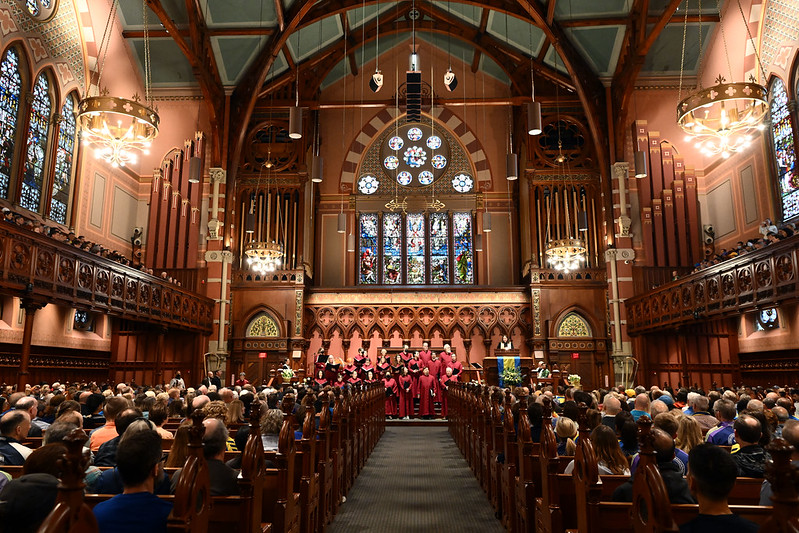
Old South Sanctuary (photo by Sarah Musemuci)


Copyright © 2009, Old South Church and by author.
Excerpts are permitted as long as full accreditation is made
to Old South Church and to the author.


Old South Sermons:

Reflections on Genre, Role, Prophets and Presidents

an Epiphany sermon
by the Rev. Dr. Nancy S. Taylor, Senior Minister

Based on Jonah 3: 1-5, 10

Sunday, January 25, 2009

Listen to this sermon


Film director Spike Lee has declared that “history can be divided into BB (Before Barack) and AB (After Barack).”

A recent Newsweek headline, asked: “Barack the Savior?” (November, 13, 2008)

A columnist for the Jerusalem Post, opined under the heading: “Obama the Savior” (April 21, 2008).

Martin Copenhaver, minister at our sister congregation, the Wellesley Congregational Church,
was quoted in Monday’s Boston Globe as declaring, “Obama is not the savior,” to which he then dryly added: “We already have one of those.” (January 18, 2009)

It is not without interest that this Christian minister listens to and reads such statements, for these are but the tip of an iceberg of proclamations and hopes now pinned to the tall, skinny 44th president.

I hear in such assertions, a profound hunger for leadership in this anxious time. I hear an uneasy populace, drowning in debt, out of work and terrified by diminishing investments, crying out: Who will save us? I hear the moans of a citizenry keenly attuned to the disjuncture between our national ideals of the rule of law and, on the other hand, the practice of signing statements designed to evade the Constitution’s strictures.

I also hear in such statements, some confusion about role. It has long been among the hazards of American civil religion to confuse fealty with faith, and security with salvation. To these we now add some confusion of the distinct roles of presidents and prophets.

To clarify: it is a president’s role to uphold the Constitution of the US and to govern this nation. He uses as tools for this work lobbying and law-making, speeches and diplomacy, budgets and bureaucracies and, if need be, the threat or use of war and violence.


The Savior’s role and tools are quite different. It is the Savior’s role to invest earth with heaven, to mediate between God and humanity, to act as the reconciling agent between our waywardness and God’s righteousness. His tools? Grace, forgiveness, reconciliation, the call to repentance and, ultimately, faithfulness to the heart of God. While these are not anathema to government, they do indicate a fundamental orientation to a kingdom not of this world.

The role of religion in America is complicated and vexing … although perhaps glorious as well. After all, it was Martin Luther King’s Christian faith that propelled him into the streets, gave him solace while in jail, nourished him with courage in the face of a cruel and deadly enemy, and burnished both his pen and his tongue with the eloquence of righteousness.

For better or worse, religion is here to stay. It is a meaning-making enterprise for many. It is a nation-building enterprise for some.

If I were given a choice between a religionless-state or the messiness and complications of a religiously infused public life, I will gladly suffer the religious foolishness of Jerry Fallwell and Pat Robertson, in order to gain the rare and glorious gift of Dr. King.

Our friend, Jonah, the prophet about whom we heard this morning, finds himself in the midst of the complications of church and state.

The Book of Jonah tells a tall tale, a fish story of outlandish proportions. It begins with a Hebrew phrase that is similar to “once upon a time.” That phrase is designed to signal the genre-conscious reader to sit back, relax, enjoy, let your imagination go … for a good story is coming. It is a story best consumed by lovers of tall tales. Biblical literalists, on the other hand, will choke on swallowing whole the story of a man who slid down the throat of a very large fish, lived inside the fish for three days and three nights, and was inelegantly vomited up … and then deposited, not out into the depths of the ocean, but fortuitously and neatly onto dry ground.

The Book of Jonah is structured like a Charlie Chaplin episode: a very little man faces an impossibly large task. Along the way, ridiculous things happen.

Once upon a time, God instructs Jonah to go to Ninevah, the capital city of the Assyrian empire. The assignment is tantamount to asking an Israeli to enter Gaza City. God instructs Jonah to go to Ninevah and, once there, to walk up and down the streets of the city, calling the city to repent.

Keen to escape this distasteful chore, Jonah runs in the opposite direction from Ninevah and boards a ship to sail away from God … as if such escape were possible.

In response, God whips up the wind and waves until the ship is in peril. Above deck the sailors are panicked. Each turns to his god to plead for a reprieve. When that fails they decide to lighten the ship’s load: throwing overboard anything not strapped down. Just imagine in your mind’s eye, the various articles that fly from the ship into the sea!

Meanwhile, below decks, Jonah (who is responsible for this predicament) sleeps soundly through the storm. He is awakened by the captain who barks at him to get praying.

When prayers fail, the sailors resort to the next best thing they can think of: they cast lots. The lot falls on Jonah. They quickly learn that Jonah’s God is T.H.E. God – the God above all gods – the news of which sends shivers down the spines of these salty sailors. Eventually, they come to the conclusion that Jonah’s powerful God will only be appeased by throwing Jonah overboard. This they do.

No sooner does the pitiful Jonah hit the waves than he is swallowed by a great fish. Jonah is later vomited out and returned to dry ground.

God appeals to Jonah a second time to go to Ninevah, the capital city of the Assyrian Empire and cry against it. Having learned the hard way, Jonah obeys. He walks up and down the streets of the city crying against it. Against all odds, the people of Ninevah turn and repent.

Jonah learned in the streets of Ninevah what Dr. King learned in the streets of Selma and Birmingham, of Montgomery and Washington DC: that people want to do the right thing; that people have a heart for God but are in need of a little encouragement; that enemies can become friends, and that ancient animosities can be laid aside in the presence of God. He learned that nations can feel like neighborhoods when a people find themselves caught up together in a good and common purpose.

One of the good and common purposes we as a people have just accomplished was a long-time dream of America’s great prophet: Dr. King. For the first time, the highest office in the land is held by a man whose race once served this nation in chains and humility, in misery and in protest.

On my way to the church on Inauguration Day I paid a visit to the statue on Commonwealth Avenue of Old South member Phillis Wheatley. Born into slavery, but then freed, Wheatley was a gifted linguist and the first published African American poet.

Walking a few more blocks down Commonwealth Avenue, I then paused at the grand statue of the abolitionist William Lloyd Garrison. I stood for a moment, marveled at and give God thanks for a man of rare courage.

Having arrived here, I took a moment to visit the plaque in the back of the sanctuary that honors Old South member Samuel Sewell. Sewell authored in 1700 the first ant-slavery tract on this soil.

Finally, I visited the portrait of Jacob Manning in the fourth floor Samuel Johnson Room.

Manning, the 15th minister of Old South, was a firm abolitionist and became a chaplain in the Union Army.

Tuesday was their day, as much as ours. In many ways it was the day they had worked for, written for, suffered for, prayed for and dreamed of. These statues, plaques and portraits give silent testimony to the greatness and goodness of those relatively few men and women who, in their time, rose above mediocrity and timidity … who challenged us both by the ideals of our nation and also by the precepts of our faith.

Historian Martin Marty recently recalled words written at the departure as president of Lyndon B. Johnson: “You weren't the best president a people ever had, but we were not the best people a president ever had." (Martin E. Marty, quoted from Sighting’s, 1/19/09 “Farewell, President”)

The role of the people in a nation like ours is a role our new president has asked us to live up to and into: to be a good people, courageous and curious, virtuous and engaged … holding the feet of our leaders to the fire of the ideals that burned in the hearts of our founders.

Presidents need good citizens, just as citizens need good presidents.

But her’s the thing: both of us – people and president – require the tenacious labors of prophets … those truth-tellers … those lightning rods of righteousness … those Jonah’s and Martin’s, William’s and Phillis’, Samuel’s and Jacob’s – those disquieting voices who speak truth to power

and remind us that the worst thing that can happen is that good people opt out, hoping that someone else will step in.

As we take our own place on the stage in this moment of history, we are asked to play more than one role. Yes, we can and should act the role of citizen in a democracy whose very soul depends on argument and input, on free speech and freedom of assembly, on voting and letter writing, on civic engagement and public policy advocacy.

But we have a higher obligation, you and I. We have a more profound role to play: the role of Christian. In this role it is our high calling to hear and heed the prophets in our midst, even when their words sting.

In this role it is laid upon us to infuse the public square with the disciplines of discipleship: love of enemy; compassion for the poor; an abiding belief in the possibilities of reconciliation; an unswerving, countercultural commitment to addressing human fractures through peaceful means;

and finally, a determination to critique both tribalism and nationalism, especially at our most shinning national moments.

Why this? Because in playing the role of Christian, it is with God’s own eyes that we must learn to look. Not with the limited vision of your eyes or my eyes … not with American eyes, or white eyes, or black eyes, not with women’s eyes, or men’s eyes, or gay eyes, not with Christian eyes, or Jewish eyes, or Muslim eyes. It is with God’s own eyes that we must learn to look out upon God’s vast, precious, troubled, beautiful, fragile and resilient world.

If you are willing to accept this role, this high calling … If you are willing to play the role of Christian by infusing into the public square these disciplines of discipleship, please say, “Amen.”


___________________________


Jonah 3: 1-5, 10

The word of the Lord came to Jonah a second time, saying, “Get up, go to Nineveh, that great city, and proclaim to it the message that I tell you.” So Jonah set out and went to Nineveh, according to the word of the Lord. Now Nineveh was an exceedingly large city, a three days’ walk across. Jonah began to go into the city, going a day’s walk. And he cried out, “Forty days more, and Nineveh shall be overthrown!”

And the people of Nineveh believed God; they proclaimed a fast, and everyone, great and small, put on sackcloth. When God saw what they did, how they turned from their evil ways, God changed his mind about the calamity that he had said he would bring upon them; and he did not do it.


Copyright © 2009, Old South Church and by author.
Excerpts are permitted as long as full accreditation is made
to Old South Church and to the author.

Old South Church
645 Boylston St. Boston, MA 02116
(617)536-1970 Tel (617)536-8061 Fax

You can E-mail us by clicking here: OSC Communications

Copyright © 2009, Old South Church