The Old South Church in Boston

Taken By Storm


Sermon by the Rev. Dr. Nancy S. Taylor

January 30, 2005

Genesis chapters 7-9, 2 Timothy 4.1-5*


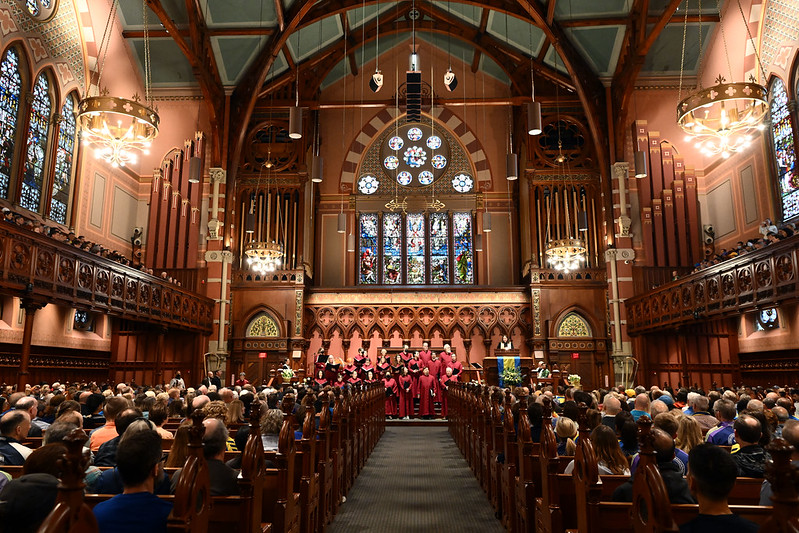
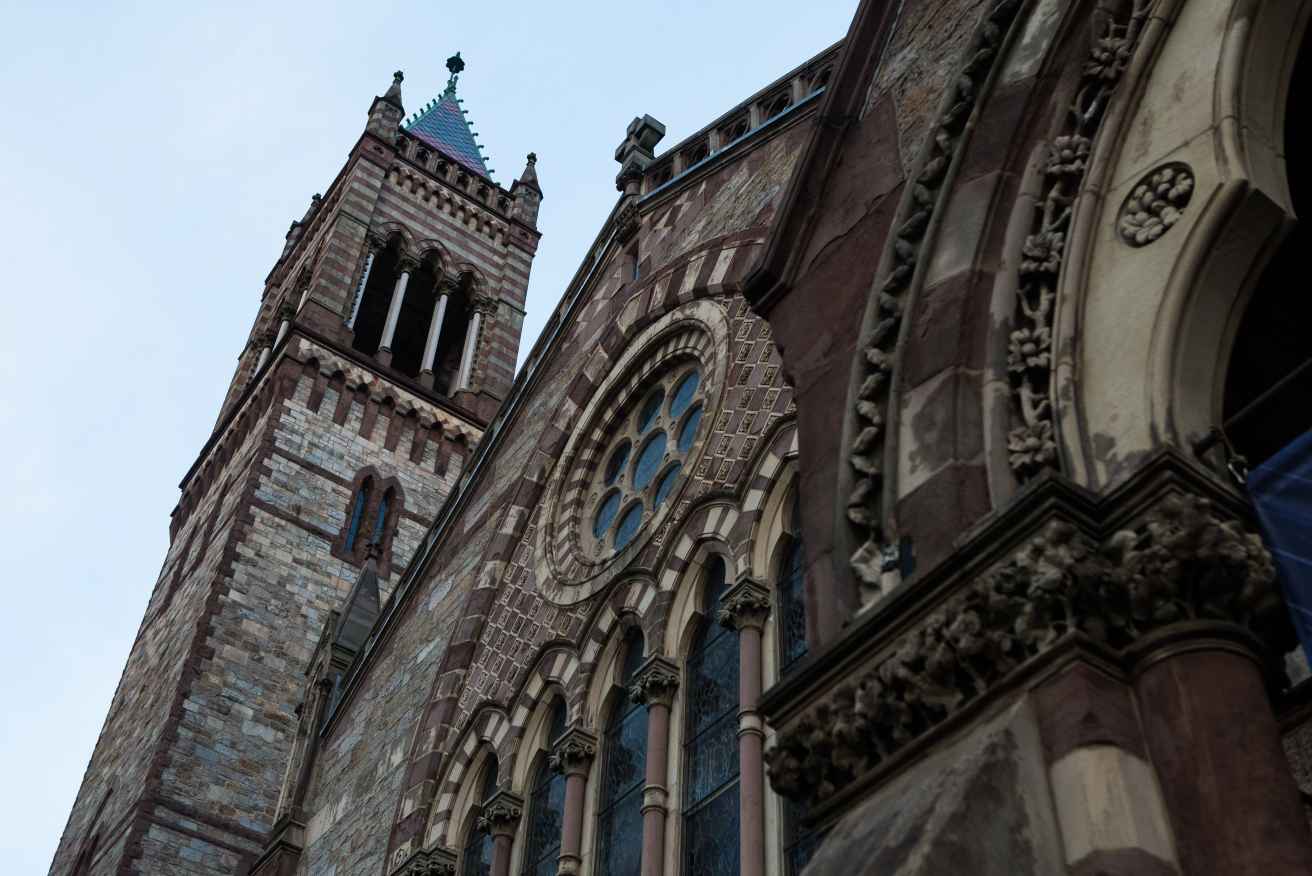
Early last week in the midst of a record-breaking blizzard and white-out conditions, I exercised my leadership for the first time as the new senior minister of the Old South Church … the church over whose portal it is written, “Behold, I have set before you an open door.”

My very first act? I closed the doors … on Monday I closed the church of the open door.

It was not the beginning I had hoped for. But, then, such things happen when you are taken by storm … in this case, by a record breaking, northeastern blizzard.

There were compelling reasons to close Old South on Monday … not least of which was that the city was under a state of emergency. But there was another reason to close the church. To have been taken by storm, as we had been, is an invitation to pause and ponder … an opportunity to become reacquainted with the sense of wonder. As I pondered that storm, I was struck by the grand beauty of it… and, by its power and peril.

I found myself reflecting on other storms in this season of storms: mudslides in California, floods in the Midwest, avalanches in the northwest; ice storms in the Southeast and, most horribly, the South Asian tsunami … the magnitude and horror of which is still beyond our imagining.

The biblical account of Noah’s ark recalls an ancient memory of a time when the earth was taken by storm … a storm and flood whose proportions were not unlike those of the tsunami … an utterly devastating storm. In the story language of Genesis, it “covered the face of the whole earth.” The story tells of those who rode the storm out and survived it: Noah and his family and the animals. It also tells of those who did not survive … of people swallowed up and swept away by rising walls of water – an ancient tsunami of catastrophic proportions where entire peoples were drowned.

Yet, in my mind’s eye, superimposed on these storms I see other storms, other kinds of storms, a collage of storms … some of them more terrible than mudslides, avalanches, blizzards, floods and even tsunamis.

I see an image from Friday’s Boston Globe of elderly Polish men weeping. Wearing caps and scarves striped in blue and white recalling their concentration camp uniforms, they mark the 60th anniversary of the freeing of the death camp at Auschwitz. By their tears we remember the storm that swept millions and millions of people away. I see Hitler’s hate-induced storm and his storm troopers. I see smoke rising from chimneys and I hear the sound of shattered glass. I see Jewish homes invaded by black-booted men menacingly armed with swastikas and machine guns.

Also, in my mind’s eye, in this month in which we mark another anniversary, the birthday of Martin Luther King, I see another storm … I see fire hoses trained on men and women of color, and snarling police dogs loosed by state troopers. I see burning crosses, and white-sheeted men, and churches bombed, and caskets for little girls, and I remember all those taken by the storm of bigotry … and a country seized by segregation.

Also, not only in my mind’s eye, but on TV and in the newspapers I see images of Iraq … a storm and swirl of soldiers, prisoners, rubble, hapless citizens, voting booths, bombs all mixed with hope and despair, possibility and anger.

And, in these days, doesn’t it feel as if a storm has broken out when you, you who are straight and married, find yourselves voting on the lives and loves of others?

And, you, you who are gay, lesbian, bisexual and transgender, does it not feel like you have been caught in a storm – like you are outside in the cold and rain – when members of your own congregation, to say nothing of millions of others, argue about and vote on whom you can love and how, and whom you can marry, and how you are a woman, and how you are a man?

And I wonder: who are the survivors and who are the victims and when will these storms subside?

Storms rage, inside and out. Some we describe as “natural” – induced by nature. And others as man-made … one of the times I’m not so strict about using inclusive language. But honesty requires that we confess that the line between natural and man-made disasters is not so clear.

For instance, the victims of the Asian tsunami were disproportionately poor … and in their ocean there is no warning system. Moreover, nature increasingly erupts in furious and unpredictable response to our rude human trespass … we have changed and altered nature by greedy destruction of the environment, and by policies and practices that threaten and change its delicate balance.

The ancient story of the Flood speaks into our 21st century because it has all of the same characters in it that our storm stories have: good people and bad people; animals, both wild and domestic, victims and survivors; innocents and perpetrators …and God. God features in all these stories of storm. God is always in the story, either as a perplexing presence or as a glaring absence. We mortals are left to wonder and fret and argue over whether God’s hand was in the storm or not. And all of us cry to the heavens: Where was God? Who is God? And, what’s the point of having a God after all?

The story of the Flood exhibits the same concerns and questions. In fact, the story is a masterpiece of theological contortionism, the work of a people who want it both ways: an omnipotent God and an unfailingly gentle God.

In the beginning of the story it is made clear that the flood is God’s flood. God wills it and God makes it happen.  But then the story takes a sharp turn and comes up with a surprise ending: the God who can do such things, promises never, ever to do it again. God declares: “I will never again destroy the earth by flood.” This is a biblical promise of the highest sort: a declamatory, for-ever-and-ever-amen statement. I am no biblical fundamentalist, but I hang my theological hat on this one: God will never again destroy the earth by flood. I, for one, intend to hold God to this promise.

John Lewis, today a Congressman from Georgia, and a hero in the civil rights movement, tells his own story about being taken by storm. He tells of an afternoon 50 years ago, in the South, when he was a child. He and fourteen other children were playing outdoors in the dirt yard at his Aunt’s house when the sky began to cloud over, the wind started to pick up, lightning flashed, and rain began to pelt the children’s bodies.

Lewis’ aunt herded all the children indoors. Inside her tiny house they stood, huddled together, silent and scared. The wind howled, the rain beat against the roof, lighting flashed, thunder crashed, and then the house itself started to shake. Then the house started to sway and the wood plank flooring began to bend. And then, to everyone’s horror, a corner of that small house started lifting up. Lewis and his aunt and the other children stared unbelieving. The storm was actually pulling the house off the ground … with fifteen children and one adult inside.

Quickly, his aunt ordered them all to clasp hands. Hold hands, she said. Then she had them walk as a group toward the corner of the house that was rising. With the wind screaming outside and sheets of rain beating on the tin roof, they walked together toward the corner that was lifting, and by their combined weight they held the corner down. Then, when another corner of the house began to lift, they struggled across together and held that corner down.

And so it went, back and forth, fifteen children walking with the wind, holding that trembling house down with the weight of their small bodies.

Reflecting on that event over a half century later, Lewis writes that societies and nations are like those children in that house, rocked again and again by one storm or another, the walls around us seeming at times as if they might fly apart.

“It seemed that way,” he writes, “in the 1960’s at the height of the civil rights movement, when America itself felt as if it might burst at the seems – so much tension, so many storms. But the people of conscience never left the house. They never ran away. They stayed, they came together, and they did the best they could, clasping hands and moving toward the corner of the house that was the weakest.

“And then another corner would lift, and we would go there.”

“And eventually and inevitably, the storm would settle, and the house would stand still.”

“But we knew another storm would come, and we would have to do it all over again.”

Friends, I don’t know about you, but to me it feels as if we are in an unusually prolific season of storms. But, then, I am not so sure. To look back across history and to look today across our world, is to see that storms are not the exception; they are the rule. Storms of war, violence, injustice, disaster and disease rage and race across God’s beautiful and fragile earth.

The Good News is that Christian faith is designed for a less-than-perfect world: it is made for those who are tempest and storm-tossed. Jesus, who lived a short and storm-tossed life, labored and taught among those who were also beaten and battered by storms: lepers and the lame, widows and orphans, peasants and prostitutes, women and slaves, fishermen and tax collectors … all of whom lived in occupied territory. Jesus could have told all these people to lay low and keep the peace. He himself could have gone underground and avoided the storms that he ignited by his teaching and presence, by his miracles and parables. He could have gone into hiding, perhaps written books instead of being such an activist, a lightning rod, a storm-rider … but he didn’t.

And neither did his followers. Indeed, the early Christian community got the message of Jesus’ in-the-eye-of-the-storm way of living … they, too, held on to each other, cared the for weakest and weathered the storms – and even succumbed to them – with that peace that passes all understanding. Such was their faith. Such can be ours.

When we are taken by storm we can come together and hold hands. We can hold on to each other, working together, even weeping together, and together moving toward those corners of our nation, our neighborhood, our family, our world that are the weakest … as we have sought to do, for instance, with our prayers and dollars for the victims of the Asian tsunami.

Old South members and friends:  you and this congregation have weathered many storms – revolutions and wars, movements and protests, disease, disaster, tragedy. Over a span of more than three centuries, this congregation has weathered and borne Christian witness in many of the storms that have blown up and afflicted this city, this nation, and our world.

Indeed, it has been during the most tempestuous and trying times, that this congregation rose to the challenge of walking into storms, not running away, and working together on behalf of the weakest among us.

We can be sure that other storms will come. They will undoubtedly surprise us, challenge us and perhaps even threaten us, but the Gospel to which we subscribe, the Good News of God’s grace and salvation, equips us to enter and weather the storms of this world … reaching out in God’s name with concern and care for all others with whom we share this planet.

God be with us. Amen.
 

Note: The story and following quotations come from the prologue to John Lewis’ new historical memoir, Walking With the Wind.
Scripture Reading

Copyright © 2005, Old South Church and by author.
Excerpts are permitted as long as full accreditation is made
to Old South Church and to the author.


Scripture Reading
Portions of Genesis chapters 7-9

Then the Lord said to Noah, “Go into the ark, you and all your household, for I have seen that you alone are righteous before me in this generation.  Take with you seven pairs of all clean animals, the male and its mate; and a pair of the animals that are not clean, the male and its mate; and seven pairs of the birds of the air also, male and female, to keep their kind alive on the face of all the earth. For in seven days I will send rain on the earth for forty days and forty nights; and every living thing that I have made I will blot out from the face of the ground.”  And after seven days the waters of the flood came on the earth.

The flood continued forty days on the earth; and the waters increased, and bore up the ark, and it rose high above the earth. The waters swelled and increased greatly on the earth; and the ark floated on the face of the waters.  The waters swelled so mightily on the earth that all the high mountains under the whole heaven were covered; the waters swelled above the mountains, covering them fifteen cubits deep.

At the end of forty days Noah opened the window of the ark that he had made and sent out the dove from him, to see if the waters had subsided from the face of the ground; but the dove found no place to set its foot, and it returned to him to the ark, for the waters were still on the face of the whole earth.  He waited another seven days, and again he sent out the dove from the ark; and the dove came back to him in the evening, and there in its beak was a freshly plucked olive leaf; so Noah knew that the waters had subsided from the earth.
God said, “This is the sign of the covenant that I make between me and you and every living creature that is with you, for all future generations; I have set my bow in the clouds, and it shall be a sign of the covenant between me and the earth.  When I bring clouds over the earth and the bow is seen in the clouds, I will remember my covenant that is between me and you and every living creature of all flesh; and the waters shall never again become a flood to destroy all flesh. When the bow is in the clouds, I will see it and remember the everlasting covenant between God and every living creature of all flesh that is on the earth.”


Scripture Reading
2 Timothy 4:1-5

In the presence of God and of Christ Jesus, who is to judge the living and the dead, and in view of his appearing and his kingdom, I solemnly urge you: proclaim the message; be persistent whether the time is favorable or unfavorable; convince, rebuke, and encourage, with the utmost patience in teaching. For the time is coming when people will not put up with sound doctrine, but having itching ears, they will accumulate for themselves teachers to suit their own desires, and will turn away from listening to the truth and wander away to myths. As for you, always be sober, endure suffering, do the work of an evangelist, carry out your ministry fully.


Back to Sermon Page

The Old South Church in Boston
645 Boylston Street
Boston, MA 02116
(617) 536-1970