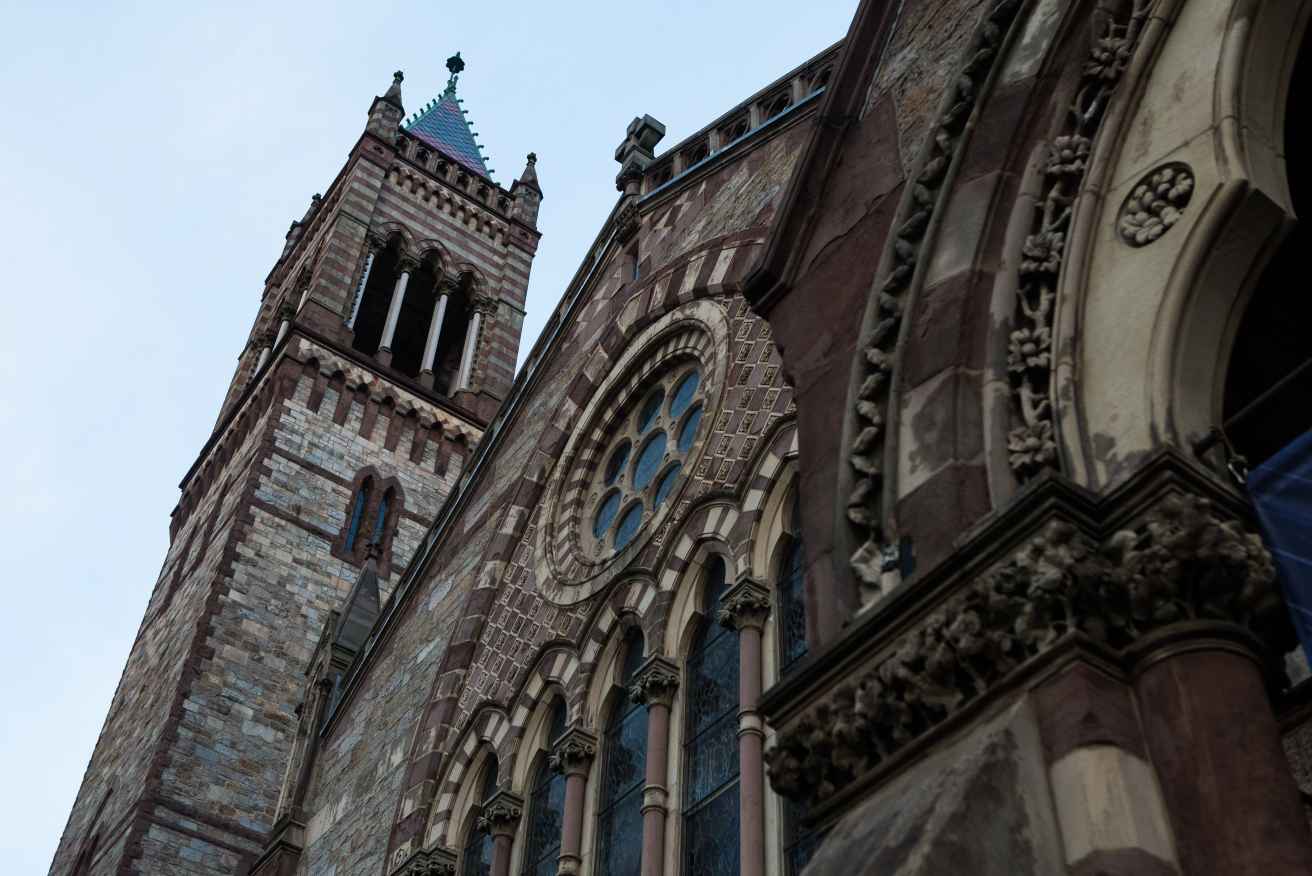
The Old South Church in Boston

Passion

A Sermon by Rev. Quinn G. Caldwell

April 1, 2007

Mark 11:1-11, 15-19

Listen to this Sermonmp3 file


Will you pray with me?  Lord, may the words of my lips and the meditations of all our hearts be acceptable in your sight, our rock and our redeemer.  Amen.

They threw the western gates of Jerusalem wide for the procession that entered that Sunday.  Hundreds, maybe even thousands, turned out and lined the streets to watch as he and his supporters rode into the city.  Many in the crowd, swept up in the excitement and the pageantry, cheered aloud and shouted words of support.  Many, the majority, maybe, watched in silent consternation as the procession passed by, uncertain what to think of the strange symbols of kingship, of the Son of God and Savior of humanity, that passed before them.  Some knew just want to think; their hatred and resentment were palpable. 

It was the Sunday before Passover, the great annual Jewish festival, and thousands of pilgrims from outlying areas and beyond were entering the city to celebrate the Israelites’ ancient escape from bondage in Egypt.  Now, Jerusalem and its people was under Roman imperial control at this time.  And from the perspective of the Romans, a subject city swelled to double its normal population by crowds of revelers gathered to celebrate a religious festival commemorating God’s defeat of, and the people’s escape from, a foreign imperial power was a very dangerous thing.

So each year, as the preparations for Passover were gearing up, Pontius Pilate, the Roman governor, came up from his home on the Mediterranean coast with extra troops to strengthen the garrison stationed in Jerusalem.  It was his procession the crowds gathered to see that day, and it was magnificent.  Sunlight glinted from swords and helmets and the fastenings of leather armor.  Foot soldiers marched in time with the beating of drums as the cavalry and high-ranking officials rode on high-stepping war horses, sleek and powerful and bedecked and deadly.  Overhead, plumes and banners streamed and snapped in the wind.  And above it all, mounted on a tall pole, flew a great golden eagle[1], the symbol of Caesar, the Emperor himself, whose fathers had been deified by the people, the one who bore the official imperial titles “Son God” and “Lord” and “Savior of Humanity.”  The message of that demonstration of pomp and magnificence and power as the military procession entered Jerusalem that day would not have been lost on anyone: “We are strong and you are not,” it said. “So behave.” 

Meanwhile, on the other side of town, a procession made up of some who refused to behave was nearing the city from the east.  This demonstration, like that other, was carefully planned.  As Pilate’s entry was timed to the first day of the week of Passover, Jesus’ entry was timed to Pilate’s.  Jesus, or his followers, had arranged ahead of time for a donkey to be tied up and waiting for him, to be handed over to those who knew the password.  They got the donkey, and Jesus climbed up on it and began to ride toward the city.  Some of his followers had prepared ahead of time by cutting leafy branches in the fields, and these ones began strewing the branches in his path, while others laid out their cloaks.  And those in front and those behind shouted the slogan they had carefully learned, a quote from a Psalm used during ancient Jewish coronations: “God saves!” they shouted.  “Blessed is the coming kingdom of our ancestor David.  Hosanna in the highest heaven!”

In later centuries—including our own—Christians would come to understand this moment as something almost magical, a spontaneous demonstration born of Jesus’ charisma and the people’s enthusiasm.  But I think it was something else.  I think it was a carefully planned and skillfully executed counter-demonstration.  Everyone in Jerusalem and the immediate surroundings would have known that Pilate and his imperial soldiers were entering the city that day.  Most of them would have seen that very thing happen before.  So, when those coming or going about their business near the eastern gates that day saw this small group—and make no mistake, despite the throngs most of us picture, this was almost certainly a tiny band, a couple of dozen at most—when they saw this procession coming and shouting “God saves” (not “Caesar saves”) and “Blessed is the one who comes in the name of the Lord” (and by “Lord” they meant God, not Caesar), and “Blessed is the coming kingdom of our ancestor David” (and not “Blessed is the present kingdom of Caesar”), those onlookers would have been very keenly aware that no matter how much this was a procession for Jesus, it was at least twice as much a procession against Rome.  It was less like a coronation and more like street theater, and the message of that counter-demonstration as Jesus entered Jerusalem that day would not have been lost on anyone: “You may rule this empire,” it said, “But we are citizens of the kingdom of God.  And we will not behave.” 

And here’s the brilliant, the really brilliant thing about this counter-demonstration: it was funny.  It would have made the onlookers laugh.  Think about it.  Have you ever heard the sound that a donkey makes?  It’s ridiculous.  All those people knew that on the other side of the city, Pilate and his procession were entering with sleek horses, martial precision, imperial splendor, and deadly power, all designed to awe and terrify the inhabitants into submission.  And then here came thirty motley peasants chucking branches and cloaks on the ground with elaborate gestures of humility and deference, hopping and dancing around as they hoarsely chanted what was once sung gorgeously at coronations.  And in their midst came Jesus riding a braying ass and grinning from ear to ear as he waved at the onlookers.

We usually tell the Palm Sunday story with Jesus humble and mild on his donkey.  I think he was intentionally ridiculous, trying to point to the ridiculousness of Caesar and Pilate’s way.  They were making fun of the Romans with their grand processions and military might, fun of those ones who believe that their wealth, or their pedigrees, or their titles, or their wars will ever truly avail them.  

Jesus and his followers, to proclaim the good news that the kingdom of God is near, refused for the love of God to live in terror of the empire of Caesar.  Instead, they staged their counter-procession, their street theater, and they make the people, the angry, scared, and subject people, laugh.  Laugh, though their lives were hard and overtaxed.  Laugh, in the face of persecution and corruption and domination.  Laugh, in lives full of threat, and death, and fear.  They brought them to life.

But despite the laughter, this was deadly serious business they were about, and they knew it, so they planned carefully.  After the procession, Jesus went up into the courtyard of the Temple to look around and prepare for the memorable scene he had planned for the next day.  The story of that demonstration is often told as if Jesus just walked into the Temple, was suddenly overcome with fury at what he discovered there, and lashed out violently—like the story of his procession, we’ve begun to tell it as if it were completely spontaneous.  But today’s story from Matthew makes it clear that this was another planned action: after the procession, he went to the Temple to scout out the best location for what he would do.  Once he was satisfied, he left for the evening. 

What he did that next morning with the money changers and the dove-sellers was not about disapproving of money-changers or selling animals for sacrifice or commerce in the Temple; all those things were clearly instructed or permitted by God.  He did what he did to indict the Temple leadership and Jerusalem elites for colluding with their Roman oppressors.  The Romans had made the Temple, the holiest place in his world, the center for imperial tax collection and the storehouse for records of tax debt.  They had mounted a golden eagle, symbol of Roman domination, over the gate to the Temple, where graven images were forbidden.  They had made the priests and other elites their agents for collecting exorbitant and bankrupting taxes from the poor.  In Jesus’ eyes, the Temple authorities had by cooperating with the Romans become oppressors in their own rights.  In so doing, they had denied God’s justice and become thieves, making the Holy Temple their den.  This Jesus—like many Jewish prophets before him—denounced loudly and physically.  And the story says that the people were spellbound.  And the leaders decided to kill him.

Jesus’ so-called Triumphal Entry and his action in the Temple are two parts of a carefully conceived whole.  Together, these two actions, deeply religious and profoundly political, set in motion the machinery that, over the course of the coming week, would lead to Jesus’ deeply religious and profoundly political death at the hands of the Romans and those among the Jewish elite that collaborated with them.  What would happen in the next week—stories that you and I will tell to each other all throughout this week—will be about his passion.  It will be about his passion in the technical Christian sense, that is, his suffering and death.  But it will also be about his passion in the colloquial sense, that is, what he cares about deeply, loves enough to die for: building the just, the lasting, the peaceful kingdom of God in human hearts and in human nations here, and now. 

When Nancy and I lead inquirers’ classes, which all these new members have recently attended, we always tell participants that being a Christian means being a citizen of at least two realms: the United States of America, and the kingdom of God.  Like Jesus, like his disciples, like the leadership of the Temple, we live with one foot in each realm.  Like them, when the two conflict we must decide where our primary allegiance lies, what we love enough to risk dying for, which realm our passion is for.  When one claims that the only way to peace is through war, and one claims that the only way to peace is through justice, we must choose.  When one claims that profit is more important than health, and one claims that all people are made in God’s image, we must choose.  When one claims that buying the right stuff and pledging the right allegiance will save, and one claims that only God saves, we must choose.  And as with Jesus on the first Palm Sunday, for Christians the choice is always religious and it is always political, for as with Jesus, we cannot separate the one from the other.

We tell ourselves the story of Holy Week over and over again each year because we know that, like Jesus, when we choose the kingdom of God over the powers of this world—and they are powerful indeed—we who have sought to live with passion like his might be called upon to live through a passion like his as well.  We rehearse these stories over and over so that when the time comes for us to choose, we can plan our counter-demonstration, our faithful witness to the world, as carefully as Jesus and his followers planned theirs.  We tell each other the stories of Holy Week so that when the time comes, we’ll know what to do. 

And of course, of course we don’t end our story with Good Friday.  Our story ends—and begins—with Easter, with God’s ringing affirmation of the choices Jesus made, with new life, with resurrection, with the overcoming of every force of fear and unjust death, with the triumph of the kingdom of God over the realms of this world, with laughter.  If we tell ourselves the story of Holy Week so that when the time comes we’ll know what to do, we tell the story of Easter so that when the time comes, we’ll know what God will do.

Two deeply religious and explicitly political processions made their way into Jerusalem on the first Palm Sunday.  One was Caesar’s; one was God’s.  One was martial and glittering and frightening; one was ragged and passionate and funny.  One would triumph on Good Friday; one would triumph on Easter.  The question this Holy Week, as always, is: “With which will you march?”[2]  Amen.


[1] Borg, Marcus J. and John Dominic Crossan.  The Last Week: What the Gospels Really Teach about Jesus’ Final Days in Jerusalem.  San Francisco: HarperSanFrancisco 2006; p.2ff. 

[2] I am indebted to Marcus Borg and John Dominic Crossan (ibid.) for the “two processions” metaphor.


Copyright © 2007, Old South Church and by author.
Excerpts are permitted as long as full accreditation is made
to Old South Church and to the author.

Back to Sermon Page

The Old South Church in Boston
645 Boylston Street
Boston, MA 02116
(617) 536-1970