The Old South Church in Boston

"Witness"

A Sermon by Rev. Quinn G. Caldwell

July 8, 2007

 Listen to this Sermon mp3 file

II Kings 5:1-15

Luke 10:1-12, 17-20


Will you pray with me?  Lord, may the words of my lips and the meditations of all our hearts
be acceptable in your sight, our rock and our redeemer.  Amen.


Will you pray with me?  Lord, may the words of my lips and the meditations of all our hearts be acceptable in your sight, our rock and our redeemer.

These days, in churches like Old South, that is to say liberal and/or progressive churches, “witness” is a word you don’t hear very often.  “Witness” as in faith witness, as in preachers thundering, “Can I get witness?!” from the pulpit.  “Witness” as in one human soul risking telling the story of that soul and God to other human souls.  “Witness” as in telling the world what God has done in your life.

If you’re like me, words like “witness” and “testify” conjure up images of courtrooms and juries, not church.  For others of us, these words no doubt evoke memories of being trapped in uncomfortable conversations with over-zealous coworkers, or of strange, teary people giving witness on televangelists’ TV programs.  For others, they may not really mean much at all.

We don’t use those words much in places like Old South, and we don’t spend much time talking about how to do those things.  Why that is, I don’t know.  Perhaps it’s because we’re worried about offending others or trapping them into sitting through our stories, or because we’re rightly concerned about overstepping our bounds in a religiously pluralistic society.  Perhaps it’s because we’re worried, here in our largely rational, scientific, overeducated context, about the reactions we will elicit from our hearers.  Perhaps it’s because our mainline churches were for so long the establishment churches, and we just didn’t need to learn to tell our faith stories because everyone we knew was already in church with us.

I suspect it’s a little of all those things.  And yet, witness and testimony are—have always been—deeply important in both the Jewish and the Christian traditions.  They are the primary way the story of our God has traveled through the human world and to human hearts.

When Naaman the Aramean was ill, it was the testimony of one young slave girl that turned him to his healing and his conversion.  Not the kings, or the general, or even the prophet himself.  One young girl said what she knew of God, and an ailing man was healed, and the grace of God headed even further out into the world on the lips of a foreign general.

When Jesus needed the towns and villages to be prepared for his coming, he sent the seventy ahead of him into a dangerous and unstable world.  And so the news spread, and grew.  And once the people started telling their stories, not even death, not even Jesus’ death, could put a stop to it.

Earlier I said that we don’t think much about witnessing and testifying.  But we do think about it some, don’t we?  Even in the two years I’ve been here, I’ve seen a growing hunger to share our stories, to learn to witness to each other and the world.  Nancy and Tadd and I have heard from many of you about the witnessing you have done in your own lives, about the ways in which it is difficult and a little scary, and deeply, deeply powerful.  Many of you have told friends and family about the God you’ve met here at Old South Church in Boston, and have brought those friends and family to join us.  In the congregational spiritual discernment process we undertook last year, and which will continue this fall, we heard God whispering to us that we need to learn more, to do more, to share our faith and tell our stories about God.  A couple of weeks ago, a new group called Bread for the Spirit began here at Old South, with the aim of giving people a space to share their stories.

So I think we do do some witnessing here at Old South, and I think we’re hungry for more.  But it is not easy.  It can make you feel like sheep among wolves.  And it does take preparation and a little practice to learn to witness, so in that spirit, to gauge where we are as a congregation and perhaps to learn a little about witnessing as well, I offer you…a quiz.

The quiz is called, “Are you ready to talk about God?”[1]  Now, fear not, you who have test anxiety.  This will not be graded, and no one but you will know your results.  If you’ve ever done a Cosmo quiz before, you’ll know what we’re doing here.  If not, just bear with me and you’ll get it.  We’ll have six questions in the form of six scenarios and for each question I’ll ask you to choose from three options what you would do in each.  You might want to keep track of your answers so you can score yourself when you’re done.  You can borrow the pen from the pew pads or use your own.  But if you don’t have anything to write with or don’t want to keep score, don’t worry; that’s fine, too.  Ready?  Here goes.

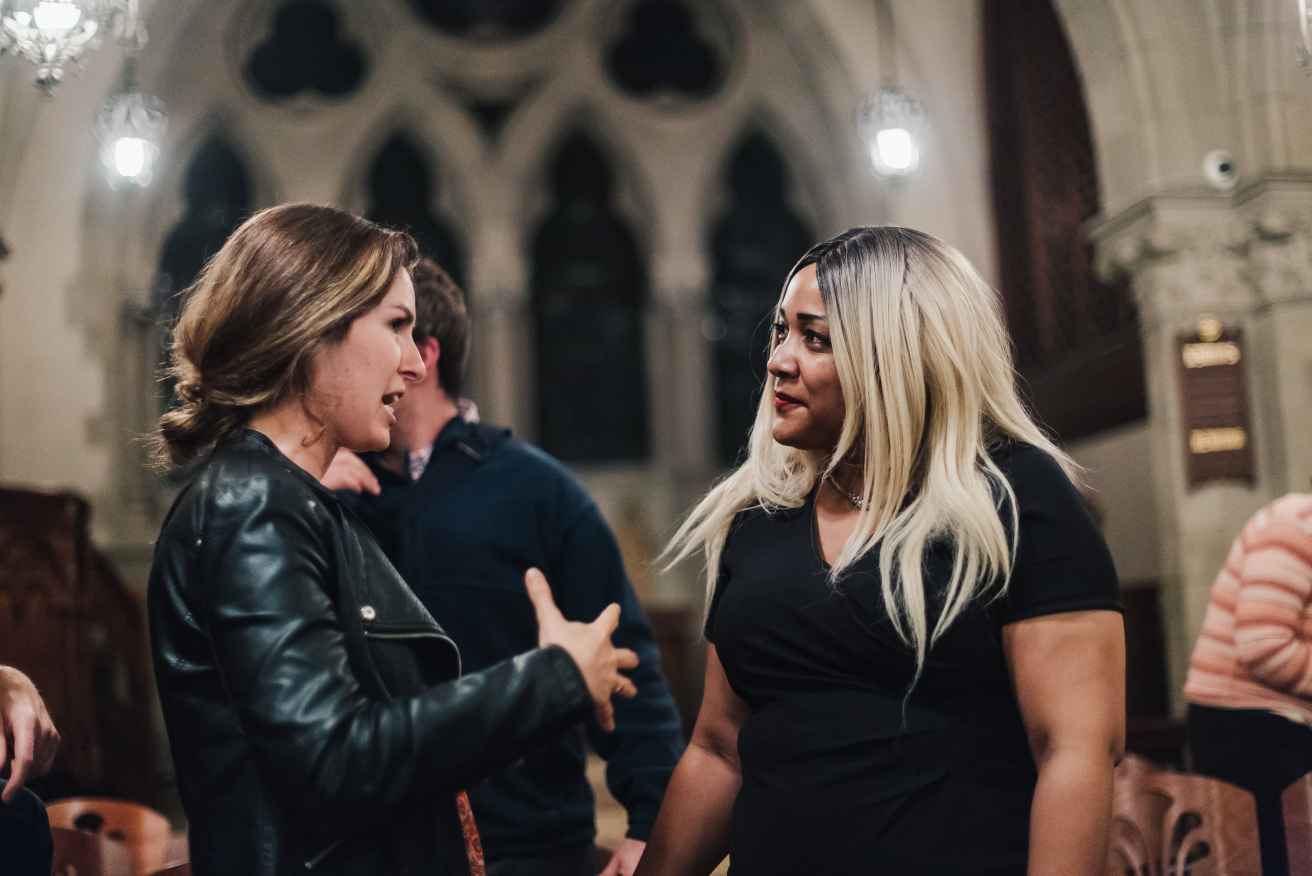
1. You’re at a party talking to your friend Bill about something going on at church, and Joan, a slight acquaintance of yours, overhears you.  Joan says, a little aggressively, “You go to church?  Why?”  How do you respond?  Do you:

a. Point frantically over her shoulder, shriek, “Oh my God!  Look!” and hide behind the curtains while everyone’s head is turned.

b. Shrug and say, “Uh, I dunno.  They have good coffee at fellowship hour.”

c. Say, “Mostly, it’s because I experience things there I don’t experience much elsewhere in my life: it’s a chance to sit and be quiet and think about what’s important, it challenges me to live as the sort of person I want to be, and best of all, it’s the place where I’m most consistently aware of God’s presence in my life.”

2. When Bill, the friend you were originally talking to, says, “I’m a very spiritual person, but I just don’t like organized religion,” do you:

a. Say, “Yeah, I don’t blame you.  You should see what a mess my church is.”

b. Kick him in the shins while yelling, “I hate when people say that!  It’s such a copout!  What does that even mean?!”

c. Say, “You know, you’d be surprised how many people in my church feel the same way.  There’s a lot not to like about organized religion; it sounds like you might have experienced some of that.  Me, too, but I try not to blame God for everything God’s followers do.  And then again, members of organized religions have done some pretty incredible things over the years, too.  Plus, not every organized religion is the same.  You should come check out mine.”

3. Joan says, “OK, whatever, but you don’t actually believe in God, though, right?”  Do you:

a. Thank your host for a lovely party and leave at once before anyone can ask any more difficult questions.

b. Laugh uncomfortably and say, “I don’t know.  Probably not.  But church activities look great on my kid’s college applications.”

c. Say, “Actually, I do.  Some days it’s harder than others, but I’ve felt God at work in my life and seen God at work in the world too often to not believe in God or to stop working on knowing more.  I struggle with my faith all the time, but I have to do what my heart tells me.”

4. Joan presses you further: “Yeah, but why do you believe?  I mean, it’s the 21st century!  Why not leave superstition in the Middle Ages where it belongs?”  Do you:

a. Frown threateningly and say, “I believe in God because the Bible says that bad, bad things happen to those who don’t believe.  So you’d better get on the bandwagon.”

b. Say, “I can’t really explain it.  Maybe you should ask my minister.”

c. Say, “Well, I believe in God because I’ve met God.  When we’re doing stuff together at my church, like singing or praying or going on service projects, or sometimes when I’m alone out in the woods, there’s a power I sense there that’s beyond just me.  It feels like being more than the sum of the parts.  Also, a few years ago, I got a really scary diagnosis at the doctor’s office.  I had never felt so alone in my life.  Then one day this feeling of being loved just washed over me, and I knew that God was there.  And then all these church members showed up to visit me in the hospital, and I knew that the feeling of being loved I’d had wasn’t just a feeling; it was real.  A psychologist or a sociologist might call those things something else, but I call them God because that’s what they feel like to me.”

5. A man who’s been hovering on the edge of the conversation till now hesitantly says, “You mentioned something about prayer.  I have this problem I’ve been dealing with for a long time now.  I’ve done everything I can think of, and nothing seems to be helping.  I’m ready to try anything.  Does praying really work?”  Which of these do you say:

a. “Wow, you must really be a wreck if praying is all you have left.”

b. “I can’t really answer that.  Truth is, I don’t pray that much myself and I tend to kind of space out whenever the minister starts praying in church.”

c. “Well, it depends on what you mean when you ask if it works.  I don’t think prayer is like a magic wand that you get to wave and make it all better.  But I do think God hears our prayers.  And I can tell you that I usually feel at least a little better after I pray, and my life just seems to work better when I do it regularly.  It doesn’t solve all my problems for me, but it does help me get through them.”

6. Joan is unconvinced, and says, “Well, I’m sorry, but I can’t buy any of this stuff.  It’s OK if you need it, but it just isn’t for me.”  What’s your response?  Is it:

a. “Well, that’s too bad.  I just hope for your sake that Hell isn’t as bad as they say it is.”

b. “That’s OK!  To each his own, I always say!  And it’s not like God’s that big a deal, anyway.”

c. “Fair enough.  I guess it won’t surprise you if I say I think you’re missing out on something good, but I totally respect your position.  And if any of you guys ever want to talk more about it, maybe you could come with me to church some day.  There are lots of us there with the same questions we’ve been talking about here.  We don’t have all the answers to the questions, but we think God’s happy we’re asking them.  And we always say, ‘No matter who you are or where you are on life’s journey, you’re welcome here’, and we mean it.”

The end.  OK, so now it’s time to score yourself.  Look over your answers.  If you answered “c” to all the questions, you are ready to talk about God and make a witness to the world.  If you answered “a” or “b” to any of them…God loves you just the same.

The point is this: Like Naaman, the world needs our witness and our testimony.  There are broken and aching people out there longing to hear a hopeful and a healing word from someone who knows.  There are ones like Naaman out there, ones who have never heard of the God we know, who have only ever been told about other kinds of Gods, judgemental and wrathful and hateful and violent, ones for whom your witness might be like the healing waters of the Jordan on blistered and peeling skin.

And God needs your witness, too.  As Jesus sent the seventy out to prepare the people’s hearts for what they would meet and receive in him, God sends us out, too, to make the way ready for God’s own coming into the hearts of those we meet.  As surely as we have received and lived the good news in our own lives, we are called to tell the story of that living to those whom we meet.  It is not easy, it will not always be well-received, it is embarrassing, it does take practice, but it is our call and our sending. 

I believe that here at Old South we have begun the task of relearning the old, old skill of witnessing to God’s action in our lives, and I praise God for that.  For the harvest is plenty but the laborers are few, and our witness is just what God and the world need.  Amen.


[1] With thanks to the StillSpeaking Initiative Writers’ Group of the United Church of Christ for their pamphlet quiz entitled “Are You Ready to Talk about Your Church?”, and especially to its primary author Lillian Daniel, Senior Pastor of the First Congregational Church of Glen Ellyn, IL.


Copyright © 2007, Old South Church and by author.
Excerpts are permitted as long as full accreditation is made
to Old South Church and to the author.

Back to Sermon Page

The Old South Church in Boston
645 Boylston Street
Boston, MA 02116
(617) 536-1970