Will you pray for me? Lord, may the words of my lips and the meditations of all our hearts be acceptable in your sight, our Rock and our Redeemer. Amen.
Just over the balcony in the rear of the Groton Community Church, United Church of Christ in Groton, New York, there is a large stained-glass window. It’s actually not much as stained-glass windows go, but to eyes unaccustomed to much luxury, as mine were as I grew up, that window was glorious. It’s the sort of triptych window you often see in churches, the central part large and arched, and on either side two smaller, narrower arches. In the central window stands Jesus, just where you would expect him to be. And he looks pretty much just as you would expect him to look, at least in an American church. You know: white robes, whiter skin, a kind smile, arms outstretched in invitation, and the promise of comfort in his eyes. It’s the kind of image one New Testament scholar1 calls “Mommy Jesus”: soft, welcoming, safe, someone who just wants to give you a hug. Growing up, I thought he was magnificent, and since old devotions die hard, I frankly still do.
Now, when I was young, I only ever saw that window on Sundays, with the morning sun streaming through, and the image was as familiar to me as my own face. But as I got older, I would sometimes find myself in the Sanctuary at night, for Youth Fellowship group meetings or other things, and I discovered that at night, that window changes. At night, Mommy Jesus turns creepy. The dear, familiar Christ image that is there in the daylight disappears, and in its place there is nothing but some muddy colors surrounding a glowing white robe, which itself frames an empty, black, gaping hole where a face should be. It’s a creepy, creepy Jesus. I remember one Christmas Eve in particular being completely ruined for me when I spent the whole service being skeeved out by my faceless Messiah up there not staring at me. Instead of getting in the Christmas spirit, I spent that whole service trying to imagine what had become of Jesus’ face. Of course, I eventually figured out that it was about which way the light flowed through the window, but to this day, I make a point of entering that sanctuary only in the morning if I can possibly help it.
Today’s story from Matthew is likewise about people wondering who Jesus was, or who he had become. Seen one way, it’s about God, and maybe Satan too, figuring out who Jesus is: it’s about a series of trials, about Jesus being tested to see whether he has the stuff to stand up to temptation. Seen another way, however, it’s about Jesus himself seeking to discover who he was, or who he was becoming. Seen this way, it’s the forty days, not the Temptation, that are important. Seen this way, it is a coming-of-age tale: a young man heads out, away from all he knows—or thinks he knows—into the wilderness, there to be alone, there to find himself—and God. It is Abraham following God’s command to head out to the unknown. It is the Israelites wandering in the wilderness for 40 years and becoming a people. It is a vision quest.
It is Jesus, alone with God and searching for himself. People had told him about his birth, no doubt. Mary had told him about the angels and the shepherds, no doubt. He remembered about the escape to Egypt, no doubt, and no doubt he was still contemplating in wonderment the way the sky cracked open and the Spirit came down at his baptism. So he knew some things about who other people thought he was. But the creeds and the hymns hadn’t been written yet; he didn’t have the benefit of later generations of Christians deciding for him who he was. And so he had to ask: who was he when there was no one around to tell him? Who was he when all that made him who he was was gone? Who was he without his friends, or his parents, or his hometown, or everybody else’s expectations? Who was he when it was just God, the sand, and him?
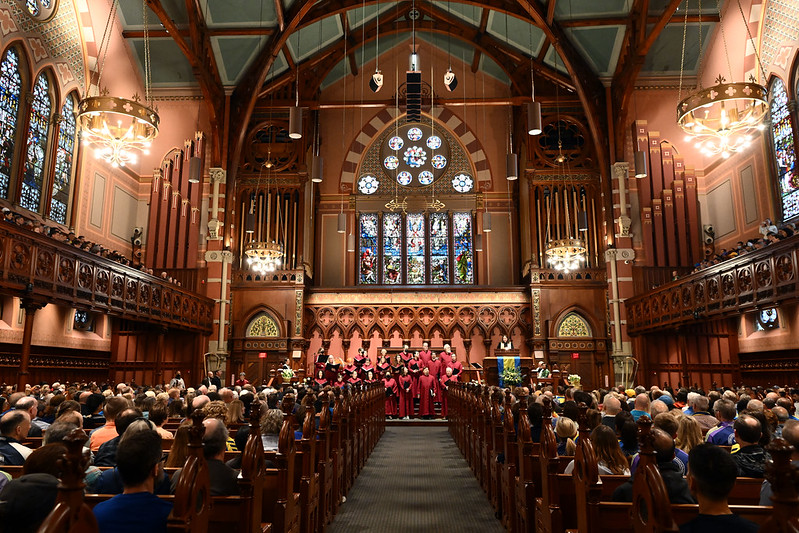
It is, likewise, what this Lent, these next five Sundays, will be about here at Old South Church. It is, after all, the twenty-first century, two thousand years after Jesus lived and walked on the earth the first time. We live in a postmodern, post-Enlightenment, post-naivete, post-Christendom, post-Christian, post-everything time. Old truths have crumbled, as they will. Old sureties are no more. Old assumptions are sagging beneath the weight of scientific discovery and global ecological crisis and Christians’ misbehavior in the world. We think we have become in many ways too smart for Christianity, or at least too smart for the old Christianity. And so it is time for us to begin asking some serious questions about who Jesus was—and is. For while we may not know the answers yet, we do know this: he is far too precious to let go.
And we are not alone. These days, more and more, perhaps most, people within the church and many without are wondering who Jesus is, and not only who he is in a general sense, but who he is for each of us personally. We ask whether the old forms still work. Whether names like Lord, or King, or Savior, have meaning in today’s world. Whether what we learned in creeds and doctrines still makes sense. Whether what you’ve hard from televangelists, or from conservative evangelical friends, or from Unitarian friends, is true. We puzzle over the virgin birth and the Trinity, over Jesus’ Jewishness and the relationship of Christianity to Judaism, over substitutionary atonement and the crucifixion, over the problem of believing in miracles—or not—in the twenty-first century. We agonize over whether Jesus holds any hope or promise for people like us at all. Old South has been in the thick of this struggle, seeking to define progressive Christianity in our new world. It is painful, glorious, un-easy, holy work.
Now, there are those out there, like the authors of the “Saving Jesus” series we will be using, that have gone so far as to claim that Jesus, our savior, needs saving: from hundreds or even thousands of years of misinterpretation, from history, even from his own followers. We don’t know if that’s true, but we’re willing to entertain the possibility. And so this Lent, we are embarking upon a wandering of our own, to discover if we can who and what Jesus Christ is. Over the next five Sundays, with video and commentary, with discussion and prayer, we will head out into the wilderness, into uncharted territory. We will go with the guidance of many of today’s leading scholars of religion, theology, ethics, and biblical studies, but we will nevertheless leave behind much of what we know—or think we know—about Jesus and about ourselves. We will ask ourselves who Jesus is. We will ask ourselves who we are. And we will see if Jesus really does need saving.
This journey in search of Jesus will not be easy. We may lose him for a time. His face will disappear. You will wonder who he has become, or where he has gone. It may get creepy. But here’s the good news: just as Jesus did, we will have the Scriptures, the wisdom of the ages and the best truths about God our ancestors could bequeath to us. Just as Jesus did, we will have the Spirit of God among us. And we will have something that Jesus didn’t have on his journey: each other.
We will not be alone. We go on this journey to the wilderness together. We begin with a meal together, and then we head out together. And, as always happens when the people of our God set out with brave hearts, and seeking souls, and prayerful acts, God will be with us, pointing, encouraging, guiding. And our very wandering and wondering, the very faith that our journey implies and requires, will bring the light back to the face of our Messiah, our anointed one, our Jesus. And if the face looks very different than it did when we started, still we trust that at the end of our forty days of wandering, as at the end of Jesus’ own wandering, God is with us, and our Savior still among us. So may it be, amen.
1 Amy-Jill Levine, Saving Jesus
Copyright © 2008, Old South Church and by author.
Excerpts are permitted as long as full accreditation is made
to Old South Church and to the author.