Old South Banner
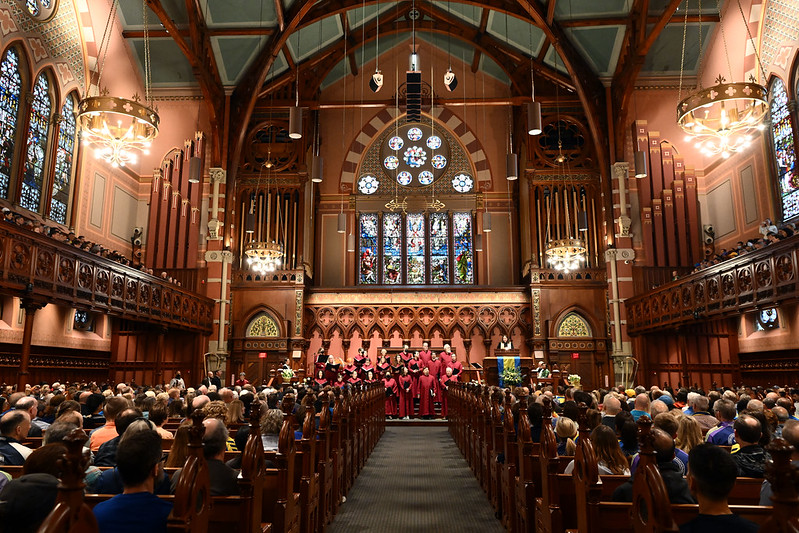
Old South Sanctuary (photo by Sarah Musemuci)


Copyright © 2009, Old South Church and by author.
Excerpts are permitted as long as full accreditation is made
to Old South Church and to the author.


Old South Sermons:

Mother's Day Reflection

by Quinn G. Caldwell, Associate Minister

2 Samuel 21: 1-14

May 10, 2009 Mother's Day

Listen to this sermon


Will you pray for me?  Lord, may the words of my lips and the meditations of all our hearts be acceptable in your sight, our Rock and our Redeemer.  Amen.

Today is, as you know, Mother’s Day. I have three things to say to you about it, and I’m willing to bet that, of the three, there will be at least one that you have not heard before.

The first one is this: the founder of Mother’s Day hated it. Or at least she hated what it became. Most historians agree that the first observance of Mother’s Day in its modern form was held by Ann Jarvis in 1907 to honor the life and work of her mother Ann, who had died two years before.

Ann (the mother, not Anna, the daughter), was a community organizer and pacifist during the Civil War, working with women to tend to the needs of soldiers on both sides of the conflict. After the war, she began to promote what she called a “Mother’s Work Day”, to organize mothers to call for an end to death by war.

That’s what Anna (the daughter) was trying to honor when she started the holiday. In some ways, that’s even what Woodrow Wilson was doing when, in 1914, he proclaimed that the way to observe the first national Mother’s Day was to display the American flag in honor of mothers whose sons had been killed in war.

By the 20s, it had all fallen to pieces, at least in Anna Jarvis’s eyes. The greeting card companies and the florists, ever ready for a new opportunity, had so effectively taken the holiday over that any edge it had ever had was completely obliterated under a mass of doilies and carnations and spent cash. According to legend, Jarvis had this to say about the way most of us (including me) will probably celebrate the holiday: “A printed card means nothing except that you are too lazy to write to the woman who has done more for you than anyone in the world. And candy! You take a box to Mother—and then eat most of it yourself. A pretty sentiment!” Anna Jarvis died in poverty, having spent her inheritance fighting against the holiday she had started.


The second thing I want to tell you about Mother’s Day is this: the story of Rizpah, and if I have my way, you will remember Rizpah every Mother’s Day from now on. Here’s the story again. There was a famine in Israel. David, the second king of Israel, asked God why, and God said this: it was because Saul, David’s predecessor, had broken an oath. Apparently Saul had promised not to attack the Gibeonites’ people, and then had done it anyway. So now, God said to David, Israel owed the Gibeonites. Blood was the only thing that could wipe out bloodguilt, said God (or at least that’s what David said God said). So the Gibeonites said they wanted seven of Saul’s sons impaled on a mountain and left to rot. David was only too willing to give them this, since it all but wiped out the royal house he had replaced. So they did it: seven of Saul’s sons and grandsons impaled and exposed on the mountaintop.

Enter Rizpah. Rizpah was a former wife of Saul’s and mother of two of the impaled ones. The story says that after they were killed, she climbed that mountain all alone, spread out a piece of burlap for a sleeping bag, and for the next half a year defended her sons’ bodies from the birds by day and the wild animals by night.

Can you picture it? This mother who has watched her sons hung on spikes in front of her. This mother who has watched as the kings and the generals have traded her sons’ lives for political expediency and retribution and claimed God wanted it. This mother, a former lady of the royal court now sleeping on burlap on a rock because she won’t leave her sons and because the king won’t let her take them down because he says God wants it this way. Can you picture it? The boys she had breastfed, hung up there like that. Rizpah, running back and forth, waving her arms at the birds until she can’t lift them anymore, yelling until she loses her voice. Have you ever tried to get a crow to leave a garden it doesn’t want to leave? Can you picture this pampered concubine with a flaming brand in her hand and her hair unbound and her eyes wild as she swings it at the wolves that come to gnaw in the middle of the night? Can you see her driving her friends away when they come to try to talk sense into her, can you see her refuse to leave her sons’ bodies because the pain of watching her sons turn into bones is better than the pain of letting her boys become carrion? Can you see her there on the mountaintop?

And can you see another son hung on another piece of wood on a different hill by different rulers? And can you see another mother at his feet?


The Jarvises weren’t the only ones planning Mother’s Days in the early years. Julia Ward Howe, author of the words to the “Battle Hymn of the Republic”, was also a social activist, a feminist, and a pacifist. Throughout the Civil War, Howe had watched as powerful men sent mothers’ sons to their deaths. She’d seen as rulers and generals claimed that the deaths of boys was the only way to solve what ailed the country. She’d watched as mothers’ hearts broke at the sight of the broken bodies of their boys. So she began organizing meetings of mothers whose sons had fought or died in the war; often these meetings included mothers from both sides of the war and invited them to join together for love of their children and say, “Never again.”

In 1872, she organized an anti-war observance that she called “Mother’s Day”. At it, she made her famous “Mother’s Day Proclamation”, which is the third thing I want you to hear. It goes. in part, like this:

Arise, all women who have hearts!
Whether your baptism be of water or of tears!
Say firmly:

We will not have questions answered by irrelevant agencies,
Our husbands will not come to us, reeking with carnage,
For caresses and applause.
Our sons shall not be taken from us to unlearn
All that we have been able to teach them of charity, mercy, and patience.
We, the women of one country
Will be too tender of those of another country
To allow our sons to be trained to injure theirs.”

From the voice of a devastated Earth a voice goes up with
Our own. It says: “Disarm! Disarm!
The sword of murder is not the balance of justice.”
Blood does not wipe out dishonor,
Nor violence indicate possession.
As men have often forsaken the plough and the anvil
At the summons of war,
Let women now leave all that may be left of home
For a great and earnest day of counsel.
Let them meet first, as women, to bewail and commemorate the dead.
Let them solemnly take counsel with each other as to the means
Whereby the great human family can live in peace…
Each bearing after his own time the sacred impress, not of Caesar,
But of God—

End quote. Ward’s vision was not of a day where mothers were thanked for all they have done, but where mothers themselves rise up over the bodies of their sons, used by the rulers of the age as pawns and sacrifices and bargaining chips. She wanted them to be like Rizpah, who used the power of her love and of her grief to rise up to acts of bravery and conscience and witness that would teach the powers that be a lesson.

The Scripture says that after all those months of Rizpah warding the animals from her sons, David took notice. David took notice, and gave the boys, and even Saul, an honest burial. Rizpah taught the king a thing or two about how to behave, and how to grieve, and how to make the world right. And the Scripture says that it was only when David buried the bones, treated those bodies well, that God again blessed Israel.


Somebody else has already told you that mothers are like God because they bring life into being. Somebody else has already told you something about mothers and God and nurturing and feeding. But Anna Jarvis? Rizpah? Julia Ward Howe? Here’s what they want you to know, I think: there is no grief anywhere like the grief of a mother who has lost her child. And there is a power in the enormity and wildness of that grief. And the power is like unto God.

Here’s what they want you to know: what Rizpah felt as she stood at the base of the stakes that held up her dead sons? The love and the grief that made her crazy and powerful for the task at hand and able to turn the heart of a king? That’s God. What Rizpah felt? That’s what God feels when she looks down and sees the powerful sending the children to war. What the Civil War mothers felt that drove them to meet for making peace and saying, “Never again”? What the mothers right in this room who have lost children feel?

That’s what God feels when Al Qaida tells boys to strap bombs to themselves and go to crowded places. That’s what God feels when Presidents safe in Washington send troops to war to spill blood to try to wipe away somebody else’s spilled blood. That’s what God feels every time a landmine explodes. That’s what God felt in the Civil War and the Gulf Wars. That’s what God felt when Mary knelt at the base of her own son’s stake.

And it was that love, that broken heart, the power of that grief that led God to say, “No more,” to empty the tomb. And it was that same power that came blowing through the world to gather together an army for peace to put an end to mourning, and crying, and pain forever, a gentle army born from the story of the death of a mother’s son, a heavenly host sent out into the world to find the Rizpahs, and gather them up, and ask them to teach us so that it will never happen again.

Which is what Anna Jarvis thought she was doing; you can see why our modern Mother’s Day became a problem for her. This year, when you send your mom the flowers or take her to brunch, remember Anna Jarvis, and Julia Ward Howe, and especially Rizpah, and think about this: imagine what your death would do to her. And then know that because of the decisions of the powerful ones of the world, there are mothers in Darfur, and in Iraq, and in Afghanistan, and on the mercy seat in Heaven, who feel that way right now.

And you mothers who have lost children, and you mothers who fear that one day you might, know this: the power, the wildness, the craziness in what you feel? That is the very power of God, calling you to help build a world where no king ever again spills the blood of a mother’s son and claims it’s God’s will.

If you want to know how God feels when the leaders of countries settle their differences with the blood of innocents, do not ask David. Ask Rizpah.

Amen.


Copyright © 2009, Old South Church and by author.
Excerpts are permitted as long as full accreditation is made
to Old South Church and to the author.

Old South Church
645 Boylston St. Boston, MA 02116
(617)536-1970 Tel (617)536-8061 Fax

You can E-mail us by clicking here: OSC Communications

Copyright © 2009, Old South Church