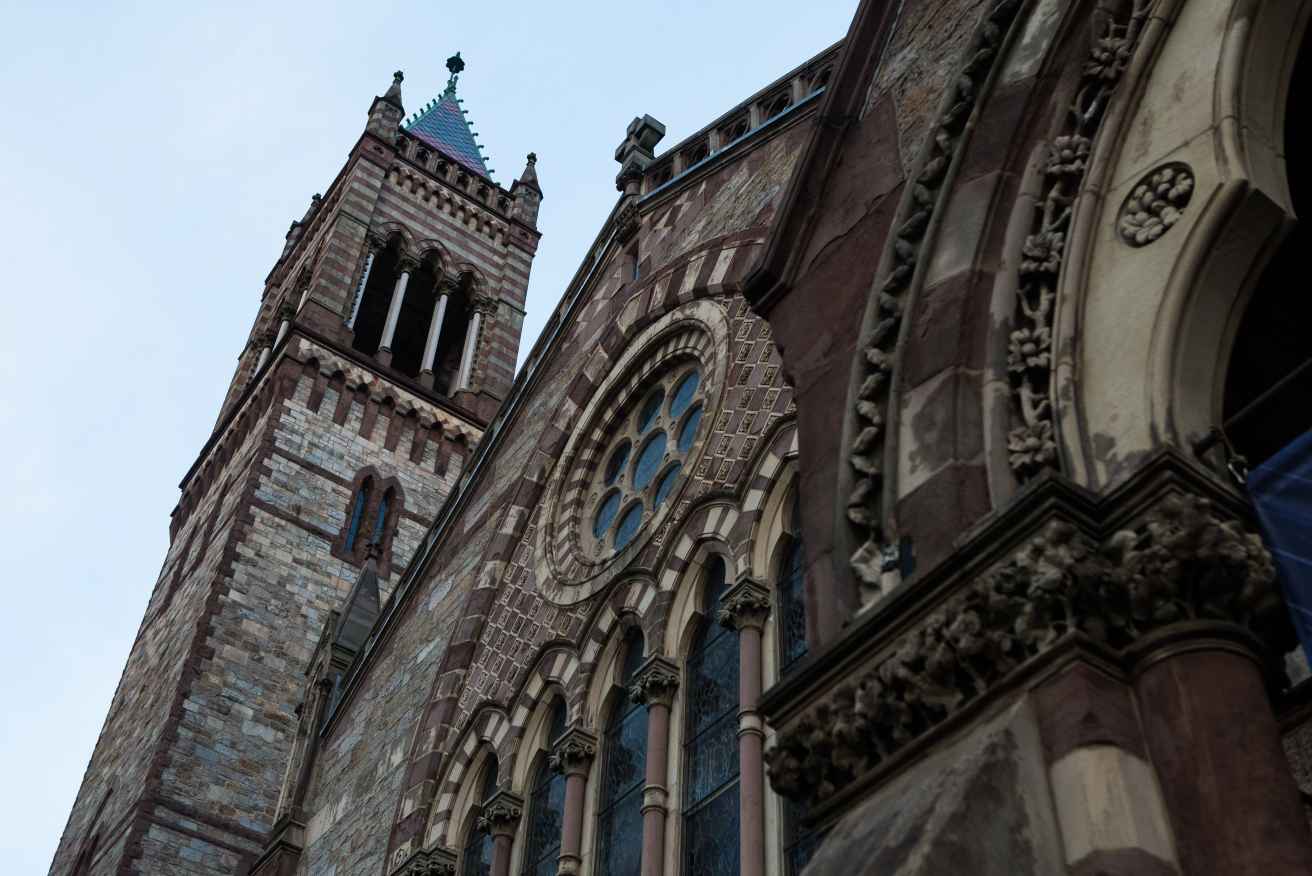
The Old South Church in Boston

Between

A Sermon by Rev. Quinn G. Caldwell

October 14, 2007

Access Sunday


Luke 17: 11-19

Listen to this Sermonmp3 file


Will you pray with me?  Lord, may the words of my lips and the meditations of all our hearts be acceptable in your sight, our rock and our redeemer.  Amen.

It was a strange little band.  There were those among them there that, in their former lives, had been rich, and those who had been poor, farmer and herder, fisherman and laborer, people that, under any other circumstances, would never have found themselves sharing the same patch of dirt.  But there they would sit, just outside the village, all day long.  As long as they were alone, they would talk and joke amongst themselves, but as soon as they saw a villager or traveler approach, they would become morose and pitiful, grimacing and groveling and begging, calling out, “Unclean!  Unclean!  Master, have mercy on us!”.  For you see, they were not actually very sick at all; the people called them lepers, and the priests had declared them unclean and unwelcome because of it, but none of them suffered from actual leprosy.  The skin diseases they had were more annoying, less dangerous than that: eczema, rashes, fungal infections; not very dangerous or very communicable, but there they were, nevertheless.  Though they felt alright most of the time, the only way they could live was by begging, and so even when they were merry among themselves—which was most of the time—when others were nearby, they became beggars, putting on the act the populace required of them if it was to throw its money—from a good safe distance—into their outstretched hands and cups.

Once in a while, a new man would join them.  It would take a few days or even a couple of weeks of getting hungrier and hungrier before he learned the trick of looking more pitiful than he felt, of sitting and speaking and being pathetically, of begging in the way that made clear that the beggar understood the gulf fixed between him and the others.

And that gulf wasn’t important just to the people walking by, who used it to congratulate themselves on their luck; it was important to the little group as well, for it was what united them.  They shared little else; not even the diseases that had gotten them declared unclean by the priests were the same.  What they had to unite them, there in the dirt outside the village, was the distance between them and everybody else, across which the people threw their money and their scorn, and sometimes their pity.

Being cast out bound them together in ways almost nothing else could.  There was even a Samaritan among them.  He’d been there so long none of them really remembered how he had come among them, though a Samaritan in a Jewish village was a strange thing even in the border country between Israel and Samaria.  He’d been one of them so long they had forgotten that Jews and Samaritans, divided by culture and by religious practice, hated one another, and that Samaritans were, to most Jewish minds, at least as unclean as lepers.  But they’d been unclean together by virtue of their illnesses for so long that his being unclean by virtue of his being a Samaritan mattered to them not at all.

So, one day, Jesus, the healer and rabble-rouser they’d been overhearing more and more travelers talking about, came walking toward the town.  When they heard he was on his way, they did what they always did, what they had to do to earn enough to survive, they became morose and pitiful, and they grimaced, and groveled, and begged, and they called out, “Master!  Have mercy on us.”  But Jesus, Jesus didn’t throw money at them, as they hoped he would.  This Jesus they’d been hearing so much about, did something no passerby had ever done before: he approached them.  He looked them in the eye, like men, not like lepers.  And, trembling with anger and disgust not for their illness but for their abasement, said, “Go!  Go and show yourselves to the priests!”

And there was such authority in his voice and such a challenge in his eye as he said it that they decided to do it.  They stood up and, backs straight and heads high, they turned, and they entered the town from which they had been cast out, and they headed straight for the priests that had named them unclean, to demand their place among the people.  And as they went, they did not pause to ask whether they were still sick, whether their rashes and their eczema and their infections had been cured, for it did not matter to them any more.  What mattered was that they had been made clean, been made acceptable, been made human again by being treating as humans.  They had been made clean by Jesus’ approach and by Jesus’ address and by Jesus’ look, reminded that, sick or not, they were human beings, sons of the God who created them, and nothing, no social stigma or tribal cultic law, would keep them from claiming their place among the people.

Nine of them marched into town, straight across the invisible boundary between their old lives and their new.  But the tenth.  The tenth marched with them as far as the edge of town—and then he stopped.  For if the nine were made clean, were indeed welcomed back among the people as they had gone to demand, he would still be…a Samaritan.  A foreigner of the worst sort.  Still unclean.

So he stopped, and he turned, and he went back to Jesus, and he thanked him, and he—a Samaritan, a foreign, northern heathen—praised the God of Israel.  And again, as before, Jesus approached him, and he looked him in the eye like a man, not like a Samaritan, and he said, “Get up and go.  Your faith has saved you.”

We do not know what happened then; the story as we have it ends there.  But I like to think of the Samaritan running after his friends, pausing a little, maybe, at the edge of the town, and then putting on an extra burst of speed.  I like to think of him catching up to them as they march toward the priests’, of them stopping in shock and surprise as he reaches them.  I like to think of the emotions that plainly show in their faces as the Samaritan grins defiantly, familiarly, at them: first scandal, then confusion, then the far away look of memory, then resolution, then great, booming peals of laughter.  I picture them slapping him on the back, putting their arms around his shoulders, and heading off with him to the priests.  I don’t know what I picture the priests doing when those ten burst into their quarters, but I’m not sure I care.  What I like to picture are the scenes of joy and relief as husbands and brothers and sons returned to their homes and their families and their widows and their work.  I like to picture the life of that village transformed and resurrected by those men’s return; after all Judean villages were tiny, and the loss of nine men would have been a great loss indeed.  And I picture the Samaritan finding a way and a place to settle among them.  And in that way, I like to picture their faith saving them all.

Today, all across our United Church of Christ, congregations are celebrating Access Sunday.  It is a day we pause to give thanks to God that we are not a community limited only to those who can walk, or see, or hear, or speak, or move perfectly, that we are not a church made up only of those who can be described by that most odious and false of labels: normal.  It is a day we give thanks for all the bodies God has created, and all the strength of spirit God has given in such abundance, and all the ways we have found to praise God with the bodies we’ve been given.  It is a day we give thanks for how far we have come in making our church accessible to all who would enter, and a day we listen for God to tell us how far we have to go.

Today, we remember heroes who, like the Samaritan, came to Jesus for the strength to claim their own as people of God and demand full inclusion in the life of society and of the church.  We call to mind people like UCC minister Harold Wilke of blessed memory, who founded the Healing Community/Caring Congregation for people with disabilities and was the first chair, in 1977, of the UCC’s Advisory Committee on the Church and the Handicapped.  In his teaching at Union Seminary and in his travels across the country, he fought for decades for recognition and full inclusion of the gifts of people with disabilities in our culture and our congregations.  When, in 1990, the Americans with Disabilities Act was signed into law, making most forms of discrimination against people with disabilities illegal, Wilke was asked to pray at the law’s signing.  And when George Bush senior handed him the pen, Wilke took it and signed his name gracefully with his toes—having been born without arms.

Today, we at Old South Church remember that once upon a time, we did not have large print worship bulletins, and we give thanks for those who asked for them.

We remember that once, we did not have a vocal amplification system or devices for the hard of hearing, and we give thanks for those with the strength to claim their right to full inclusion in our worship by asking for them.

We remember that once, those who could not come to worship were consigned to miss it, and we give thanks that now those who cannot come can listen online or receive CD recordings.

We remember that, once upon a time, everything that happened in our service had to be heard to be experienced, and we give thanks that now at least half our services are interpreted into American Sign Language for the deaf and hard of hearing.

We remember that the words in our portico, “Behold, I have set before thee an open door” used to hang over steps in that same portico that prevented people in wheelchairs from coming through that open door.  We give thanks for the oft-repeated request to do something about that, for all the people that worked for years to solve the problem, and for the new sloping sidewalk that welcomes people to roll on in under those words and through that door—which opens, by the way, as all God’s doors do, automatically.

On Access Sunday, we praise God for being the kind of God that crosses every gulf that stands between the people and their Creator, and the people and each other, whether that gulf be as concrete as a set of stairs or as intangible as an ancient cultural prejudice.  We thank God for the people that have been on the outside of the church’s life, who have met Jesus and been challenged by him to claim their rightful place in his church, and we pray that Jesus give us the strength to see and hear the ones that, despite our best intentions, are still kept outside our walls.

We give thanks for all that has been done to give all the people access to our church.  More importantly, we give thanks for all that God has done to give the church access to all the people.  For the truth that Jesus knew, the truth that the lepers and the Samaritan learned, is that without access to all the people, without all their gifts and all their glory, we are not as strong as we could be, we are not as fulsome as God wishes for us to be, we are not as strong as Christ calls us to be, we are not as wise as the Spirit hopes we will be.  For until all the people, with all their kinds of bodies, have access to the church, and until the church has access to all the people, with all their kinds of bodies, we are not yet the church that God dreams we will be.

May God help us, and may God make it so, and one day, when we have stuffed every person of every kind of ability possible into this place, may the people say of us, like the Samaritan, that we were saved by our faith.  Amen.


Copyright © 2007, Old South Church and by author.
Excerpts are permitted as long as full accreditation is made
to Old South Church and to the author.

Back to Sermon Page

The Old South Church in Boston
645 Boylston Street
Boston, MA 02116
(617) 536-1970