Will you pray for me? Lord, may the words of my lips and the meditations of all our hearts be acceptable in your sight,
our rock and our redeemer. Amen.It always happened the same way. One Saturday, late in November, Margaret would walk into her tidy, well-kept kitchen. She would stop there, right in the middle of the shining floor—always in the same spot—place her fists on her hips, and look around, surveying the room like a general planning a battle. Then she would take a deep breath. As a smile spread over her face, that breath would expand and expand her already expansive breast until anyone watching would fear that the buttons would pop right off her shirt. Then, just when it seemed that the miracle that had held her shirt together till then would surely wear off and the whole thing would burst apart around her, she’d let that breath out, all in a rush, and say, “Well now.” “Well now,” she would say with a gleam in her eye, and then she’d set to work.
A grandchild happening into the room over the next hour or two would just have time to catch a glimpse of cupboards and drawers hanging open, of bottles and jars and tins and bowls and measuring cups and utensils piled all around the kitchen, and of Margaret herself with a pencil and paper in her hand and her hair coming loose from its bun, before she would fly at them, arms waving and laughter breaking out all over her plump frame. “Get out!” she would laugh. “Get out! I’m getting ready to make pudding, and I don’t need you underfoot. Get out!”
Whoever it was that had wandered into the kitchen at such an inopportune moment would turn on his or her heels and hurry out of the room without so much as a peep. For she had said the magic word. Pudding! The news spread through the whole house in a matter of minutes. Pudding! Pudding! Gran was getting ready to make her Christmas pudding.
Now, Margaret was a strong and an accomplished woman. She had gone to college in a day when almost no women did. She had married her school sweetheart, and had lived with him through poverty, and plenty, and poverty again, and plenty again. She had raised five children, and buried two. Over time, she and her husband had built a comfortable home and a living to retire on, and then, just when she thought she was done raising children, her favorite son had been killed in the war, she had taken in her daughter-in-law and grandchildren in. She had lived through a lot, had conquered a lot, had suffered a fair amount. And of it all, of all the things she had done or could do, the thing she was most proud of, the crowning achievement and greatest joy of her life, was her Christmas pudding.
It was her intention to be sure that by the time she died, she had passed on her joy and her recipe to her children and grandchildren, and it was surely working. For by the time she had finished her inventorying—for that’s what the fuss in the kitchen was about—everyone in the house was alive with expectation and excitement.
When she went out to do the shopping, the grandchildren, hurried and encouraged by their mother and grandfather, would race to the kitchen and, in a process quite unnecessary in a kitchen as clean as Margaret’s, would set to work washing and scrubbing and drying the bowls and pots and pans and utensils she had pulled out for them. When they were dry, they would lay them out, all ready in their places: the two big pots on went the stove with their tops on, with the two pudding molds next to them, the same mold always next to the same pot; the cutting board went on the table with the knives on top, the two big glass mixing bowls right next to it, each with their own wooden spoon, and a smaller ceramic mixing bowl—the one with the flowers on it, not the one with the birds—standing next to them. Everything that Margaret had pulled out of the cupboards and drawers was carefully arranged, each in the spot it had occupied on the day before pudding day since the beginning of time. The grandchildren had all known where everything went since they were five—the oldest, bossy one would tell the others that she’d known since she was three—and they all checked and rechecked the setup while they waited for Gran to return.
When she finally came in with her bags full of shopping, she always said the same thing. Airily, and feigning surprise, she would go, “Oh, did you do the washing up? How nice! Now, get on out of here while I get these things unpacked—and stay out” (this she said with a playful dig in the ribs at the nearest grandchild) “until tomorrow!” And the children would troop out of the kitchen, not to return until the morning.
The next day, Sunday morning, the kids would spring out of bed almost as early and almost as loudly as if it were Christmas itself. After a hurried breakfast, they would go to church, which always lasted forever on that day. As soon as they got back, the family would gather in the kitchen, clothes changed and aprons tied over every big and little body, and the cooking would begin.
But not just the cooking. The story-telling, too. For this wasn’t just any pudding, Gran would say; it was a Christmas pudding, and it told a story. Every ingredient was a part of the story, and as they worked, Margaret told it to them.
They always started with an orange. While they squeezed it and zested its rind, she would begin by telling them that the orange was a gift from far away, just like Jesus.
While they shredded carrots, she said that carrots were roots, and she told them about the root of Jesse, the ancient king of the Israelites, and about how Jesus grew from that root, and was the best king of all. And then they would flake and chop almonds and pecans, which grew from trees, she’d say, like the strong tree Jesus was.
And so the story and the pudding progressed:
There was molasses (she called it treacle) for the sweetness of Mary, and of the baby;
Butter from the milk of the cow that breathed its warm breath on baby Jesus in the manger;
Egg yolks that looked like the sun, for the Sun of Righteousness;
Nutmeg and cinnamon and mace, spices like the ones the wise men brought that baby king as gifts.
And there was communion in Margaret’s pudding: as she tenderly broke stale bread into crumbs, Margaret would tell them in a trembling voice about how human hands had broken Jesus’ body, the bread of heaven
As they measured out sherry—lots of sherry—she would remind them of the blood that had been poured out for them.
They would be solemn for a while after that, but were soon cheerful again as they chopped and sliced and measured the fruits: there were dates and prunes and raisins and currants and sultana grapes (which they all knew were Gran’s favorite), all reminding them that they were to be and to bear good fruit in the world.
Finally, the very last ingredient of all, they would pour out and measure some stout, because, she would say (and this is where her story broke down a little), life is hard even with Jesus in it, and everything goes better with a little Guinness.
Then, the ingredients all measured out and ready, they would begin to mix. Margaret would direct and guide and orchestrate, and as they put each item into the bowls at its right time, she would make them tell her what it stood for, until the whole story had been told all over again. Once the whole mixture was together in one of the great glass mixing bowls, each member of the family stepped up to the bowl, one by one, grabbed the big wooden spoon, and gave the whole thing a good strong stir for luck.
Then the whole gooey, gloppy mess was packed into two pudding tins, covered tightly, and placed in the two big pots with some water in the bottom to slowly steam cook for the next six hours. “Now we baptize it, just like we did with you!” Gran would always say to the kids as she lowered each pudding into the pot. (Incidentally, this was another place where her story broke down a little, as it would be many years before the children realized that when they saw a baby being baptized in church, it was not in fact being scalded like a pudding.)
After the puddings finished cooking, they were tipped, firm and so dark brown they were almost black, from their tins upside down onto beautiful cake plates, covered with glass covers, and set on shelves right in plain view, where they would keep until Christmas, for the next four weeks or more. From time to time, the children would wear their Gran down with their begging until she took one of the puddings down and removed the cover to let them smell the delicious smell and maybe press its firm side with a little finger. But that was all. “It’s not Christmas yet!” she’d say in response to their disappointed cries as she replaced the pudding on the shelf. “We have to wait,” she’d say, “and that’s part of the story, too!”
Weeks later, when it was finally time for Christmas dessert, she’d bring a pudding to the dining room already doused in brandy, and she would hand it and a match to her husband (she was always too afraid of setting herself on fire to do this part), and say dramatically, “Now, fire for the Holy Spirit!” And as Grampy set the whole thing alight with blue fire, the family would cheer. And Margaret, her shirt and buttons again in danger of parting company, would look around at them and just beam.
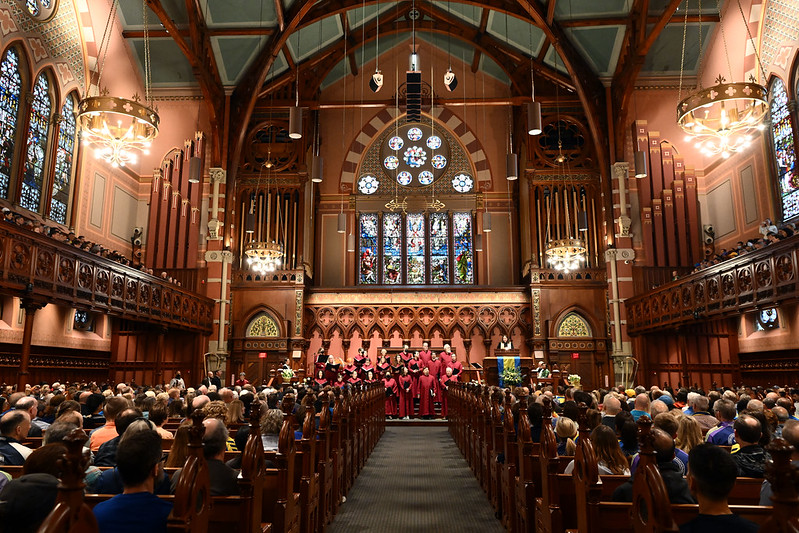
Today at Old South, we join with churches around in the world in celebrating Reign of Christ Sunday, also known as Christ the King Sunday. It is the Sunday that we pause to remember how God, the one in whom all things on heaven and earth are created, came to us as Jesus the Christ, the firstborn of all creation and the firstborn from the dead, to remind us that all things, you and me and the earth and the stars and all things visible and invisible, are full of God, for God is the one that holds them all together. It’s the Sunday that we remind ourselves that God is to be found everywhere in our lives if we but look, and that Christ is king not through might or arms, but by being so buried in the heart of the world that to deny his sovereignty would be to deny our very selves.
Reign of Christ is a relatively new festival in the Christian year, having been instituted just in the first half of the 20th century. Anglican churches in England have held this to be a special Sunday for much longer than that, however. At least since the 16th century, this Sunday had been—and still is in many places—known affectionately as Stir-up Sunday. It was called Stir-up Sunday because of the collect, or short prayer, assigned for the day in the Anglican Book of Common Prayer. It goes like this: “Stir up, we beseech thee, O Lord, the wills of thy faithful people; that they, plenteously bringing forth the fruit of good works, may of thee be plenteously rewarded; through Jesus Christ our Lord. Amen.” So, Stir-up Sunday. But that’s not all. For you see, it was just too delicious, too perfect a coincidence to ignore, that this Sunday, with its “stir up” and its petition for plenteous fruit, came just at the time of year that English people usually prepared their Christmas puddings. And so Stir-up Sunday became the traditional day for stirring up the year’s puddings.
It is an association both delightful and profound. The people took the tradition of Christmas puddings, a thoroughly local custom in no way biblical and which would have been completely unrecognizable to Jesus or Paul or anyone who knew them, and linked it in joy to a beloved prayer and the beginning of one of the holiest seasons of the year. In so doing, they stirred together the sacred and the profane, heaven and earth—both of which, they well knew, were created by God. In so doing, they invited God into their kitchens and their baking and their Christmas traditions, and so sanctified their puddings.
This Sunday, we crown Christ king and ruler of all, the one in whom all fullness dwells and through whom and for whom all was created. Next Sunday, we begin in earnest to wait for that heavenly ruler, having been begotten of heaven’s own heart, to be born a human baby. That is, we begin to wait again for God to point out for us the great scandal of our faith: that God and we are forever, inextricably, intertwined. That heaven and earth, God and human, sacred prayer and homely custom, Jesus Christ and Margaret are so mixed up in one another, so stirred together, baptized, and lit on fire with the Spirit, that nothing, nothing, nothing will ever separate the one from the other.
Will you pray with me? Stir up, we beseech thee, O Lord, the wills of thy faithful people. Give us Margaret’s eyes, eyes to see this world all shot through with your holiness; give us courage and depth of soul to share the vision with all we meet, that we, plenteously bringing forth the fruit of good works, may of thee be plenteously rewarded. We pray in the name of Jesus, begotten of your very heart. Amen.
Copyright © 2007, Old South Church and by author.
Excerpts are permitted as long as full accreditation is made
to Old South Church and to the author.