Old South Banner
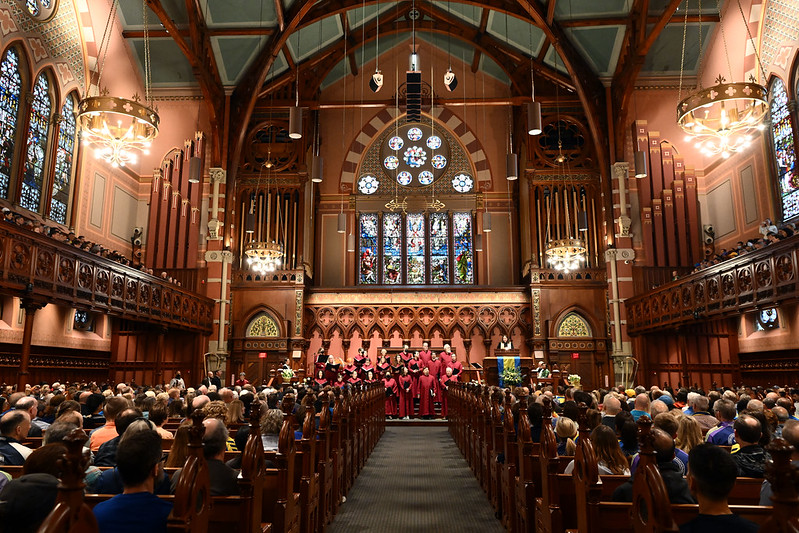
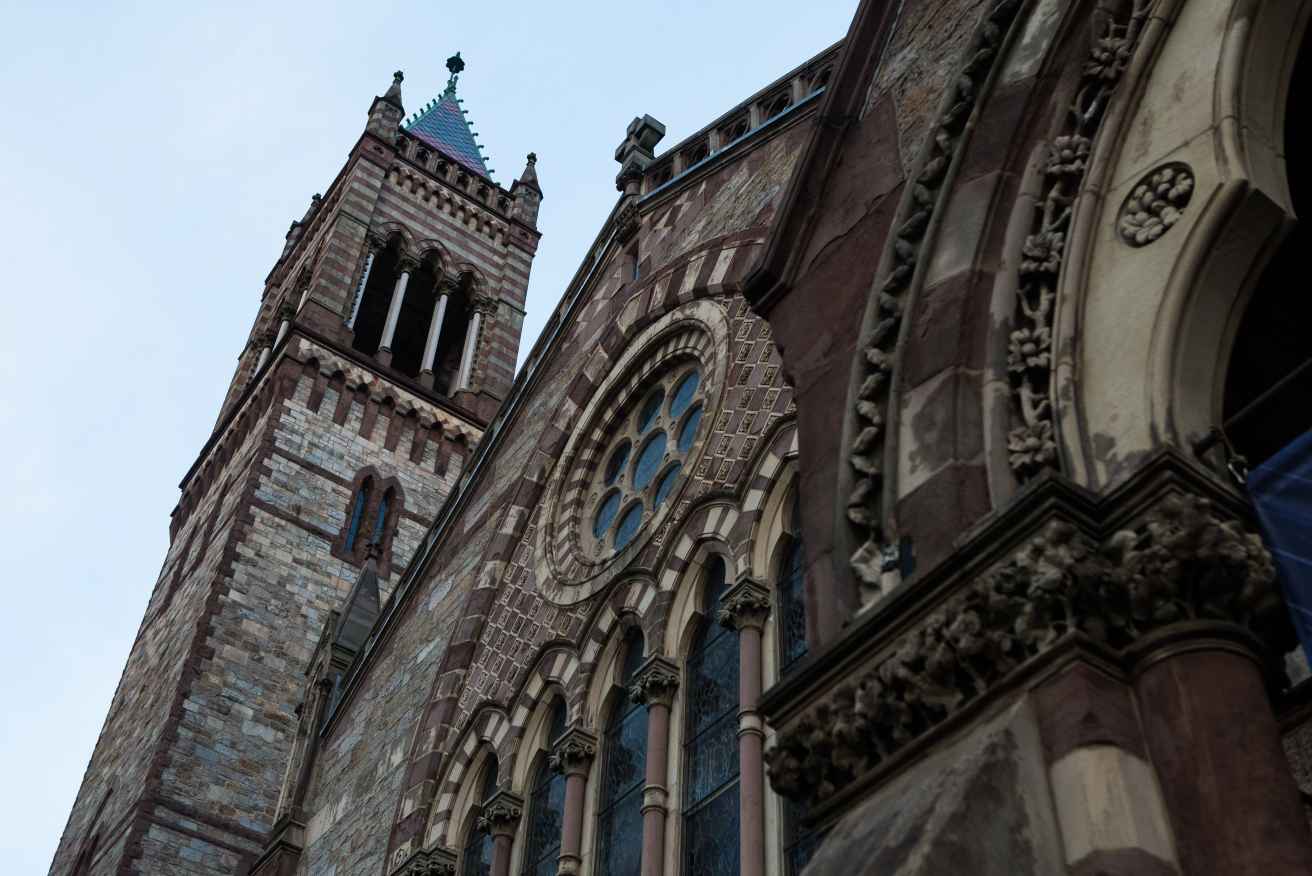
Old South Sanctuary (photo by Sarah Musemuci)


Copyright © 2009, Old South Church and by author.
Excerpts are permitted as long as full accreditation is made
to Old South Church and to the author.


Old South Sermons:

Practice Resurrection

by Quinn G. Caldwell, Associate Minister

Mark 16: 14-20

April 26, 2009, Care of Creation Sunday

Listen to this sermon


Will you pray for me?  Lord, may the words of my lips and the meditations of all our hearts be acceptable in your sight, our Rock and our Redeemer.  Amen.

Beaten unconscious.

Mocked by crowds.

Imprisoned by the government.

Underestimated by nearly everybody.

And a savior to millions, perhaps, one day, including you.

And as if all that weren’t enough, also a mother forced to give her children up when her husband divorced her for being too hard to control, also a scientist routinely denied access to funds and jobs because of the tribe she was born into, also the first east African woman to earn a Ph.D., also the first African woman to win a Nobel Peace Prize, and a Christian.

If you don’t know who she is, you should, because she’s saving the world. Her name is Wangari Maathai. Here’s her story: she was born in Kenya in 1940. Educated through high school in Kenya, she eventually came to college in the United States. At the University of Pittsburgh to earn a Master’s in biology, she first came into contact with a rare and unusual breed of people: environmentalists. They were working to control air pollution in that city, and they gave her the bug.

She began to reflect on the environmental degradation she had been witnessing in her own country, and the ways in which humans were responsible for it. Among the worst problems in Kenya, then and now, was desertification. Desertification means this: death overwhelming life. Almost always, as in Kenya, the result of human actions such as deforestation and unwise farming or building practices, desertification is just what it sounds like: the desert taking over. Water sources dry up, sand dunes travel and cover not only arable land but entire cities, biodiversity plummets, what once was at least marginal land becomes uninhabitable. Death gains the victory.

For a sense of how powerful desertification can be, consider this: just last week, Chinese scientists announced the discovery of an extra 180 miles of the Great Wall of China. The scientists had no idea these sections of the Wall existed because they had long been buried by sandstorms, the result of erosion caused by destructive farming techniques1. 180 miles of one of the greatest works of human hands had been so thoroughly obliterated that nobody even knew it was there, and for every inch of the wall covered, only God knows how much livable land was lost. Death and the desert won.

But back to Kenya. Wangari Maathai returned and began to work in university and government posts there. She saw what people with eyes to see always see about environmental degradation: that the desertification that was taking over Kenya was disproportionately affecting the poor, the marginalized and, most especially, women, who were the farmers and the gatherers of wood. Women were being condemned to lives of drudgery and servitude, while their children choked on the dust and slowly starved. Death was winning.

Wangari Maathai saw this: there were demons of sexism and poverty and desertification to cast out from Kenya. Kenya needed its women to learn a new tongue, a new way of speaking to the world. Kenya was sick, and needed someone to lay their hands on it, and heal it. And Maatha? Well, Maathai knew about Jesus, knew what had happened with him, knew that those who work with him find themselves able to work miracles.

So, she started a nursery. She started a nursery and began giving the trees to the women of Kenya to plant. Then she offered them a stipend for every indigenous seedling they raised from seed collected from the surrounding forests, and a stipend for every seedling that was passed on to another woman to plant. Before long, nurseries were common sights on family farms throughout Kenya, women were forming collectives to exchange seeds and raise seedlings, the men were learning from the women how to save the land, and great belts of thousands of trees each were stretching across the country, holding back the encroaching desert. The Green Belt Movement was born.

It has taken a lot of work and a lot of resistance from the men, and especially the men in government, but since the seventies, 30,000 poor rural women have been educated in forestry, beekeeping, food processing, and other trades that provide a livelihood for themselves and their families. 30 million trees have been planted. The green belts are no longer holding the desert and the poverty at bay; they are turning it back, reclaiming land and lives for greenness and for hope, and for a sign to the world that life will have the victory. Maathai received the Nobel Peace Prize for her work, not only the first African woman to receive it, but the first environmentalist to receive it as well, and the publicity has been enough to spread the Green Belt Movement around the world. As the scripture says, “And they went out and proclaimed the good news everywhere, while the Lord worked with them and conformed the message by the signs that accompanied it.”

Jesus, having risen from the dead, having driven back the forces of arid death and sprung fresh and dewy back into the world, instructs the Disciples to go out and preach the good news to all the creation. Not to every person, not to all the tribes or peoples; he says to all the creation. To everything and everyone: to the trees and the soil and the wheat and the desert, this news: life will win; death will not have the victory for long. The desert may be able to cover the Great Wall of China, but it will not cover the people of God for long. If Jesus doesn’t stay dead, then nothing will for long. If Jesus doesn’t stay dead, the Great Wall will not stay buried. If Jesus doesn’t stay dead, the desert will not win. If Jesus doesn’t stay dead, it will be poor, uneducated women that will be the ones to turn it back.

Since we celebrated Earth Day this past Wednesday and Care of Creation Sunday today, I wanted to share with you one of my favorite poems. It’s by Wendell Berry and it’s inserted in your bulletin. It’s called “Manifesto: The Mad Farmer Liberation Front”, which may in fact be the best title for a poem ever. In it, Berry, author, farmer, and devout Christian (who also wrote the text to today’s anthem) tells the secret that the farmers, and the Christians, and the Green Belt women know: resurrection is not only something that God does; it’s something that, with the grace of God, the rest of us can—and should—do as well. Practice resurrection.

Preach the good news to the whole Creation, Jesus says, and on earth day, what he and Wendell Berry mean is this: plant things at the edge of the desert. Get on your knees in the dirt of the world, and plant things. Stand at the line where death is advancing, and do not let it come. Stand there for a hundred years if you must, and if you cannot stand there for a hundred years, then plant something that will and tell the children to watch it.

Preach the good news to the whole creation: If God’s love was going to grow to overwhelm the earth, then even God needed to be planted, needed to go down into the ground for three days, needed to be covered over and closed up in the ground by tender hands. They thought they were burying him; instead, they were planting him. And he took all the violence, all the fear, all the ignorance, all the humiliation with him right into the earth, where all is transformed, so that he could rise like a green blade with power to drive the desert back.

There are some among us who understand about planting things, about resurrection practices. Jim Hood and Diane Gaucher, who are responsible for the award-winning flower gardens in front of the church, have been germinating a new idea: an edible churchyard at Old South Church in Boston. The idea, pending the approval of the church’s Operations Committee, is this: that we will join the growing movement of people who are reclaiming urban and suburban spaces for food production, that we will reconnect ourselves to the earth from which all things, even God’s love, spring. We will plant a vegetable garden at Old South. Organic, beautiful, productive, the garden will contain rare and heirloom seeds whose planting will protect and increase the diversity in our food supply. It will be a witness to a city devoid of kitchen gardens and food production capacity, a witness to a desert of ignorance where people believe that their food is grown at Shaw’s supermarket. It will be a witness that a connection to the source of our food matters, a connection to the dirt matters, and that food, thoughtfully produced, responsibly tended, and faithfully distributed in a hungry world, is a lot like resurrection.

We will call it the Garden of Eden Edible Churchyard, but I say that it’s a victory garden. For if it works as we hope it will, if it makes us and the city that will witness it to think more carefully about what kind of food we grow, if it makes us think more carefully about where our food comes from, if it makes us eager to plant things in our own yards that will turn back the forces of hunger and ignorance and separation from the land, it will be a victory over the desert, a victory over hunger, a victory over the forces that separate us from the land. If that happens, then we will not just be preaching resurrection, we will be practicing it as well.

Jesus went down into the ground bearing all the hurt the world could give, and came up in glory to drive back the desert, to be a green belt of hope for the poor women and the marginalized men, to be a garden of delight and sustenance for the world. And the message is this: Wherever death is encroaching, stand on the front line and hold it back. Where the desert is advancing, stand there and plant trees. Where hunger is advancing, stand there, and plant vegetables.

And when the end is near, when it has gotten as bad as it will ever get, when it has all fallen completely apart and death is on the verge of winning forever, stand there, and plant God.

Practice resurrection.

Amen.

Manifesto:
The Mad Farmer Liberation Front

by Wendell Berry


Love the quick profit, the annual raise,
vacation with pay. Want more
of everything ready-made. Be afraid
to know your neighbors and to die.
And you will have a window in your head.
Not even your future will be a mystery
any more. Your mind will be punched in a card
and shut away in a little drawer.
When they want you to buy something
they will call you. When they want you
to die for profit they will let you know.

So, friends, every day do something
that won't compute. Love the Lord.
Love the world. Work for nothing.
Take all that you have and be poor.
Love someone who does not deserve it.
Denounce the government and embrace
the flag. Hope to live in that free
republic for which it stands.
Give your approval to all you cannot
understand. Praise ignorance, for what man
has not encountered he has not destroyed.

Ask the questions that have no answers.
Invest in the millenium. Plant sequoias.
Say that your main crop is the forest
that you did not plant,
that you will not live to harvest.
Say that the leaves are harvested
when they have rotted into the mold.
Call that profit. Prophesy such returns.

Put your faith in the two inches of humus
that will build under the trees
every thousand years.
Listen to carrion - put your ear
close, and hear the faint chattering
of the songs that are to come.
Expect the end of the world. Laugh.
Laughter is immeasurable. Be joyful
though you have considered all the facts.
So long as women do not go cheap
for power, please women more than men.
Ask yourself: Will this satisfy
a woman satisfied to bear a child?
Will this disturb the sleep
of a woman near to giving birth?

Go with your love to the fields.
Lie down in the shade. Rest your head
in her lap. Swear allegiance
to what is nighest your thoughts.
As soon as the generals and the politicos
can predict the motions of your mind,
lose it. Leave it as a sign
to mark the false trail, the way
you didn't go. Be like the fox
who makes more tracks than necessary,
some in the wrong direction.
Practice resurrection.

from The Country of Marriage, copyright © 1973 by Wendell Berry


1 “Great Wall of china Longer Than Believed as 180 Missing Miles Found” http://www.guardian.co.uk/world/2009/apr/20/great-wall-china-discovery .


Copyright © 2009, Old South Church and by author.
Excerpts are permitted as long as full accreditation is made
to Old South Church and to the author.

Old South Church
645 Boylston St. Boston, MA 02116
(617)536-1970 Tel (617)536-8061 Fax

You can E-mail us by clicking here: OSC Communications

Copyright © 2009, Old South Church