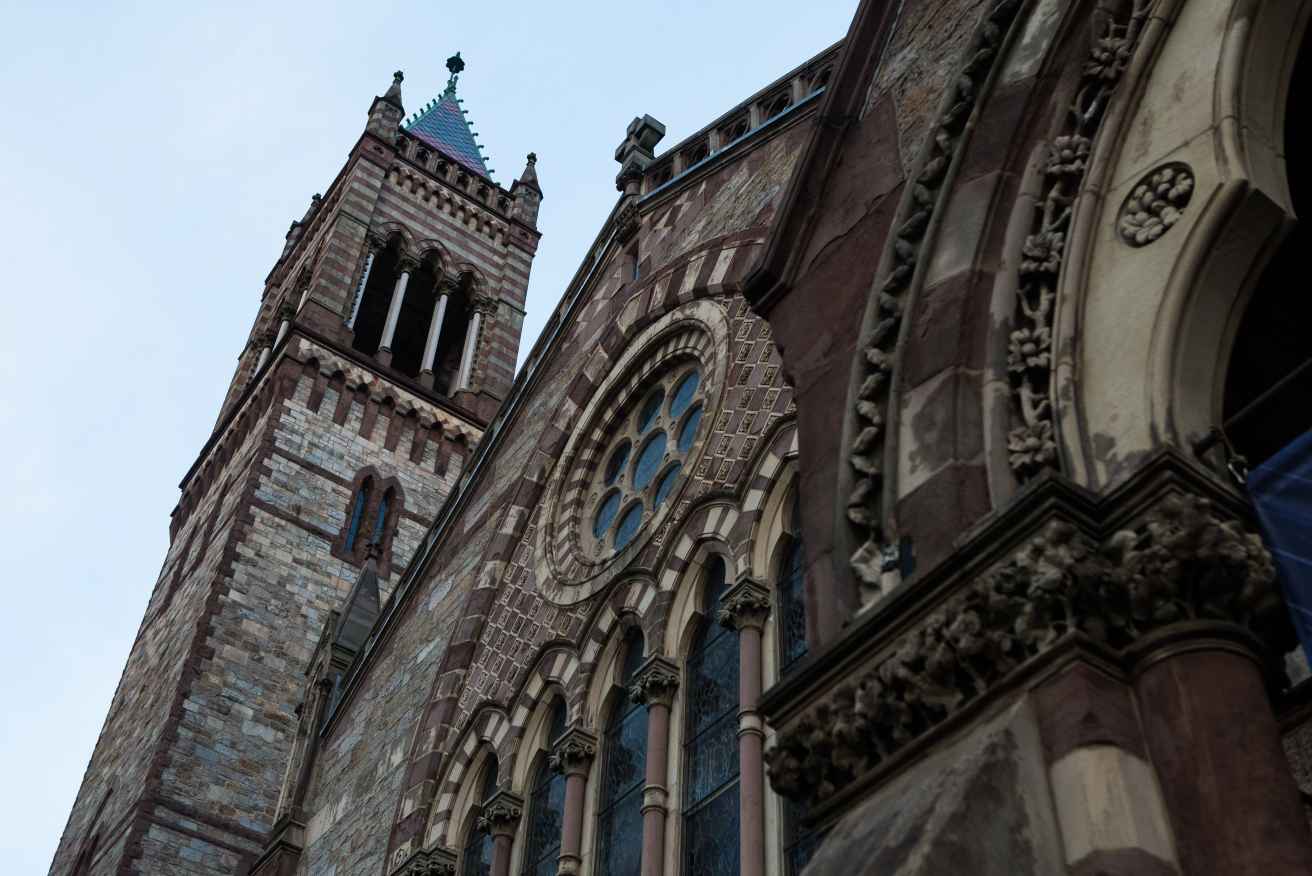
Old South Banner
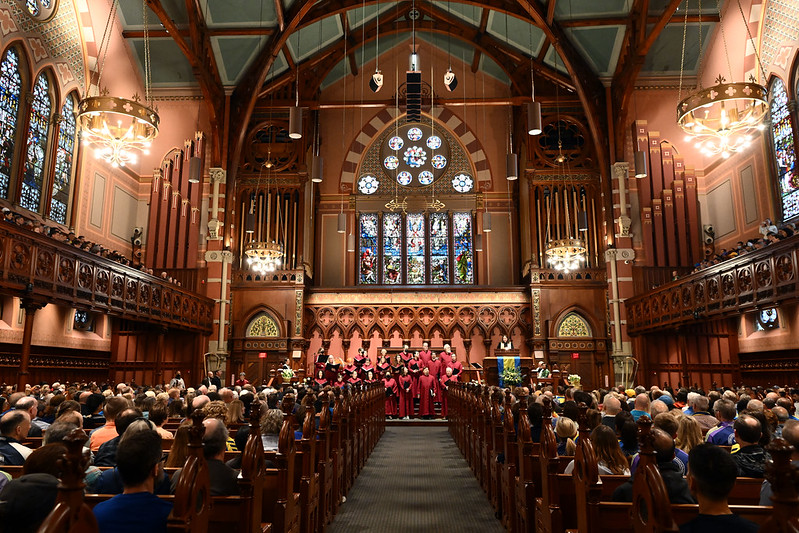
Old South Sanctuary (photo by Sarah Musemuci)


Copyright © 2008, Old South Church and by author.
Excerpts are permitted as long as full accreditation is made
to Old South Church and to the author.


Old South Sermons:

Flock
 

by Quinn G. Caldwell, Associate Minister

Ezekiel 34:17-23

Romans 8:19-25, 28-29

Sunday, April 27, 2008, Care of Creation Sunday

Listen to this sermon


Will you pray for me?  Lord, may the words of my lips and the meditations of all our hearts be acceptable in your sight, our Rock and our Redeemer.  Amen.

As Nancy said in the Words of Welcome, this past Tuesday was Earth Day, and today, Old South celebrates Care of Creation Sunday.

Meanwhile, all across the country over the next few weeks, congregations in the United Church of Christ, including Old South, are having sacred conversations about race in the United States.  Part of the reason for doing this is to help us recognize that here in this country, there is no escaping the fact that everything—everything—in our lives together is in some way touched or shaped by race.  So, it seems only right that we spend this Care of Creation Sunday thinking about the intersection of race and the environment.

For a long time now, there has been a myth out there that the environment is something only white people care about.  To the extent that environmentalists’ thinking has focused only on the impacts humans have on animals or on nature as divorced from humans, this has historically been largely true, in no small part because historically, white people have been the only ones with time or energy for worrying much about the animals—or the wealth and leisure to wander around in the woods for fun; everybody else has been spending their time and energy just trying to survive.  But here’s the thing: care of the creation is not just about saving the redwoods or the spotted owl or far-away forests (though it is about that); it’s also about human environments, about cities and towns, water supplies and air standards, factories and dumps.  Environmentalism is also about which of us are living in places with good water, clean soil, and non-carcinogenic air—and which of us are not, and why.

This is a truth our United Church of Christ has long recognized.  In the mid-nineteen eighties, the UCC’s Commission for Racial Justice decided to make an examination of the siting of hazardous waste facilities and polluted areas in the Unites States, to try to discover which, if any, demographic factors were linked to the locations of toxic sites.  In 1987, the commission released their report, Toxic Wastes and Race in the United States, and it changed everything.

Among the findings: Just three communities, all predominantly African-American and Latino, contained forty percent of the nation’s hazardous waste landfill capacity.  Three out of every five African Americans and Latino Americans, and half of all Asian Pacific Islanders and Native Americans, lived in communities with uncontrolled toxic waste sites.  Communities with the greatest number of commercial hazardous waste facilities also had the greatest number of minorities and people of color.  And most importantly: statistically speaking, race—not socioeconomic status or education, but race—was the single most important predictor in the location of both commercial hazardous waste facilities and uncontrolled toxic waste sites in the United States. [1]

“As for you, my flock, thus says the Lord God: I shall judge.  Is it not enough for you to feed on the good pasture, but you must tread down with your feet the rest of your pasture?  When you drink of clear water, must you foul the rest with your feet?  And must my sheep eat what you have trodden down with your feet, and drink what you have fouled with your feet?”

Now, nobody thought then or now that anyone was intentionally choosing to dump toxic waste near people of color just for their being people of color, though it’s no doubt true that sometimes the decision was made out of a belief that people of color mattered less than Euro-Americans.  Most often, the decision was made, as these decisions usually are, on the basis of power: nobody wants toxic waste in their backyard, and everybody’s going to resist having it there when it’s proposed.  And if everybody’s resisting, well, the people with the most power (read: money, education, and organized people) are going to win, and the people with the least power are going to get the dumps.  And in the United States, the people with the least power have historically been people of color.  The authors of the report coined the term “environmental racism” to describe this dynamic.  Environmental racism is made up of two parts: the exclusion of people of color from environmental decisions that affect them and the unequal protection for people of color against exposure to toxic waste,

When that report came out in 1987, it spurred the environmental justice movement into being.  Last year, the UCC released a follow-up report, Toxic Wastes and Race at Twenty.  It turns out that race is still the best predictor of the location of toxic waste sites.  People of color are even more concentrated near hazardous waste sites than they were twenty years ago, and people of color are significantly disproportionately represented in communities with such sites. [2]  Just two examples: in Lowell, MA, people of color are 33% more likely to live near a toxic site than are whites; in Lawrence, they’re over 50% more likely.

And God says to the flock: Is it not enough for you to feed on the good pasture, but you must tread down with your feet the rest of your pasture?  When you drink of clear water, must you foul the rest with your feet?  And must my sheep eat what you have trodden down with your feet, and drink what you have fouled with your feet?

Or as Paul put it, the creation and its children are groaning to birth something new.  When kids play on playgrounds contaminated by lead, the creation groans to birth a society that spends as much on tending to the health of its children as it does on its wars.  When whole communities are devastated by cancer epidemics because of what’s in the water they drink, the creation groans to birth a nation that holds its corporations and their leaders fully accountable for the costs and the evils of their doing business.  When trucks drive down country roads in the dark of night and dump toxic cargos along roadsides, the creation groans for a different way.  When we would all still rather pay for cheap things whose production creates toxic waste than for more expensive ones that do not, when black mothers worried about the health of their families are denied protection by the government agencies created to give it to them[3], the creation groans for a world where black mothers, or poor mothers, or uneducated mothers or mothers who are all three are given the same power and protection as the mothers who are white, or rich, or well-educated.

The creation, subjected to futility and in bondage to decay, groans and waits with eager longing for the revealing of the children of God.

A story about the revealing of the children of God: I said a moment ago that the environmental justice movement was begun by the UCC’s Toxic Wastes and Race report.  Actually, it began much earlier than that.  In the summer of 1978, a contractor was hired by a Raleigh, NC-based company to take oil contaminated with PCBs (that’s poly-chlorinated biphenyls, which are bad news) to a recycling facility.  Instead, he got rid of the oil by spraying almost 30,000 gallons of it along rural roadsides in the dead of night.

He and others were eventually prosecuted for the crime, but the state was left with the responsibility of cleaning up the mess, which would eventually amount to 60,000 tons of contaminated soil.  After examining 90 sites, the state chose one in Shocco Township in Warren County.  Given what we’ve been talking about, it was an unsurprising choice: in terms of per capita income, Warren County ranked 97th out of 100 counties in the state.  The county was 64% African-American; the town of Shocco was 75% African-American.

The public outcry began immediately.  Two different lawsuits were filed—and lost—by landfill opponents.  When it became clear that the state was going to proceed with its plan, the protests started.  Soon, the protests had garnered national media attention—far beyond what these sorts of protests usually earn.  The protests got the attention they did not because the cause was so just, though it was, but because they weren’t put on by your garden-variety protestors: they weren’t angry college kids or hippie tree-huggers or white liberals.  These were poor, upstanding, usually well-behaved black churchwomen, and they were mad.

They had decided that they were sheep that weren’t going to be pushed around, weren’t going to have their pastures trampled and their waters fouled by bigger sheep.  They were sheep with a good shepherd, and that shepherd was telling them to fight.  So fight they did.  And the children of God that creation was waiting for were revealed on national TV. 

Those women lay their bodies down right there in the road, right there in front of the dump trucks hauling the dirt.  They lay themselves down and would not leave until they were dragged away and arrested by police and soldiers from Fort Bragg—also contaminated with PCB’s, by the way.

The protest grew.  Before it was all over, the whole country knew about Warren County, NC, and almost 500 people were arrested in the protests, among them a local congressman—and several members of the UCC’s Commission for Racial Justice, who had been called in to help by those church ladies to teach them nonviolent protest techniques. [4][5][6]

It was the first time anyone in the US had been arrested for trying to stop a toxic waste dump[7], and it was black, Christian churchwomen that did it.

Unfortunately, the protests did not stop the landfill (though the site would be totally abated by the state some twenty years later).  What they did do was to plant the seeds of the environmental justice movement.  Black church leaders and others, appalled at what had happened in Warren County, began to look at environmental issues in a new light, and thinkers and leaders in the environmental movement began to realize that environmental racism was as important an issue as the extinction of the whales.  And it was this incident and those good churchpeople that moved the UCC’s Commission for Racial Justice to compile its famous report that would bring the seeds planted by those ladies to fruition as a whole movement.

So, if those protestors didn’t stop the landfill altogether, they did join Ezekiel in naming the sin they saw among them, and invited others to join in stopping it.  They did follow the call and the guidance of their good shepherd in trying to claim their right to healthy pastures and in trying to reform the flock.  They did know that they were called according to God’s purpose, which was to protect themselves, their families, and their creation.  They did reveal themselves as children of God, brave midwives of grace working to help the creation to birth a new thing.

The changes since then have been small, but they are a start: since the Warren County protests and the Toxic Wastes and Race report, the EPA has started the Office of Environmental Justice (small and underfunded though it may be), Bill Clinton issued an executive order requiring that federal agencies examine and address the ways environmental degradation disproportionately affect people of color, Erin Brockovich (a poor white woman) won her lawsuit and Julia Roberts made it famous, and people of color—many of them church people—have begun to gather for environmental summits.  It’s not a new creation, but it is a start.  And as long as faithful Christians are ready to stand up—or lay down—and resist, there is hope.

Ezekiel says: is it not enough for you to feed on the good pasture, but you must tread down with your feet the rest of your pasture?  When you drink of clear water, must you foul the rest with your feet?  And must my sheep eat what you have trodden down with your feet, and drink what you have fouled with your feet?

Paul says: the creation waits with eager longing for the revealing of the glory of the children of God…in hope that the creation itself will be set free from its bondage to decay and will obtain the freedom of the glory of the children of God.

May it be so.  God help us.  Amen.


[1] Toxic Wastes and Race in the United States.  UCC Commission on Racial Justice, 1987.  www.ucc.org/about-us/archives/pdfs/toxwrace87.pdf.  Accessed 25 April, 2008; and

Cone, James. “Whose Earth is it, Anyway?” in Dieter Hessel and Larry Rasmussen, eds. Earth Habitat: Eco-Injustice and the Church’s Response.  Minneapolis: Fortress Press, 2001.

[2] Toxic Wastes and Race at Twenty.  UCC Justice and Witness Ministries, 2007.  www.ucc.org/justice/advocacy_resources/pdfs/environmental-justice/toxic-wastes-and-race-at-twenty-1987-2007.pdf. Accessed 25 April, 2008.

[3] Ibid.

[4]Warren County PCB Fact Sheet”, North Carolina Department of Environment and Natural Resources Division of Waste Management.  http://wastenot.enr.state.nc.us/WarrenCo_Fact_Sheeet.html.

[5] www.pollutionissues.com/Ve-Z/Warren-County_North_Carolina.html.  From Pollutionissues.com.  Retrieved 25 April, 2008.

[6] Cone.

[7] Cone.


Copyright © 2008, Old South Church and by author.
Excerpts are permitted as long as full accreditation is made
to Old South Church and to the author.

Old South Church
645 Boylston St. Boston, MA 02116
(617)536-1970 Tel (617)536-8061 Fax

You can E-mail us by clicking here: OSC Communications

Copyright © 2008, Old South Church