The Old South Church in Boston

A Conversation

A Sermon by Ian Holland

Ephesians 1-3:14

July 16, 2006

Listen to this Sermonmp3 file


There is a bumper sticker available now that goes

“God said it. I believe it. That settles it.”!

It is an expression that some conservative Christians adopt as a basis for their beliefs.  It represents a static view of the relationship between God and God’s people as a one sided communication from God, written down in the Bible, there for us to blindly follow. There is no room for growth, for learning or for acknowledging the nature of each of our individual relationships with our God.

The “God is still speaking” campaign of the United Church of Christ offers a very different message. God is still speaking to us and eagerly invites our response through prayer and action.   The campaign’s tagline “Never place a period where God placed a comma” affirms the idea of the continuing conversation, of learning and of growth.  The “still speaking” campaign challenges us not to get locked into absolute positions, nor subscribe to a bumper sticker static image of the word of God.  It imagines a partnership of mutuality and active engagement between our loving God and us; individually and as a community.

And that brings us to Paul and the text for today.   The reading is challenging.  It is essentially one long, run-on sentence and very hymn-like in language.     In reading this passage, I wished that Paul would have used a few more periods and a few less commas to help with its comprehension.  It is chewy and very dense in theological ideas and expression. 

It is easy to forget that this passage is part of a letter;

a letter from a man in prison to a community of people he had brought together as a Christian Church.  The traditional understanding of this letter is that Paul wrote to the church in Ephesus from a Roman prison not long before his death at the hands of the emperor Nero.  

This letter was part of Paul’s continuing response to the conversation that the Resurrected Jesus had started with him on the road to Damascus.  

His letter starts with a simple introduction and greeting.  

And then,

right at the start of this multi-page letter, it continues with today’s text:

Blessed be the God and Father of our Lord Jesus Christ,

who has blessed us in Christ            

with every spiritual blessing in the heavenly places,

just as he chose us in Christ

before the foundation of the world

to be holy

and blameless before him in love.

And so on …

Would we write this letter today? 

Would you or I use similar language and ideas as part of our response in the conversation God has started with us?  Would we be comfortable affirming these ideas as our own and using such rich Christ-centered language in our own expression of personal faith?   Now, together with some of Paul’s other statements on the role of women and others in the church, we might associate this kind of language with the ‘that settles it’ school of Christianity rather than with the ‘still speaking’ crowd.

But Paul’s letter is for us all.

In the ugly harshness and loneliness of a cell in Rome, his eyes damaged by a disease, separated from his family and friends in Corinth, Philippi and Ephesus, he writes to you and I of being incredibly blessed.    

“Blessed with every spiritual blessing in the heavenly places.”

… And you can hear his expression of blessedness in every word of the passage that follows.  The depth of his feelings and sheer joyful thankfulness for the presence of Christ in his life fills his heart so completely, that he can hardly stand to end each sentence.      

Here today,

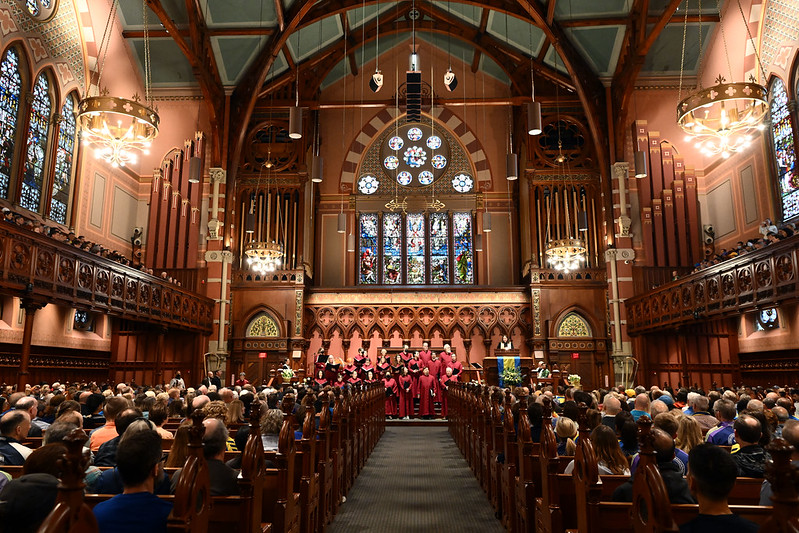
in this beautiful room

would you or I claim such a state of profound joyful blessedness?

We are under such bombardment each and everyday from advertising messages, from society at large, and our own inherent ambitions and appetites that there always seems to be something more that we need; things that we are encouraged to feel we really need to be complete, to be happy. 

Our sense of completeness, contentment, assurance is perpetually out of balance. How can we feel blessed, if we feel scared?  With news of terror all around, unsafe cities, hurricanes, yellow alerts, sirens blaring, financial insecurity (even with all the surrounding abundance) how can we feel blessed? 

And yet, if we simply give ourselves the time, a break from the externally delivered messages of anxiety and emptiness, perhaps we can listen to the conversation God has started with each one of us, and to engage actively with the idea that we really have been

blessed with every spiritual blessing of the heavenly places.

One person who opened herself to that idea is the author and poet Mary Karr, who, in the throes of alcoholism and depression was told by a friend to just say thanks when something small but pleasant occurred any time in her day ... a good cup of coffee, a drink of water on a hot day, an action of pleasant courtesy.  When Mary asked, “thanks to whom?” the response was, don’t over think it, simply acknowledge the moment and give thanks.  And so began Mary’s response to the persistent and gentle stream of blessings in her own life. It was the start of her conversation with God that eventually led her to baptism and communion with the Catholic Church.  After 40 years of undiluted agnosticism, poetry as her only scripture, and a certain scorn for believers; until she became one; she writes that:

 “prayer led me to God, and God led me to church—a journey fueled by gradually accruing comforts and some massively freakish coincidences..” 

The words of Paul played a part in her journey too and now Paul’s words encourage us to think for a moment; to celebrate how blessed we are; to celebrate and give thanks to God for the beauty of our lives; the uniqueness of our experiences, our gifts, talents and hopes.  He challenges us to consider how our faith impacts how we think of ourselves; how we live our lives and how belief in Jesus can transform us.

In our response to Paul’s letter and the continuation of our own conversation with God, we are free to choose our own language, our own vocabulary and our own expressive actions.  We are free to agree, even disagree and to struggle with the implications of the words of scripture.   The important thing is to engage in the conversation and in the relationship.  The invitation to respond is open and perpetual with Paul’s hymn echoing in the background:

Blessed be the God and Father of our Lord Jesus Christ,

who has blessed us in Christ with every spiritual blessing in the heavenly places,

just as he chose us in Christ

before the foundation of the world

to be holy and blameless before him in love.


Copyright © 2006, Old South Church and by author.
Excerpts are permitted as long as full accreditation is made
to Old South Church and to the author.

Back to Sermon Page

The Old South Church in Boston
645 Boylston Street
Boston, MA 02116
(617) 536-1970