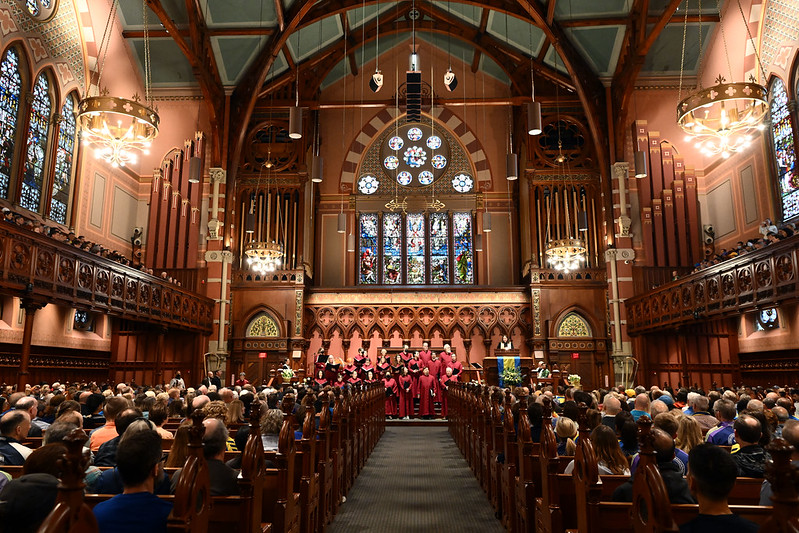
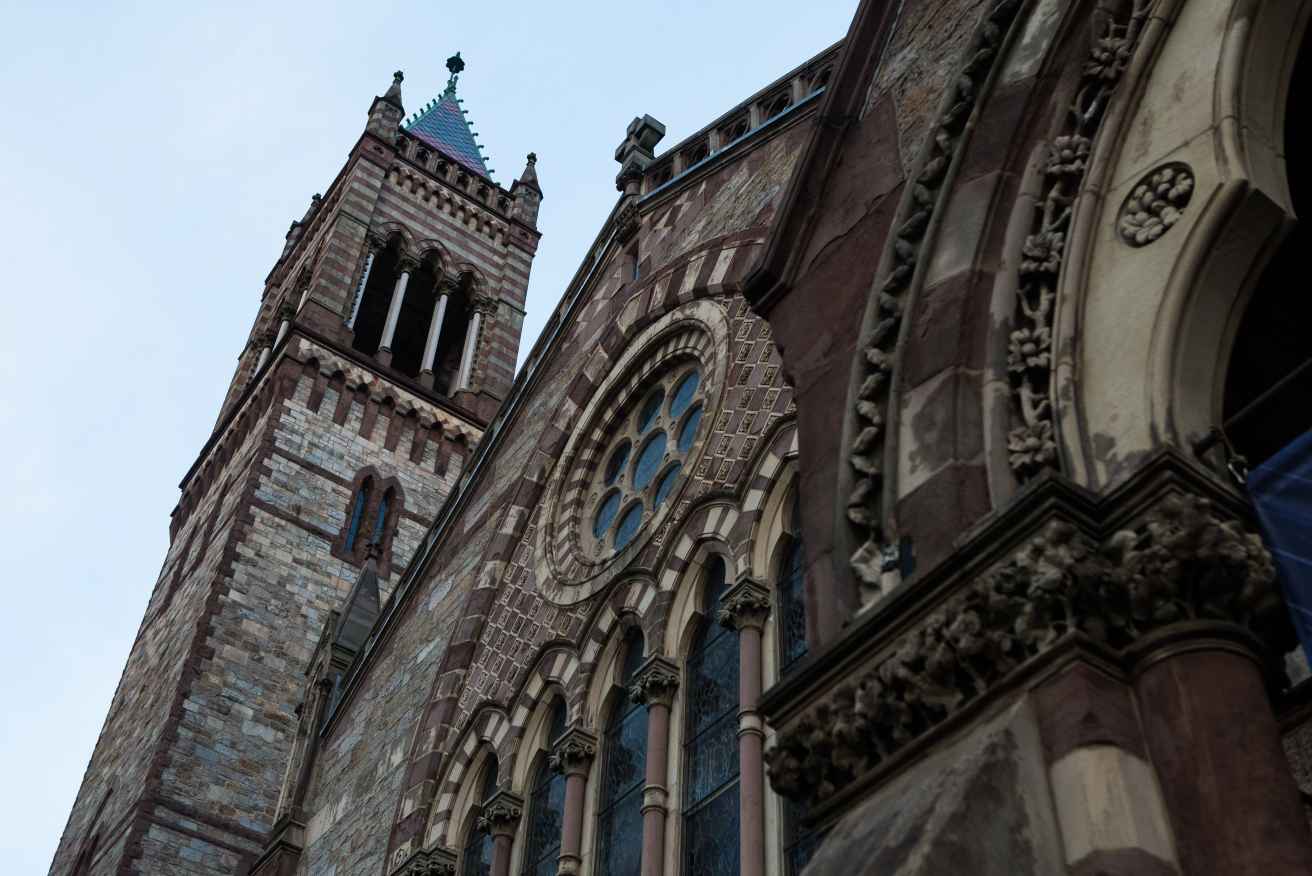
The Old South Church in Boston

Let Jesus Show!

A Sermon by Jeff VonWald

April 30, 2006

Psalm 100
Luke 24: 36-43

Listen to this Sermonmp3 file


I want to share with you a funny story Frederick Buechner tells about a Christmas pageant gone awry.[1] And the story goes something like this…

The manger is down in front at the chancel steps where it always is. Mary is there, and Joseph. Wise men are there, and shepherds. And of course, in the midst of them all, is baby Jesus.

The nativity story is read aloud, and carols sung. And all goes like clockwork.  That is, all goes like clockwork, until the singing of the angels, who are played by the children. At the right moment, those little angels come to see Jesus. But as they arrive, there are so many of them, that they begin to crowd and elbow for position. And as a result, one particular little angel, a girl about nine years old, ends up so far out on the margins, that even by standing on tiptoe, she cannot see the baby Jesus.

Glory to God in the highest,’ they sing, ‘and on earth peace, and good will to all’

But then, …in the little pause that follows the music, the little angel can contain her frustration no longer. And so, lifting her voice to a volume no one thought possible, she electrifies the congregation with an enormous “unangelic” scream: LET JESUS SHOW!

Now, at this point in the pageant, there is much more that is scheduled to happen. But instead of moving ahead, the church’s rector decides to end things right there. He pronounces the benediction; and everyone files out, with that unforgettable scream ringing in their ears.

Well!  …Friends, fortunately for you – or perhaps unfortunately – we will not end today’s service before it is finished! But the rector of that church has said that ending the service on that day was one of the best decisions he ever made. You see, the content of the little girl’s scream represents one of the deepest desires of our hearts. We want to see Jesus, and know who he is.

<>            Just look at magazine covers at the newsstands. Look at the best seller lists. Look even at the marquees around the movie theatres. Even outside the church, there is an amazing amount of wondering about this Jesus. And, what is more, there is wondering about Jesus within the church. 

Specifically, during this season of Easter, as we move slowly away from Easter morning, and into a time for further reflection, questions arise for us: Just what is this resurrection we proclaim? And just what was the resurrected Jesus like?

            Now these are not just modern questions. In fact, even if we limit our reflection to our own Scriptures, we have evidence of diverse ideas about the resurrection, even among the earliest Christians. Most apparent to us from today’s scripture reading is the debate about whether the resurrection was into a spiritual body, or a physical one. The Apostle Paul’s letters seem to present a spiritual resurrection. John’s gospel seems to present a middle view between spirit and fleshly Jesus. And Luke’s gospel, which we heard today, insists on a physical resurrection. As the story goes in Luke, Jesus flatly denies that he is some kind of ghost, even going so far as to eat a piece of fish, just to prove it.

Now, again, there is a wide range of ideas about what happened back then, both among early Christians and among Christians in our time. But whatever our own ideas about the resurrection, for today we are given Luke’s message to hear out. And Luke proclaims an embodied Jesus. But why, we might wonder, is this point so vital to him?

            Perhaps reflecting on a bit of my own story will help us get at it. See, as a child, I’d been raised in a fundamentalist Christian community. And, by the time I was in college, I found belief in God and in Jesus to be unbelievable. At first, it was the idea of a God who punishes people on the basis of religion or sexuality. Then it was the suggestion that God wants us to ignore the science of our day. Then it was the idea that God plans injustice for some higher purpose. And then, it was the very idea of God.

            But while my belief in God faltered in those days, there was something about Jesus that was compelling all along. In fact, the more the ideas I’d been taught about God seemed distasteful to me, the more appealing Jesus seemed. Or, at least the Jesus I saw in the gospels seemed appealing.

That Jesus, it seemed to me, was a sort of antithesis to what I’d been taught about God. The Jesus of the Gospels was even an antithesis to the Jesus many people around me were proclaiming. He did not reject the outcaste, but embraced them. He did not dismiss people of other religions, but heard the spirit of Truth in them. He did not seek to create violence, but healing. And, he was not bound by past interpretations of scripture, but by the living word and spirit of God speaking through them.

The Jesus of the Gospels, it seemed to me, was someone I could believe in. But it also seemed to me that the Jesus of the gospels was now a figure of the past, a ghost, nowhere alive today.

            You see, Christ must become embodied anew in each age. And if he does not, his resurrection is largely irrelevant in that age. Even Paul – who proclaims that resurrection is spiritual, and whose understanding of resurrection is perhaps easier for many of us to get hold of than a story about Jesus eating a fish  …even Paul goes on to insist that the spirit must find flesh …that in a way, the incarnation of Christ must be ongoing.

And so, what we proclaim as Christians is not that Jesus WAS risen. What we proclaim is that Jesus IS risen, and that he is alive today.

But the question is: where is he today, and what does he look like?

Well from one angle, as Jesus himself said, he is embodied in those whom society rejects, or our own hearts cannot contain: the stranger, the oppressed, the lost, the poor, …or maybe even the wealthy. But from another angle, the scriptures teach us, Jesus is embodied IN US.

Yes, Jesus is embodied in us. This is what Paul means when he says, “It is not I who live, but Christ who lives in me.” It’s what he means when he says, “Don’t you know, you are the temple of the Holy Spirit.” And it’s what our scriptures mean when they refer time and time again to the church as Christ’s body for the world today.

And this is not just lip service. I haven’t been at Old South all that long. But I’ve been here long enough to know that this is indeed Christ’s body, because the body is where the spirit resides. And the spirit of Christ is here, and in communities like Old South around the world.

<>            But as often as we hear that important message that we are Christ’s body, it’s easy to forget that this is not just something we say in order to make ourselves feel good, or to build ourselves up. No, it is also a responsibility. It is the responsibility to be Jesus for one another, and not just for one another, but for the world. In other words, to be Christ’s body entails the responsibility to let Jesus show, in the flesh.

And what does letting Jesus show entail? Well it means many things. And we are given these things in the example of Jesus’ own ministry. But one of these things, and the one I want to lift up for us today, is that – as difficult or challenging as it may be for us as progressive Christians – we have a responsibility to proclaim Jesus publicly, even in our daily lives.

Let me return to my own story for just a moment. As you might imagine, during my college years, when I was so disoriented and disillusioned with religion, there were plenty of voices about Jesus around me. But those voices were proclaiming the same Jesus of exclusion and supposed literalism I’d heard all my life. Again, the inclusive and open Jesus I saw in the gospels, was nowhere to be seen. But the more tragic thing is that during those years, there were indeed Christians nearby who were proclaiming the Jesus of the Gospels. And there were even friends of mine nearby, who had been raised in communities that proclaimed him. But the problem for me was that they did not proclaim him publicly, or even in simple interactions that lent themselves to speaking of him. And so, for me, the Jesus of the gospels remained a figure of the past.

And you know, I’ll tell you, I have met that younger version of myself over and over and over again since then… in places like our own jazz service here at Old South, in interactions with new acquaintances at social occasions, in friends who’ve struggled alone with understanding or accepting their sexuality, and on and on. The world needs a public Jesus, who shows up concretely in the flesh.

Now, I want to be clear. I am encouraging us to imagine yet more ways for us to let Jesus show publicly. But I am decidedly not trying to imply that we should try to convert those who hold a life-affirming religious path of their own. I simply do not believe in that.

But there is a difference between trying to convert people of other faiths, and providing the good news of an inclusive and thoughtful living Christ to those who are seeking a faith of their own. What’s more, there is even a big difference between trying to convert people of other faiths, and showing even them that there is a real and living community of Christians that respects them as they are, and that will walk with them into a future of peace and justice. And finally, there is a difference between being overpowering about our Christian identity, and being open about it when situations call for being open, for the sake of the very meaning of Christianity in our times.

In a world where the Christianity of Christ’s own spirit of justice and inclusion has become a so-called “alternative Christianity,” and where injustice and hatred are lived out daily in the name of Christ, the world needs to see a concrete embodiment of the Jesus of the gospels.

And it needs to see him urgently.

Yes, the world needs progressive Christians who will not deny Jesus in everyday interactions. Yes, the world needs people who wear crosses, not just while making war, but while making justice, compassion, and peace. Yes, the world even needs things like rainbow-colored Jesus fish on bumpers and on backpacks!

We began this reflection with a question: Did the Jesus of long ago really eat a piece of fish in order to show that he was real? Or is this story the product of debate about the nature of resurrection, or perhaps a story mostly with a point about the nature of God and of faith? Well, we may have deeply held beliefs about that, or we may have mostly questions. And God loves us, and this community loves us, no matter what those beliefs or questions are.

But the ones who fully know the answer are those confused and despised people of that day, 2000 years ago, who in some way experienced a resurrected Christ who was real and affirming and life-altering.

For the confused and despised people of our day, the question is whether the Jesus of our day will show up for them. And as Christ’s body today, only we can answer that question.

So let’s let Jesus show. And may God give us the courage and the wisdom to do it faithfully, and do it well.                              

Amen.


[1] The story is revised and abridged from a version told by Frederick Buechner in his article, “Bidding Farewell,” pp. 26-31, The Christian Century, vol. 123, No. 7; April 4, 2006.


Copyright © 2006, Old South Church and by author.
Excerpts are permitted as long as full accreditation is made
to Old South Church and to the author.

Back to Sermon Page

The Old South Church in Boston
645 Boylston Street
Boston, MA 02116
(617) 536-1970