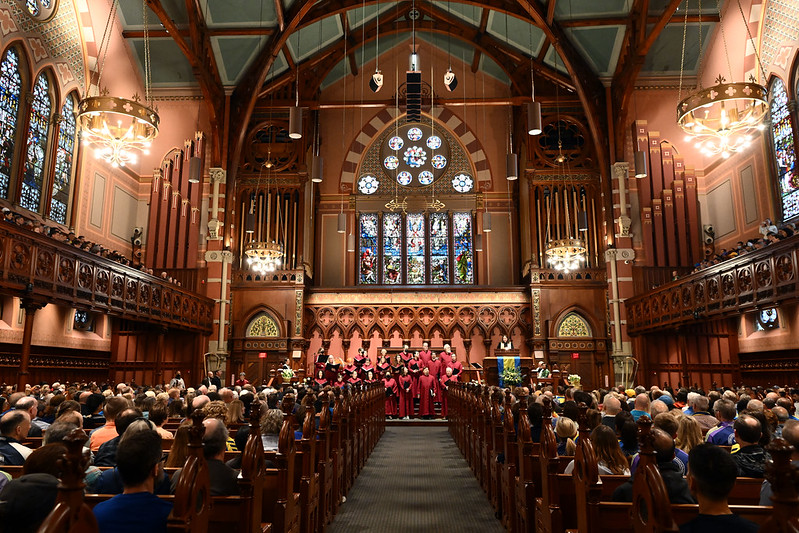
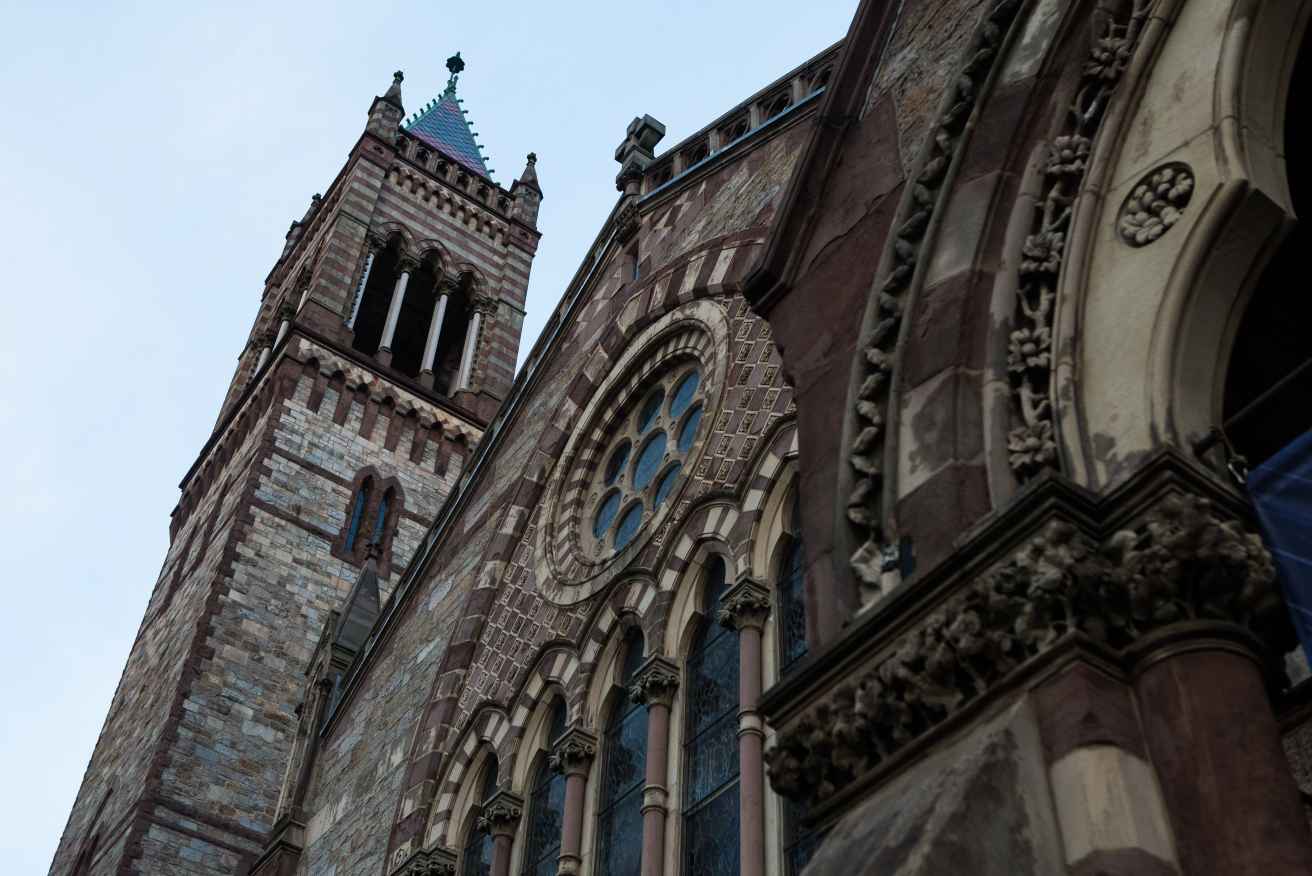
The Old South Church in Boston

Fighting or Feeding?

A Sermon by Rev. Dr. Kenneth Orth

July 30, 2006
John 6: 1-21

          “Let us be still and know that God is.  God was also in the beginning, and when all of our human striving has ceased, God will still be.  From everlasting to everlasting, only God is God.  The One who holds our beginnings and our endings, the One who is Love itself, the One from whom nothing can separate us.  In this Spirit, let us listen for the Living God.”

          Growing up in rural South Dakota, my faith was shaped by a particular brand of Congregationalism that may seem strange as I recount it to you.  My extended family belonged to a rural congregation called the Petersburg Congregational Church.  We were part of the German Congregational Churches, founded by Congregationalists with a particular mission to the German immigrants who moved across the upper Midwestern plains in the late 1800’s, homesteading the windswept prairies.   

          One of the customs of the churches in our area was that men and women were seated on opposite sides of the middle aisle of the church. On any given Sunday if you were to enter the church, you would have seen the men seated to the right and the women to the left of the central aisle.  As children, we boys were seated in front of the men, and my three sisters would be seated in front of the women. 

           The ostensible reason for this arrangement of sexual segregation was to keep impure thoughts or actions from interfering with one’s spiritual edification during services.  However, keeping us apart from our other family members or friends always mystified me, particularly as I grew older and struggled to integrate sexuality and spirituality.  As I studied more in the areas of spirituality, two Greek words came into focus on this issue.   

          The first is the word “diaballein” from which we get our word “diabolical”.  It means, “to separate, to tear apart, to compartmentalize.”  The other is “symballein” from which we get our word, “symbol”.  It means, “to unify, to bring together, to hold together in one place what can seem like opposites at first encounter.”    The spiritual quest is one of being whole, and bringing our whole life before God.  It is to be the end of compartmentalization as we “practice the presence of God” in our whole lives.  

          So this separation has always bothered my spiritual sensibility, the worst of which would be to leave parts of me entirely outside this sanctuary as I come to worship.  The forces that would ask me to do that are what we might call diabolical.  And the symbols that would hold things together, that would take all of my experience of body, mind and spirit and lift them up before God, seeking integrity, are at the core of our spiritual growth and mature development. 

          So the sexual segregation of the church of my childhood has stood as a symbol to me of an area that God calls us to heal and bring together.  But gender agendas just below the surface of many passages from scripture have been brought into my spiritual consciousness by my former spiritual director of some ten plus years, Martin L. Smith.  Martin was the past superior of the Society of St. John the Evangelist, the Episcopal monastic community across the river in Cambridge.  He has since moved to Washington DC, where he is involved in parish ministry there.  His mentoring and insightful remarks have helped me understand much more fully the subtleties of scripture—especially the lectionary passage for this Sunday.   

          First of all, as we look at this story in today’s gospel reading, the feeding of the five thousand, we need to acknowledge that there is a deliberate mistranslation in the text.  The Greek text makes it clear that it is the males who sat down on that hillside across the Sea of Galilee.  The women and children were separated from them.  Since this story is one of the few stories that appears in all four gospels, we can compare and contrast.  In Matthew, it says there are “4000 men, besides the women and children” and in Luke there are 5000 men who are in groups of 50.  So we may ask ourselves, what is really going on here?  Why are 5000 men gathered together in the uninhabited hill country on the other side of the Sea of Galilee?  The Jewish historian Josephus tells us that this particular area of the wilderness was the traditional place that rebels gathered to work on plans to overthrow the Roman occupation.  Here we see 5000 men not just milling about, but gathered into groups of 50 and 100, (according to Mark and Luke), which happen to be the traditional size of a platoon.  Also it is near the Passover, which is a time in which the Jewish people celebrated their liberation from their slavery in Egypt.  It was traditionally a time when the feelings would run very high about the shame and misery of their current situation of being under the rule of Rome. 

          By the time the stories were actually written down, the reason for these arrangements of men in strict formation was probably lost.  Yet Roman occupiers would have recognized immediately that these men were gathering to declare an end to the occupation. This helps us make more sense of the verse that late we read saying, “When Jesus realized that they were about to come and take him by force to make him king, he withdrew again to the mountain by himself.”  These people were desperate for a leader who would use political force and violence to establish a new kingdom and release them from Roman occupation.   

          So what we are encountering here is actually another temptation story.  Jesus is being tempted to join these revolutionaries to overturn the Roman occupation of Israel, and use violence to establish God’s realm of peace and justice.  But Jesus refuses to give in to the idea of war as being able to be a viable way to establish the kingdom of God.  He refuses to let go of his dream of a non-violent “reign of God”.  He says a resounding “No” to the fighting, the solution put forth again and again in the past and by us as we face the human predicament to find a way for power to be based in justice.  Let us make no mistake about it.  We are a world at war.  The armed conflicts in Israel, Lebanon, Iraq to name only a few.  And we are tempted to be drawn into the fray.  Or to be silent and feel powerless.  Do we have the faith to look to God for help, for guidance, for hope?  To open ourselves to God’s agenda for peace? 

          Daily I am aware of tens or maybe hundreds of opportunities to be tempted into a violent, controlling, power-based, testosterone-driven response to life in our culture.  “Are you up for it?”  “Are you man enough?”  Jesus shows us another way to live into our integrity and wholeness.   

          Jesus says no to the temptation to violence and withdraws to the mountain.  But not without first challenging the very agenda of these men.  They ask, “Are you man enough to lead us to victory in overthrowing these Roman occupiers?”  And Jesus utterly rejects the question itself.  Instead he takes hold of the question and changes it into a question about feeding each other and offering nurturance to one another.  Jesus is telling them and us that God’s hidden ways are in places where people are not looking for them, in the hopes of the poor and the powerless, in the love offered by the excluded and cast out.  The agenda about the way to win that these men propose is replaced by the agenda that comes out of the core of commitment to one another.

          This reminds me of the legend of San Lorenzo, a story I have related to you before but which bears repeating.  San Lorenzo was a walled medieval city.  It is said in the legend that the conquerors came to the city gates and said to the inhabitants, “Bring us your riches.”  The people went back into the city and later returned to the gates carrying their sick and elderly, those who were bruised and broken in body, mind, or spirit.  They carried them lovingly and gently on their shoulders and in their arms.  They said, “These are our treasures.”  It is said that the conquerors immediately threw down their weapons and took off their armor, exclaiming, “May we come and live here?  This is the city we have been looking for our whole lives!”   

           “Where are we to buy bread for these people to eat?” Jesus asks.   The focus here is clear:  “How much food do we need and how will we get it?”  But even Philip is ready to give Jesus a lesson in reality.  He says to Jesus “Six months wages could not buy food for these people.”  It is just not feasible, economically and technically.  Give it up!  From the male perspective of those gathered, we should just stop asking the question about food.  It is clear, it can’t be done.  This just isn’t the way the world works.  Some will be fed, others will go hungry.  Let’s get back to the real question about power and political control!

          But Jesus is not deterred by arguments based on practicality.  He insists they carry on the feeding, even in the face of it being impossible.  Just do it.  You start with what you have and you start giving out.  The young man begins:  five loaves and two fish.  He is not yet convinced it amounts to nothing. He is ready to offer it all.  We don’t know what happened.  We are left in the dark as to the practical matters.  Acting in trust creates an amazing quantity of leftovers.  This story that begins with a laughable scarcity ends up with a laughable abundance.  When it comes to feeding and nurturing God tells us there will be enough.   

          Through Jesus, God declares that we are to start.  Face down our rationalizations.  Release our protests about practicalities.  This story is a symbol of our understanding that in faith, there is enough to feed everyone.  But we must cooperate with God’s plan, and change our agenda from violence and overpowering, controlling and forcing our ways, to feeding and serving, offering up what we have.

          One of the parts of the Congregational Care and Support Committee that I love is the fact that we have on hand soups and casseroles for those who are in need:  a family with a newborn and very little time to sleep let alone prepare a meal; a person returning from the hospital needing to conserve the little energy they have for the healing process; a grieving family who lost their main cook to cancer or a violent death.  We even filled boxes with goodies to offer some hope to busy students away from home, facing final exams.  Feeding bodies, nurturing souls!      

          This story of feeding ends with Jesus going to the mountain alone.  No one understands or really gets it.  The loneliness of Jesus continues even as it is getting dark and the disciples go back across the sea to Capernaum without him.  The sea becomes rough and the winds are strong.  But Jesus comes to them saying, “It is I.  Do not be afraid.”  Jesus will come to us with his, “I Am.” also translated, as “I am who I am. I will be who I will be.”  Do not try to tempt me to fight.  Do not put your agenda upon me and think it is correct.   Recognize that I am God and I will not be put into your box and carried around by you.  You cannot even nail me down.  Hating, fighting, the endless cycle of blame, setting up systems to support violence and separation:  these are not part of the agenda of God.  But Jesus tells us he will come to support and care and accompany us to what might seem like impossible places.  Start here.  Start now.  Start by giving, feeding, nurturing.  Recognize the treasures among you!

         God’s act in the resurrection of Jesus is the end of the brutality of the state that thinks violence has the last word.  The power of fighting cannot stop God.  It will not end the value that God has placed upon feeding and nurturing God’s creation.  Even the final acts of Jesus recall today’s scriptures.  “Jesus took the loaves, and when he had given thanks, he distributed them to all who were seated.”  In his final night in that upper room, he served by bending to wash the feet of those who would follow him, by blessing bread and breaking it.  He fed people.   

          Do we understand?  Will we live our lives accordingly, refusing the temptations to violence and fighting?  What is our own agenda this week?  Who will we feed today?  Who will we nurture?  Will we lay down our fighting and come into the community of Christ where our currency is love and kindliness our law, and our food and faith will be shared as one for evermore.  Have we understood?  Will we let Jesus feed us today with the food of his loving kindness, his companionship in our loneliness, his support in our despair and hopelessness, his offering us direction when we are lost.  Saying to our hearts, “Peace, be still.” 

          For let us be still and know that God is.  God was also in the beginning.  And when all our human striving has ceased, God will still be.  From everlasting to everlasting, God is God.  The One who holds our beginnings and our endings.  The One who is Love itself.  The One from whom nothing can separate us.  In this Spirit, let us live more fully in the presence of the Living God.  Amen.

          Benediction:

          And now may the grace of God,

          Deeper than our imaginations,

          The strength of Christ,

          Stronger than our need;

          And the communion of the Holy Spirit,

          Richer than our togetherness;     

          Guide and sustain us today

          And in all our tomorrows.  Amen.


Copyright © 2006, Old South Church and by author.
Excerpts are permitted as long as full accreditation is made
to Old South Church and to the author.

Back to Sermon Page

The Old South Church in Boston
645 Boylston Street
Boston, MA 02116
(617) 536-1970