The Old South Church in Boston

Sanctuary

A Sermon by Rev. Nancy S. Taylor

October 1, 2006[1]

Based on Micah 1:1-9

Listen to this Sermonmp3 file


Let us pray. Holy, holy, holy God … we have greeted you and met you in prayer and song. We have heard your voice through the words of the psalmist and the prophet. Now may these ancient words and this ancient faith come true in our midst and in our lives. May the words of my mouth and the meditations of our hearts be acceptable in your sight, O God, our Strength and our Redeemer. Amen.

In the 13th century in Japan, an upper-class woman whose husband had been killed in war founded a Buddhist convent named Tokeiji.

Over time the convent took on a special mission. It became a sanctuary for women fleeing abusive husbands and women who had been discarded by husbands who simply no longer wanted them. To find refuge in Tokeiji, a woman took off her shoes and tossed them over the Convent gate. Recognizing the signal of a woman in distress, the nuns rushed to open the gate, welcomed her in and provided safe haven. Men were denied access to the convent. The women within its walls were cared for, educated and protected. Tokeiji functioned as Japan’s first refuge for women

The convent maintained its ministry as a sanctuary for women for over 600 years until Japanese laws changed so that women were no longer at the mercy of their husbands. Today the temple serves as a shrine to the memory of brave women who defied the ethos of a brutish society by creating sanctuary … a place of safety in a manifestly unsafe world. 

The early Christians were known for creating sanctuary: places where widows and orphans were surrounded with, and protected by, surrogate families … where the hungry were fed and the ill tended to.

Defying a society based on patriarchy and privilege they created havens of equality where rich and poor, Jew and Gentile, women and men, slave and free found themselves sitting at the same tables, eating the same foods.


But the early Christians didn’t stop there. Not content that such havens be limited to weekly worship, they extended the idea of sanctuary, from a weekly Sunday practice, to a network of institutions. They founded hospices and hospitals: homes for those who would otherwise have been exposed and vulnerable.


Not content to stop there, they then promoted the idea that sanctuary could be more than a physical space, more than a church, or a hospice, or a shelter. Sanctuary, they contended, could be a way of living together … a way that honored and protected life. And so it was that the early Christians witnessed against the practices of infanticide and gladiatorial contest, condemning these as antithetical to human community. By challenging and influencing the ethical practices of the Greco-Roman world, the followers of Jesus extended the concept of sanctuary to reach out into – to invade and pervade – the culture. They created a new way of being human together on this earth.


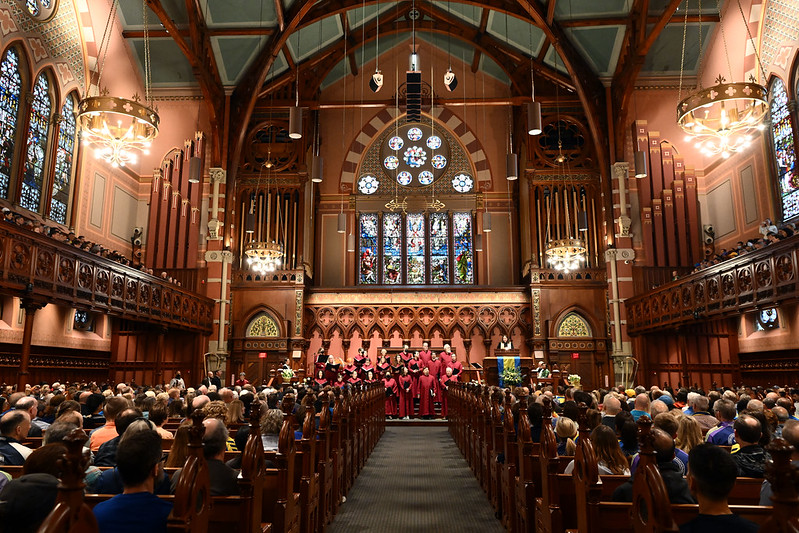
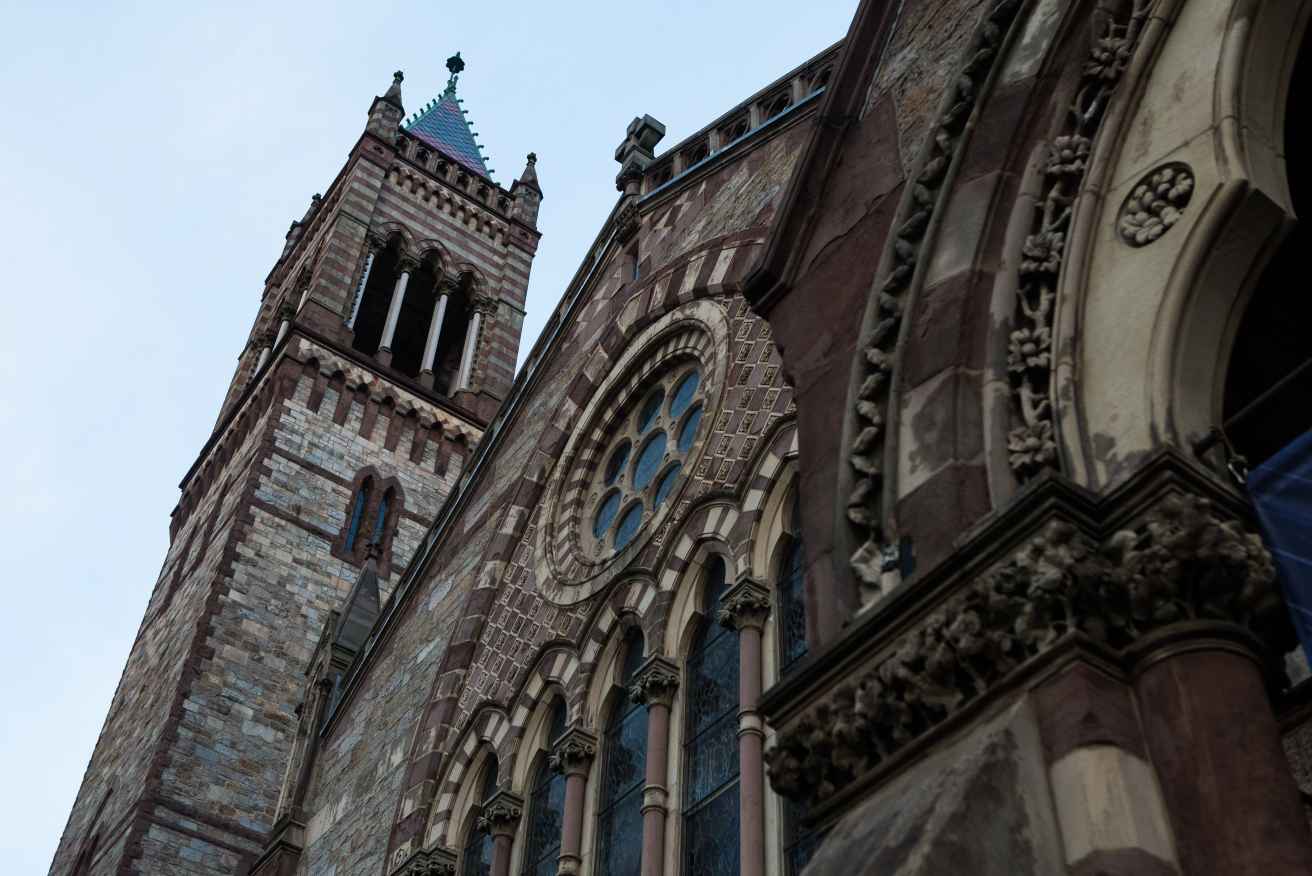
It is a fair guess that the people gathered in Marquand Chapel this morning are the sort of people who spend time in sanctuaries … ones we work in and ones we visit. If you are like me, you can’t pass a house of worship without looking at it and wondering what’s inside. Our friends and families know this about us. When traveling, we irresistibly gravitate toward sanctuaries: chapels, basilicas, temples, ashrams, mosques. Our tastes are eclectic and discriminating. We are sanctuary connoisseurs, sanctuary aficionados. We are sanctuary fanatics, sanctuary junkies. We can’t get enough of them!

Each sanctuary is an opportunity to encounter God … and more than that, to experience how others encounter God: in clear glass or stained glass, with silence or a thundering organ, with bright lights or flickering candles. Each sanctuary is designed to create an effect, a mood, a quality of space. Each is built to be the kind of place where God will feel at home … the sort of place God might like to come in, take off her shoes, and stay for a spell.
<> 

But what happens when it is God who is in need of sanctuary? What happens when, like those Japanese women, God is barefoot, in distress and seeking refuge from a violent world?


That is the burden of the opening chapter of the Book of Micah. The corruption by the religious and political leaders of Micah’s day has reached scandalous proportions. Micah rails against religious practice that has become untethered from ethical performance.
 

Shocked and grieved by human moral failure God through Micah – or Micah through God – laments and wails, barefoot and naked. It is a disturbing image Micah presents. It is an image of a God who is beside herself with anger and grief.
 

Moved by God’s pathos, Micah sets out to create sanctuary for God … a haven from violence and injustice. With words, pronouncements and judgments Micah begins to make sanctuary. He builds it. He posits it. He demands it. He denounces the corruptions and pretensions of the Jerusalem establishment. He expresses disdain for arrogant rulers who claim to be doing God’s work, but who do so over the broken backs of the people.


Micah ministered during the reigns Jotham, Ahaz and Hezekiah. We minister during the reigns of Bush, Zawahri, Benedict, Musharraf, Karzai, Olmert, Chavez, bin Laden and Kim Jong-il. Micah was faced with tumultuous, international events in the 8th century BCE; we, with very different, but no less tumultuous, international events in the 21st century of the Common Era. Ours is a century whose opening years have been marked by terror, tsunami, holy wars, genocide, pandemic, a voracious appetite for oil, a wounded Africa and a fractured and brutish Middle East. Ours, too, is a time of scandalous behavior by national and religious leaders … leaders who issue fatwa’s, encyclicals, edicts, sermons, and speeches that play tug-of-war with God.


Imagine God’s dismay over the way religious and national leader claim God is on their side, their side is right, their war is a holy war. Surely, it is enough to make God crazy with grief … enough to send God out into the world disoriented: lamenting, wailing, barefoot and naked.


Ah, but this is where we come in! You see, what we have to offer is exactly what Micah had to offer. We have sanctuary to offer, an ancient and venerable Christian practice: the practice of creating sacred spaces, holy places, safe houses, where God can toss her shoes over the gate, be welcomed in and find refuge from a manifestly violent world.


But there is a catch. For God to feel safe in our sanctuaries, they must be places pleasing to God. They must be places where worship and justice are inseparable, indeed, indistinguishable. For, as Micah insists, it is not possible to be righteous without doing justice.
 

For God to feel welcome in our sanctuaries, they must be places where we who gather week after week, pray as earnestly for our enemies as for our own sons and daughters who are sent into harms way … places where the widening gap between rich and poor is confessed as shameful and lamented out loud … places where the colors of the skins of God’s people are embraced as beautiful, rather than as a cause of suspicion. For God to feel safe in our sanctuaries, they must be places where torture is regarded as scandalous, no matter what the excuse; they must be places where the most powerful men on earth are called to account for preying on the young and vulnerable. For God to feel safe in our sanctuaries, they must be places where those who pass the peace, those who follow the Prince of Peace truly and deeply believe that waging peace is more effective, more salutary and more God-fearing than waging war, preemptive or otherwise.
 

You and I are sanctuary dwellers, sanctuary denizens. We are sanctuary aficionados. We, who are pastors and preachers and teachers of pastors, we bear responsibility for making our sanctuaries places where God is not only talked about, serenaded in song and turned to in prayer, but places where God feels heard and listened to … holy places where God feels at home.


A few months ago Copley Square in Boston was filled with military boots, thousands of them, each pair of boots representing one solider killed in the Iraq War. The traveling exhibition[2] is intended to explore the human cost of war and to champion our collective responsibility to promote peace. The boots stand at silent attention as a memorial to those who have fallen. To walk among the boots is to experience sanctuary … a haven where it is holy and human to lament the loss of young lives; where it is holy and human to lament our propensity for violence.
<> 

I don’t know why the creators of the exhibit chose to represent fallen soldiers with boots – rather than helmets, for example. I don’t know why it was that God instructed Moses to take off his shoes when he stood on holy ground. I don’t know why desperate women in Japan tossed their shoes over the gate of the convent instead of rattling the gate to get in. I don’t know why Jesus decided it was the disciples’ feet that needed washing on that Thursday evening. I don’t know why Micah imagines that a grieving God is a barefoot God. 


It may be that there is nothing quite so vulnerable as a human being without shoes … and nothing quite so human. 


What I do know is that in Micah’s theology human beings bear responsibility for making God feel safe.


I also know that Micah provided a formula for how to make God feel safe. Not coincidentally, it is the same formula for how to make each other feel safe – and not just each other, but also the other others, those others. It is this: do justice, love kindness, and whether barefoot or shod, walk humbly with God.


Let us be about the holy Christian work of making sanctuary.


[1] I dedicate this sermon to my late husband, Peter Southwell-Sander, who died in June. Peter was a member of the Academy of Homiletics and the international Societas Homiletica. A priest of the Church of England and Canon Emeritus of Chelmsford Cathedral, Peter held standing in the United Church of Christ.

The sermon was also adapted and preached on October 10, 2006 at Marquand Chapel at Yale Divinity School October 10, 2006 Convocation & Reunion

[2] The traveling exhibition, Eyes Wide Open, is sponsored by the American Friends Service Committee.


Copyright © 2006, Old South Church and by author.
Excerpts are permitted as long as full accreditation is made
to Old South Church and to the author.

Back to Sermon Page

The Old South Church in Boston
645 Boylston Street
Boston, MA 02116
(617) 536-1970