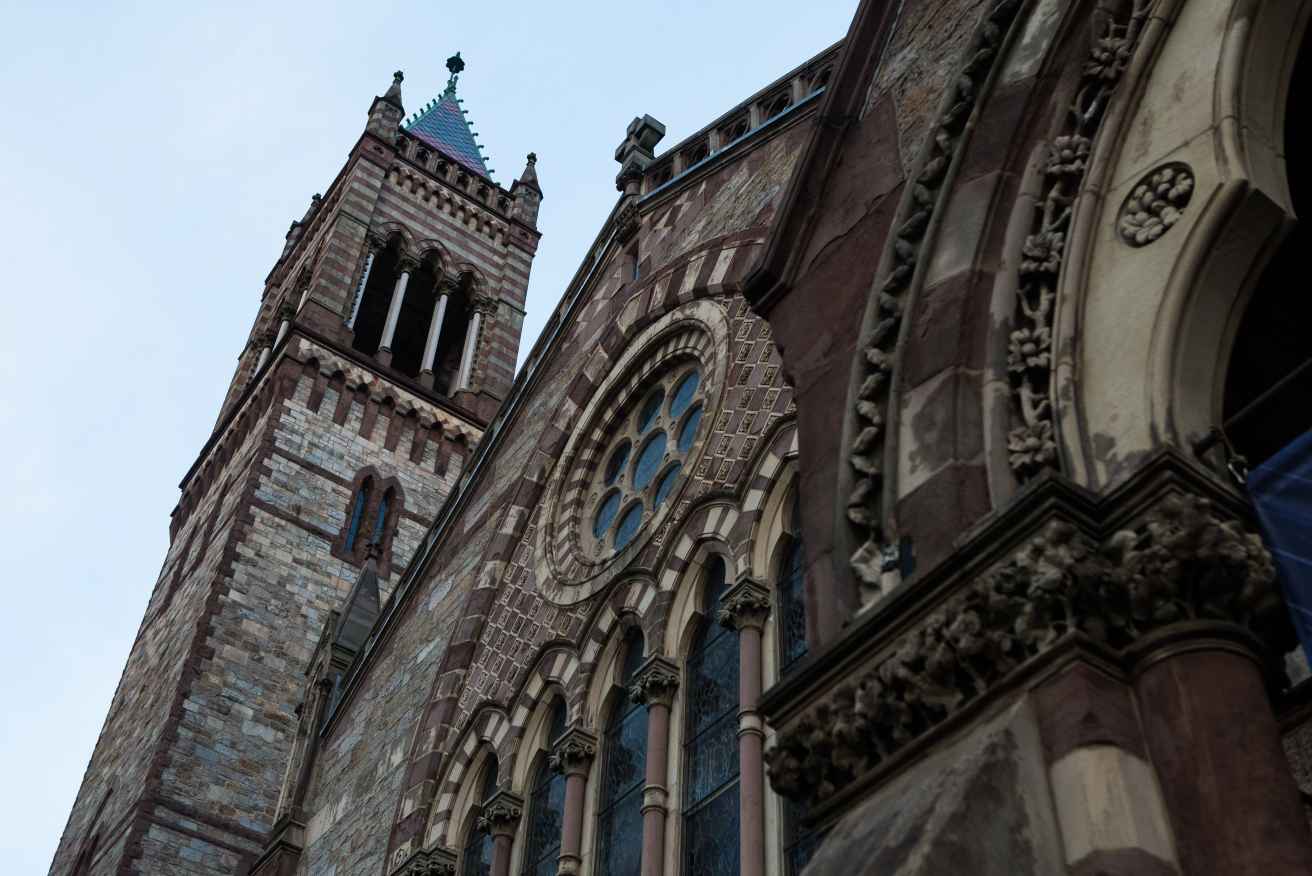
The Old South Church in Boston

On Light


a reflection by Rev. Nancy S. Taylor

Based on the text of Lux Aeterna by Morten Lauridsen and John 1:1-14

April 2, 2006


Listen to this Sermonmp3 file


One of the curiosities about Old South Church is the stark difference between our former home, the Old South Meetinghouse, and this building, sometimes known as the New Old South Church.

Our former home, the Meetinghouse on Washington Street, is a Colonial style sanctuary. Its walls are white. Its windows are clear glass. There is no adornment, no embellishment. The light that enters that space is unfiltered, strong and bright. On a sunny day the congregation would have been drenched in light.

Our Puritan ancestors who designed that space believed that simple is sacred; that plain is pure; that to be unadorned is to be unsullied.

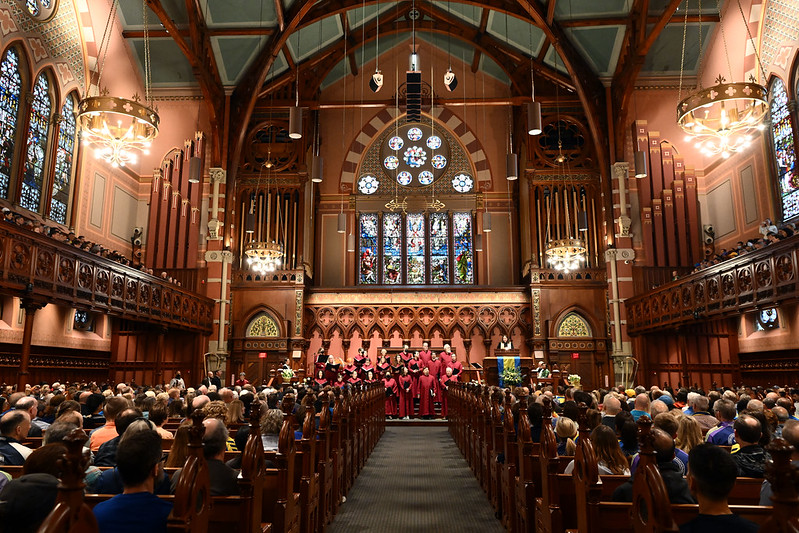
It is a sure bet that these Puritan ancestors groaned in their graves when they first got wind of the riot of color, texture, material and design of the proposed New Old South Church. There, in the Meetinghouse, God is meant to be experienced through light that is direct, unfiltered and strong. Here, in this sanctuary, God is meant to be experienced through refracted light, muted hues and earthen colors. Here God is experienced in the images and stories of the Bible depicted in the windows, in the contrast and complement of wood and stone, cloth and paint, metal and glass.

How did the descendants of the Puritans end up with this? Or, as a visitor asked me one day: “What went so wrong?”

The simplest answer is that, while the people who built this building in the 1870’s were descended from the Puritans, they themselves were no Puritans. This building is nothing if not an adamant statement of that change in identity.

In the end, however, perhaps too much made of the architectural differences between this sanctuary and our former one and between these stained glass windows and those clear windows.

Architects are rightly interested in how light works in such a space as this. They are interested in the building’s orientation to the sun, to the play of light and shadow, of color and contrast. It is their purpose to create thereby an aesthetic experience.

I submit that while it is the architect’s job to create an aesthetic experience, it is the job of the congregation to create a relational experience.

I submit that for those of us who worship here, for those who enter this building, whether for the first time, or for the 1000th time, the experience of light that matters most is the light in the eyes of those who greet us.

I submit that Jesus, the light of the world, the light that enlightens everyone, the light that shines even in our human darkness … Jesus is a doorway kind of light … more than a window kind of light.

Imagine encountering the front door of this church for the first time. Some of you here today undoubtedly did just that. As you approached the building, perhaps you wondered: what is behind this door? What or who will I encounter within? Will I be greeted or ignored? Will I be welcomed or wondered at? If I am frail or in a wheelchair, can I even open this door? Will there be room for me within? Am I dressed appropriately? Will anyone inside look like me, talk like me?

The door can assume an enormous significance.

The Benedictines, a monastic order founded by St. Benedict in the 5th century, understood the importance of doors. St. Benedict wrote a detailed manual called the Rule of Benedict. Written to guide and order the life of his cloistered brothers and sisters, the Rule of Benedict is considered one of the great spiritual documents of the Western world.

It is not by accident that St. Benedict includes in his Rule, an entire chapter on how to answer the door. Why would a spiritual classic devote an enter chapter to answering the door? Because for Benedict, “the way we answer the door is the way we deal with the world.”1  And, the way we answer the door, is the way we welcome Christ. And, the way we answer the door, is the way we represent Christ to the world.

Listen to what Benedict says about how to manage the door. “At the door of the monastery, place a sensible person who knows how to take a message and deliver a reply, and whose wisdom keeps them from roaming about. This porter will need a room near the entrance so that visitors will always find someone there to answer them. As soon as anyone knocks or a poor person calls out, the porter will say, ‘Thanks be to God’ … then, with all the gentleness that comes from reverence of God, provide a prompt answer with the warmth of love.”

In Benedict’s Rule, the porter recognizes every visitor as a blessing from God. And, the porter is always ready to answer the door, day or night.

It is through our doors that the true light of Christ enters. Our windows provide an aesthetic experience, to be sure. But it is through our doors that we offer a relational experience … an experience of the grace and hospitality of God.
 

Social groups, whether economic, tribal, political or religious, typically construct boundaries between themselves and others: national borders, residential fences, security walls, gates and barricades, neighborhoods, private clubs and inner sanctums: doors. Sometimes there are signs that say “Keep Out”, “Members Only”, “Men Only”, “Whites Only”.

At other times, while the signals are more subtle, they nevertheless communicate: you don’t belong here, you’re not one of us, you’re not welcome at this communion table. Such boundaries have caused immigrants to change their names; they have caused black children to try to rub their skin white; they have caused women to suffer in silence and gays and lesbians to hide in dark closets; they have caused countless people of deep and pious faith to leave the Christian church.

Jesus, he whom we call the light of the world, consistently challenged the closed-door policy he encountered at every turn. He broke open the doors of the Temple in Jerusalem, claiming that it should be “a house of prayer for all peoples”2, rather than the nationalistic shrine it had become. Over and over again Jesus transgressed the social boundaries of his day and culture. He ate with lepers; he conversed familiarly with women; he touched those who were ritually impure; he embraced the excluded.

When it came to border crossings in the first century, Jesus, the light of the world, broke the law.

The kind of light Jesus brings comes through doors more than windows. It is a light that animates our welcome, one to another, and dissolves borders, shelters the stranger, includes the outcast and embraces the immigrant.

Carved into stone in the portico of this Church are these words from the Bible: “Behold, I have set before you an open door”3.

Those words remind us that just as the porter keeps vigil at the door of Benedictine monasteries, so must we keep vigil at this door. It is the tender and arduous work of this congregation to keep that door open and to receive the visitor as a blessing. Only by such vigilance will the light of Christ shine through, lighting the way for friend and stranger, welcoming all who enter.


1.   The Rule of Benedict, Joan Chittister, p. 171-172.
2.   Luke 19:46 and Isaiah 57:6
3,  The Book of Revelation 3:8


Copyright © 2006, Old South Church and by author.
Excerpts are permitted as long as full accreditation is made
to Old South Church and to the author.

Back to Sermon Page

The Old South Church in Boston
645 Boylston Street
Boston, MA 02116
(617) 536-1970