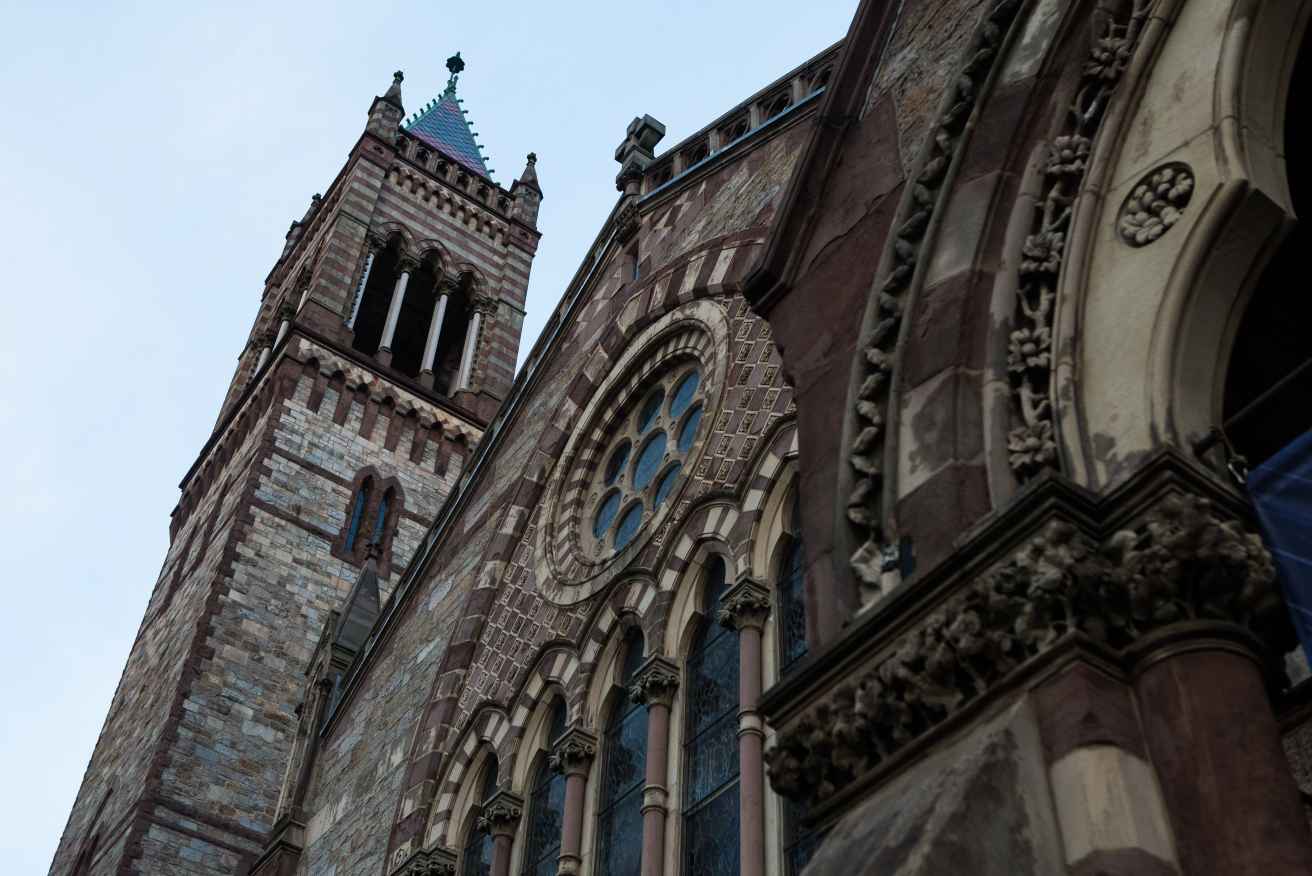
The Old South Church in Boston

How the Mighty Have Fallen

A Sermon by Senior Minister Nancy S. Taylor

Based on 2 Samuel 1: 17-27

July 2, 2006

Listen to this Sermonmp3 file


“In any small town, there is enough grief to freeze your blood.” (Frederick Buechner).

Today’s reading from the 2nd Book of Samuel is an expression of grief, a long, cry of pain and lamentation. David, who had slain the giant Philistine, Goliath … David, among the mightiest soldiers in Israel … David, author of psalms and future King of Israel … David gives voice to a cry of lament over the battlefield deaths of Saul and Jonathan.

David’s lament is regarded as one of the most eloquent and timeless expressions of grief in world literature. It is David’s tribute to Saul, Israel’s first monarch, and to Jonathan, the crown prince.

But David does more than utter his own, personal lament. He orders the nation to learn it and, through it, to give voice to their own national grief. David’s lament is intensely private … for through it he gives voice to his own profound sorrow at losing his great friend, Jonathan. At the same time it is unabashedly public … expressing the grief of an entire nation.

It may seem unfortunate to you, as it did to me, that on the eve of our most important national holiday – Independence Day – the Christian liturgical calendar assigns a reading about national grief.

            The barbeques are being readied. The picnics are packed. The beach chairs are in the car. The fireworks are poised. Who wants to grieve today? Wouldn’t we rather celebrate? After all, here we are, in the church that brought you the Boston Tea Party.

Our former building, the Old South Meetinghouse, gave welcome to thousands of people who gathered there to debate the tea tax. A member of this church, Samuel Adams, gave the signal to dump the tea. That act of defiance was arguably the most decisive moment in this people’s quest to become a nation … a free and independent people. Many of us would rather celebrate that moment today than explore David’s and Israel’s grief over the deaths of Saul and Jonathan.

But in the house of God the Christian calendar trumps both national pride and local church pride and so it is that this lamentation stands. Not only does it stand: it challenges and judges us.

What is perhaps most powerful about this lament, and about David’s summons to all the people to learn it, is that David insists on taking death seriously, even the death of soldiers on the field of battle.

As a nation, we know all too well how easy it is to allow battlefield deaths to pile up without our hardly noticing, without pausing to grieve the loss.

David will not let the moment go. He will not allow Saul and Jonathan to die without notice, without commentary, without weeping and wailing and national mourning. For David, because life matters, death matters. Every death matters. Every death, even battlefield deaths, are to be noticed and mourned.

David is generally considered the author of many of the psalms in the Bible. Did you know that fully 70% of the biblical psalms are laments? These psalms, many of which derive from the praying life of King David, relentlessly notice and name death, defeat and suffering. They name such things, face them, and bring them to God in corporate worship.

By contrast, while disaster is endlessly reported on in our 21st century world, we rarely pause long enough to utter a corporate lament. We hear and read about disaster all the time: the disasters of flood and famine, the disasters of political malfeasance and societal scandal, the disasters of global warming and of a war gone terribly awry. But the images come so fast and furiously, they pile up, one on top of another, until we cannot or will not take them in.

There are so many great things about this nation … and so many things we do well. But what we are not so good at, is expressing public grief. We tend to like things to be cheerful and hopeful. Our national leaders would rather put a positive spin on things than dwell on the grief we are all experiencing. Moreover, the Administration has resisted media coverage of the war dead coming home. We are not supposed to see the toll and cost of war.

David’s lament, by contrast, is an act of defiance. By noticing death and by naming his grief and the grief of a nation, he insists that our humanity – our capacity to feel grief – will not be diminished or silenced.

David’s lament provides the young nation of Israel one of its finest moments: it will not judged great by how many wars it begins or wins. Like every nation, it will be judged by its capacity to notice the tragedy of war.

Our President has been at pains to assure us that our war dead were heroic and that they died in the cause of freedom. But however true those things may (or may not) be … it is not enough. We need to name and lament the loss. We need to acknowledge that our beautiful young sons and our beautiful young daughters have been stolen from their mothers and fathers, from their sons and daughters, from their spouses and siblings. We need to be able to say how much this hurts, how much each death matters.

So, before lighting the grilles, before setting off the fireworks, on the eve of our own national holiday, in this house of the God who calls us to turn spears into pruning hooks and swords into plowshares, in the presence of our host, Jesus Christ, the Prince of Peace, let us pause to notice and lament those who have died.

At the sound of the chime, I invite you to sing together: “Lord, have mercy upon us”.

Since the beginning of the Iraq War, as of June 30 2006, there have been 2,753 coalition deaths.

* (Lord, have mercy upon us)

2,528 Americans have died, two Australians, 113 Britons, 13 Bulgarians, three Danes …

* (Lord, have mercy upon us).

Two Dutch, two Estonians, one Fijian, one Hungarian, 31 Italians …

* (Lord, have mercy upon us)

One Kazakh, one Latvian, 17 Poles, two Romanians, two Salvadoran …

* (Lord, have mercy upon us)

Three Slovaks, 11 Spaniards, two Thai, and 18 Ukrainians …

* (Lord, have mercy upon us)

In addition, according to the Pentagon, at least 18,696 U.S. troops have been wounded in action …

* (Lord, have mercy upon us)

While it is more difficult to count the number of Iraqi civilians who have lost their lives, it is estimated that that number is between 38,000 and 43,000 …

*(Lord, have mercy upon us).

In writing about David’s lament, biblical scholar Eugene Peterson argues that we must “teach one another how to take seriously these great cadences of pain … so that we are not diminished but are deepened by them.” Pain isn’t the worst thing … Death isn’t the worst thing. The worst thing is failing to deal with reality and becoming disconnected from what is actual.” (p. 120)

There is, indeed, enough pain in any small town – or, God knows, in any nation – to freeze your blood. To face and name the pain, to grieve the tragic, national loss of so many young people … it is this that thaws us and deepens us. It is this that brings us close to the warm heart of God. It is by such noticing, and by such lamentation, that we take the true measure of this war, that we reclaim our nation’s soul, and that we find our own humanity.


Sources

Interpretation: First and Second Samuel, ed. Walter Brueggemann

Leap Over a Wall: Reflections on the Life of David, by Eugene H. Peterson


Copyright © 2006, Old South Church and by author.
Excerpts are permitted as long as full accreditation is made
to Old South Church and to the author.

Back to Sermon Page

The Old South Church in Boston
645 Boylston Street
Boston, MA 02116
(617) 536-1970