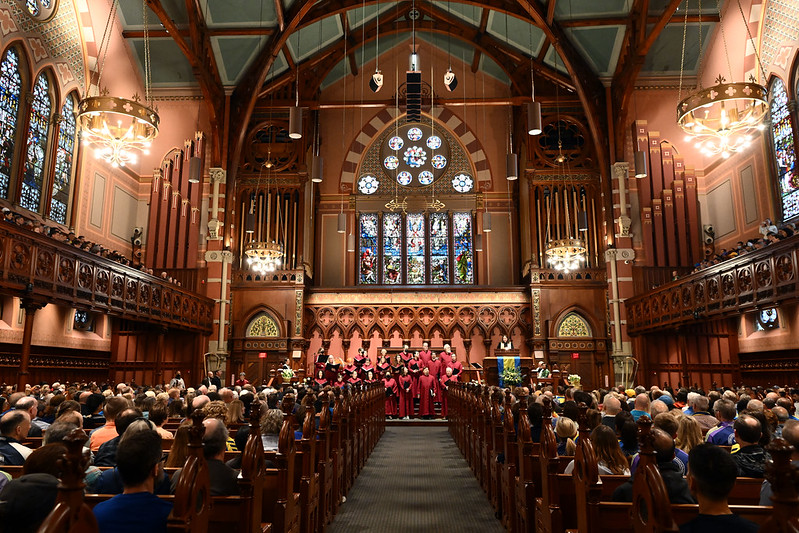
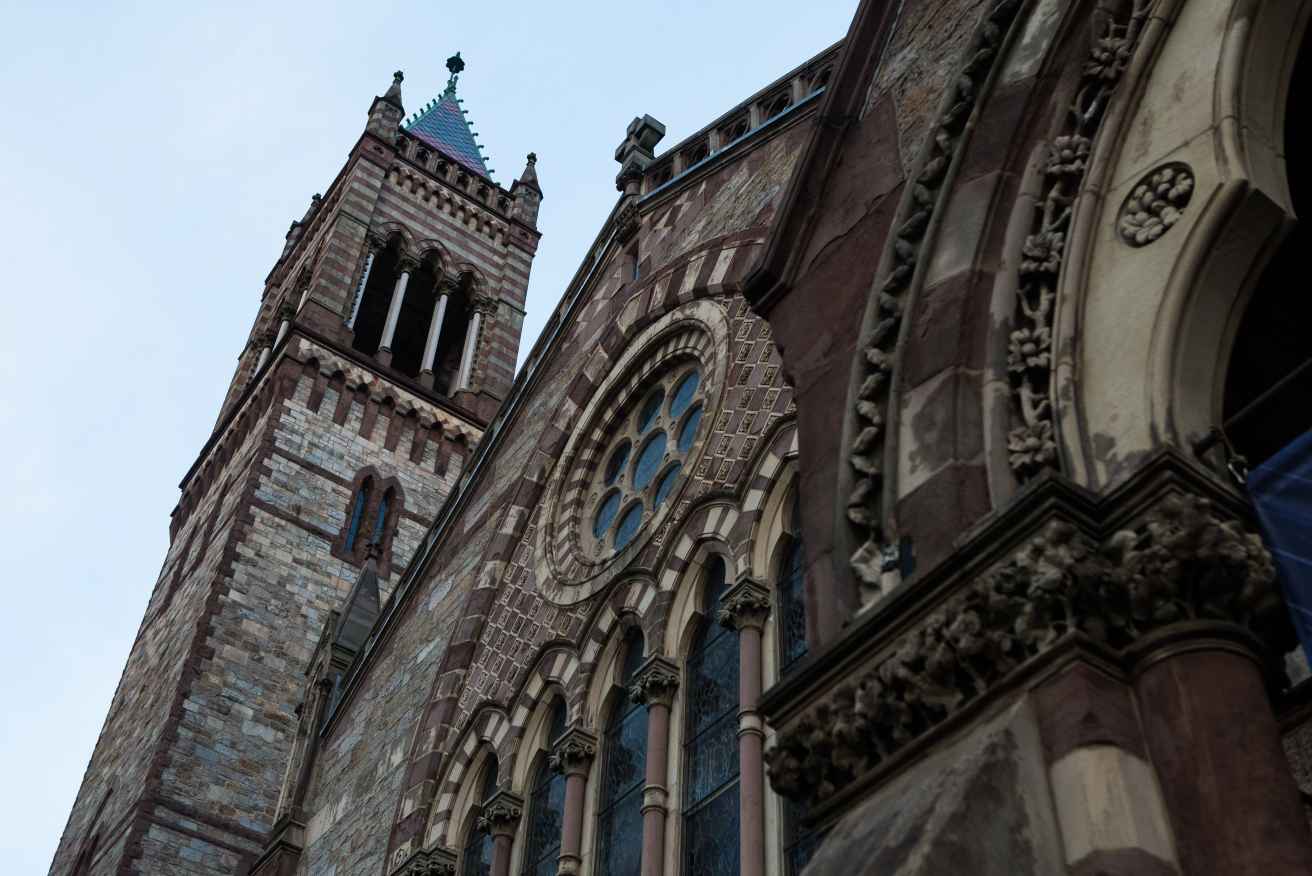
The Old South Church in Boston

Jesus of Nazareth: Mime & Mirror

a sermon[1]

by the Rev. Nancy S. Taylor, Senior Minister

Text: Mark 8: 22-26
Jesus heals a man born blind

March 2, 2008 - The Fourth Sunday In Lent

Listen to this Sermonmp3 file


Travel with me back in time … back to a time before layers of ecclesiastical sediment piled up so thickly that it has become difficult to find Jesus beneath the deposits of the centuries. Travel with me back to a time before the build up of layers of creeds and councils and canon, before the build up of layers of synods and sacraments, of encyclicals and ecclesiologies. Come with me to a time before there was a doctrine of the Trinity or any number of theories about the atonement.

Come with me to the first century in Palestine … to the home of Mark the Evangelist. Mark is preparing to author the first story of Jesus, the first biography, the first Gospel.

As Mark sits before a blank parchment, hand poised to write his story of Jesus, he decides to begin in the middle. He gives his story of Jesus no prelude. There are no stars or magi. There is no virgin, no babe leaping in the womb, no angels visiting, no shepherds abiding, no crowded inn, no threat to the newborn babe, no twelve-year-old Jesus in the temple teaching the elders.

In Mark’s story, Jesus walks on stage fully grown. Wordlessly he walks on stage by walking into the waters of the Jordon to be baptized. Wordlessly, he emerges from his baptism. Still dripping from the Jordan, wordlessly he is driven into the wilderness where he fasts and is tempted.

Jesus emerges from the desert and enters a synagogue. It is in the synagogue that Jesus first finds his voice … sort of. Mark reports that those who hear Jesus are astonished at his teaching. But Mark fails to report one single word of what Jesus says!

In fact, throughout his entire Gospel, Mark ascribes precious few words to Jesus. There is no Sermon on the Mount. There are no Beatitudes. No Lord’s Prayer. There are no long discourses as in John’s gospel. There are few parables.

Mark sees Jesus as a kind of mime.

Mime is the art of silence and the art of gesture. Mime is poetry in motion. Mime uses stylized gestures to help make the invisible visible. The actions of a mime are suggestive, not prescriptive. They are invitational and interactive. They provoke our attention and our imagination. The beauty and genius of mime is that it communicates across cultural and linguistic boundaries.

Mark wants us to see what he sees. He wants us to see how visual Jesus is!  “Look!” says Mark pointing. “Watch and see the way Jesus is miming his way through Palestine!”

He is lifting bread and breaking it. He is laying hands upon the sick. He is walking into forbidden territories. He is calling a tax collector from his tax collecting booth. He is eating with sinners. He is plucking heads of grain from a grain field on the Sabbath. He is walking on water. He is teaching from a boat. He is riding on a colt. He is overthrowing the tables of money changers.

Jesus says precious little throughout Mark’s gospel. When he is arrested and questioned by Pilate: silence. When he is hanging on the cross and being taunted: silence.

 Mark then ends his story of Jesus with silence: with the deafening silence of an empty tomb.

 The silence of Jesus is provocative and it is invitational. For those who can embrace it, this silence animates and arouses. It is life-giving and challenging. It stirs us into life.

 And, Mark presents Jesus as one who is in constant motion: He is in the river! He is in the desert! He is climbing a mountain … ambling through a village … at the seashore … teaching from a boat … entering Gentile territory … in a garden … in a home … on a hillside … in the city … in the temple!
 

In all this moving about Jesus engages in boundary-crossing. He is entering the country of the Geresenes. Now he is in the territory of the Samaritans. Now he is conversing with a Syrophonecian. Now he is mixed up with tax collectors, now with lepers, now with women, now with children, now with sinners.

 Look, says, Mark, pointing: Look and see what Jesus does with his body. Watch what he does with other people’s bodies. Keep an eye out for those to whom he speaks, those whom he touches, and for where he goes.

A woman in the crowd touches the hem of his garment. Did you see what transpired? Power left him and entered her!

Mark presents Jesus as a mime whose gestures are more important than his words.

Mark want us to experience Jesus as evocative, provocative and invitational. Jesus, says Mark, is poetry in motion … a poem our eyes follow because we are dazzled by the bright truth of him.

Mark also presents Jesus as a kind of mirror. As Jesus walks through Palestine healing and teaching and eating, it is as if he is holding up a mirror everywhere he goes. Our eyes are trained upon him – all eyes are trained up him – yet we find that we are seeing ourselves more clearly

Jesus upsets the tables in the Temple and drives out the money changers… and we find ourselves asking: are our houses of prayer are all that God would want them to be?

He enters the region of Tyre  and there strikes up a conversation with a Syrophonecian and we wonder: What would it be like to walk into the heart of Roxbury, say, or maybe the Hasidic district in NYC and there strike up a conversation with a stranger, with “the other.”

He chastises the disciples for trying to keep children from bothering him … and we wince, remembering times we have thought of children as a bother.

He sends out the twelve, two by two, with no provisions… and we shudder, imagining what it would feel like to be that exposed, that vulnerable, that trusting of God.

Jesus announces that true greatness means the last shall be first and the first last…  and we shrink in acknowledgement of our own acquiescence  to the hierarchies of power and privilege that are our daily bread.

Mark shows us a Jesus who is so free, we cannot help but see our own limits. He portrays a Jesus who is so authentic, we are cast back upon our own poor imitations of our true selves.

Mark’s Jesus is also demanding. He asks difficult questions and provides few answers.

As he is healing the paralytic, he asks: “Which is easier: to say your sins are forgiven or rise, take up your mat and walk?  And we cannot help but wonder: What is the difference between being healed and being whole?

He turns to his disciples and demands: Who do you say that I am? … and we are forced to wrestle with that question for ourselves. Who do we say that he is?

His opponents engage him about paying taxes, and he asks: Whose image is on this coin? … and we find ourselves weighing our own allegiances to God and Caesar.    

He is healing a man born blind, and asks the man: What do you see? The man responds, “I see people, but they look like trees walking.” And who among us is not reminded of our own poor sight… that we see but only partially … and that we ache to see with the clarity with which Jesus sees.

In the presence of Jesus, Mark finds himself looking in the mirror …looking critically at his own traditions and culture, at the meaningfulness of his life; at his assumptions; at what makes him afraid and what holds him back … at what he sees and at what makes him blind.

In Jesus, Mark encounters someone so free, so authentic, so provocative and life-giving, he cannot keep it to himself.  He sits down in his home in Palestine and writes. He writes to us and for us so that we might see what he sees and so we can experience what he experiences.

And that is this: a Jesus who invites our passionate and subjective engagement with the source of life,  with the Author of the Universe, the Creator of the whirling stars; the One who paints buttercups yellow  and poppies a shocking orange. He invites our engagement with the One who raises the dead who forgives without end … the One who gives us life who calls us by name … the One who sends us a mime and a mirror and asks: “What do you see?”

In her poem, “Tell all the Truth but tell it slant”[2],  Emily Dickinson writes … The truth must dazzle gradually / Or every man be blind …

For those who have eyes to see: Jesus is God’s best poem. Jesus is God’s slant wise, and dazzling truth. 


__________________________________

Mark 8: 22-26

22: And they came to Beth-sa'ida. And some people brought to him a blind man, and begged him to touch him. 23: And he took the blind man by the hand, and led him out of the village; and when he had spit on his eyes and laid his hands upon him, he asked him, "Do you see anything?" 24: And he looked up and said, "I see men; but they look like trees, walking." 25: Then again he laid his hands upon his eyes; and he looked intently and was restored, and saw everything clearly. 26: And he sent him away to his home, saying, "Do not even enter the village."


[1] Adapted from “Jesus of Nazareth: Mime, Mirror, Muse,” a lecture I delivered at Harvard’s Memorial Church, February 20, 2008, as a part of a six-part series on The Enigma of Jesus.

[2]Tell all the Truth but tell it slant” by  Emily Dickinson: Tell all the Truth but tell it slant/ Success in Cirrcuit lies/ Too bright for our infirm Delight/ The Truth's superb surprise/ As Lightening to the Children eased/ With explanation kind/ The Truth must dazzle gradually/ Or every man be blind---


 [u1]Mark’s blind may is not necessarily “born” blind.


Copyright © 2008, Old South Church and by author.
Excerpts are permitted as long as full accreditation is made
to Old South Church and to the author.

Back to Sermon Page

The Old South Church in Boston
645 Boylston Street
Boston, MA 02116
(617) 536-1970