Old South Banner
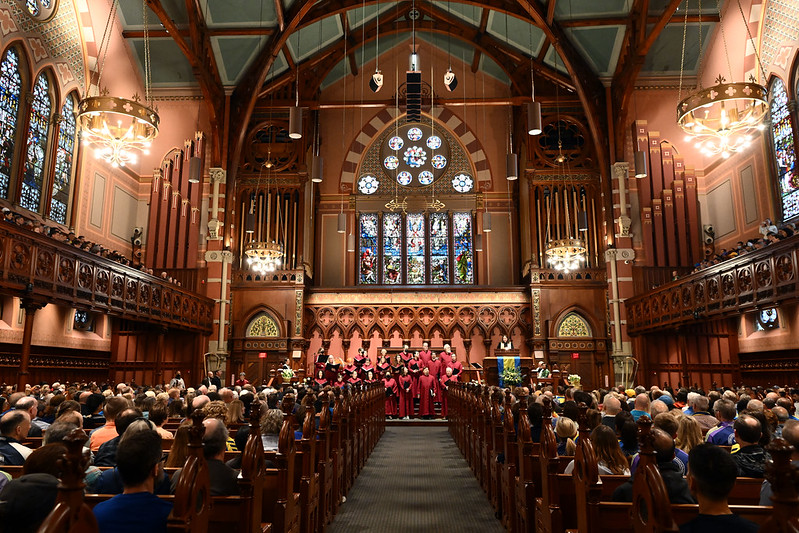
Old South Sanctuary (photo by Sarah Musemuci)


Copyright © 2008, Old South Church and by author.
Excerpts are permitted as long as full accreditation is made
to Old South Church and to the author.


Old South Sermons:

Seller of Purple
 

by Rev. Nancy S. Taylor, Senior Minister

Based on Acts 16: 9-15

Sunday, November, 2008
Twenty-fifth Sunday after Pentecost
and two days before the November 4th presidential election

Listen to this sermon


It feels as if our nation is caught in a defective kaleidoscope, refracting only red and blue: red states and blue states, us and them, winners and losers, liberals and conservatives, real Americans and the other kind.

Or you might say that these past two years have been about black and white … the prospect of a black family moving into a White House: dream-come-true for some, nightmare for others.

Throughout the course of these past two years, no matter what side we are on, we have heard and read of, have seen and witnessed, our fellow citizens in ways that jar, offend and disappoint.

In any case, the colors of this season feel more like black and blue: a nation bruised, partisan, divided … with the mudslinging of this campaign season and the taste of the mud very much in our mouths.

It feels as if we are caught in a defective kaleidoscope … and the sparkling, dazzling, beautiful spectrum of God’s colors are reduced to a paltry few … colors that clash rather than compliment, fight rather than delight.

Perhaps it is not without consequence that red and blue, when mixed together, make purple.

Purple is a liturgical color … a churchly color. The church has taken this color of royalty

and symbol of empire and claimed it for Christ, our Sovereign, King of kings, Lord of lords … this One who, in contrast to mortal sovereigns, shall reign for ever and ever.

For Christians, it is Christ – not Caesar, Bush, Obama or McCain – to whom we owe our true allegiance.

Today at Old South, two days before the November 2008 presidential elections, I suggest we take a Sabbath break from clashing colors and mix it up a bit. Today, purple is on offer.

It is in the port city of Philippi, on the edge of Macedonia, at the far fringes of the Jewish Diaspora that Paul happens upon Lydia.

Paul is not looking for her. It is an accident that he comes upon her. It is the Sabbath day and what he is searching for is a synagogue … and men. He is looking for a place to preach and he is hoping for masculine ears to receive his Gospel, his good news, his radical news about a new Sovereign: the Son of God, the Prince of Peace … whose kingdom and rule trump Caesar’s.

Discovering that there is no synagogue in Philippi, Paul is directed to an outdoor site by the river where Jews are said to gather for prayer and worship.

He finds only women … and not all of them are even Jews. Among them is Lydia. She is hard to miss. She is a seller of purple, a dealer in purple cloth. With the instincts of a good businesswoman she is wearing her wares. She is all about accessories so she is draped in purple: purple ribbons in her hair, dangly purple earrings, purple shawl.

It was the ancient Phoenicians who discovered that crushed shellfish oozed a fabulous purple color that could be used to dye cloth.

The shades of purple they could produce were glorious: but the process was costly and time-consuming. It took thousands of crustaceans to make even a yard or two of purple cloth. Purple, as the saying went, was worth its weight in silver.

Precisely because it was so precious, purple became a sign of wealth and a symbol of political power. A single glance at a Roman senator, and you could size up his seniority and influence.

Tunics and togas with lots of purple indicated a senior senator who wielded great power. The emperor, alone, wore a toga made entirely of purple cloth.

Lydia stands out because she is selling purple: purple cloth, purple robes, purple thread … the power of purple. She is an unusual woman. She is the head of her household, a traveling merchant. She is worldly and successful, an entrepreneur who trades with the rich, the famous and the powerful.

Lydia is a pagan. She is what the Jews of her day call a “God-fearer” … an ancient equivalent to a “seeker.” She is drawn to prayer and ritual. She is curious about this living God who is not made of wood or stone … this God who freed slaves and has a soft spot for widows and orphans. But she is not yet a believer.

As Paul speaks of Jesus, Lydia edges closer. She hears of a King who has conquered death … of a Savior who takes our sins upon him and rescues us from our own brokenness. She hears Paul speak of a Prince who wages peace with words and with healing, rather than with war and swords … a Prince who feeds the hungry, loves the unlovely, and lifts up the poor and meek. She hears of a Sovereign whose realm is ruled by grace, not threat.

As she listens to the story of Jesus, her heart opens, God enters and she is won over. She converts, bringing with her into the church her entire household.

It is in Lydia – in her story and in her heart – that the imperial purple of the Roman Empire and the message of the Gospel are met. They are met in a woman whose life was spent selling luxury goods to the rich and powerful, but who finds true riches and real power in the story of a different kind of Prince.

Purple is on offer today at Old South. Purple is the color of royalty … for the King of kings.

Purple is also the color of two seasons of the church year: Advent and Lent. In the life of the church, purple symbolizes penitence. Purple power is the power of forgiveness, of humility, of right-relation between ourselves, each other – including those other “others” – and God … it is the color of wholeness and of healing.

Worldly power is so much about being right or wrong, about winning and loosing … and so it is that power is wielded in clashing colors of red and blue, black and white … producing in their wake a bruising, black and blue.

Our worldly kaleidoscopes are damaged and in need of repair … they are not letting in enough light!

Out-of-doors, by a river in Philippi, Lydia learned that the gospel is a study in reversals. The first is last. The lost are found. The servant leads. And purple, the color of royalty and power, drapes the shoulders of the Prince of Peace …the one who once entered Jerusalem on a donkey, rather than a war horse … a Prince who could not afford to purchase what Lydia has to sell … but who, without cost, gave Lydia her whole life.

It is no accident that as we sit in this sanctuary we are drenched in kaleidoscopic colors … dazzling colors of stained glass that portray images of the Hebrew prophets, lions of justice –  Isaiah, Jeremiah, Ezekiel and Daniel – who confronted kings and potentates on behalf of the poor… and the four evangelists – Mathew, Mark, Luke and John –  who poured out their lives to tell the story of Jesus … and narratives of parables and miracles … and the proclamation of angles to shepherds of Good New of Great Joy to All the Earth.

Here, surrounded by and drenched in the glorious spectrum of God’s colors, we counter the reductionist tendency to pit color against color. Here we are treated to a God’s-eye-view, a perspective refracted by the light of eternity.

Your mission, good Christians, should you accept it: vote. By all means, vote. And this: carry into the voting booth the story of Lydia and the healing power of purple.


Acts 16:9-15

During the night Paul had a vision: there stood a man of Macedonia pleading with him and saying, “Come over to Macedonia and help us.” When he had seen the vision, we immediately tried to cross over to Macedonia, being convinced that God had called us to proclaim the good news to them. We set sail from Troas and took a straight course to Samothrace, the following day to Neapolis, and from there to Philippi, which is a leading city of the district of Macedonia and a Roman colony. We remained in this city for some days. On the sabbath day we went outside the gate by the river, where we supposed there was a place of prayer; and we sat down and spoke to the women who had gathered there. A certain woman named Lydia, a worshiper of God, was listening to us; she was from the city of Thyatira and a dealer in purple cloth. The Lord opened her heart to listen eagerly to what was said by Paul. When she and her household were baptized, she urged us, saying, “If you have judged me to be faithful to the Lord, come and stay at my home.” And she prevailed upon us.


Copyright © 2008, Old South Church and by author.
Excerpts are permitted as long as full accreditation is made
to Old South Church and to the author.

Old South Church
645 Boylston St. Boston, MA 02116
(617)536-1970 Tel (617)536-8061 Fax

You can E-mail us by clicking here: OSC Communications

Copyright © 2008, Old South Church