Robbers, Robin Hood and Samuel Adams
Based on Luke 10: 25-37 (The Parable of the Good Samaritan)
The Boston Tea Party of 1773 was the largest mass action of the decade, the first large-scale act of civil disobedience on this soil, and perhaps the most galvanizing event of the American Revolution.
In the Colonial Era, virtually everyone drank tea. Tea appeared on the tables of the wealthiest aristocrats and the poorest laborers. Thus, when the British placed a punishing tax on tea to the Colonies, the patriot coalition in Boston organized to resist. With the rallying cry, “No taxation without representation,” the entire spectrum of social classes was mobilized: rich and poor, educated and illiterate. Indeed, two Old South members, Samuel Adams, a statesman and George Hewes, a shoemaker, exemplify that very social diversity. Meetings were held at Fanueil Hall. But as the crowds swelled, the meetings moved over to the Old South Meeting House, this congregation’s former home.
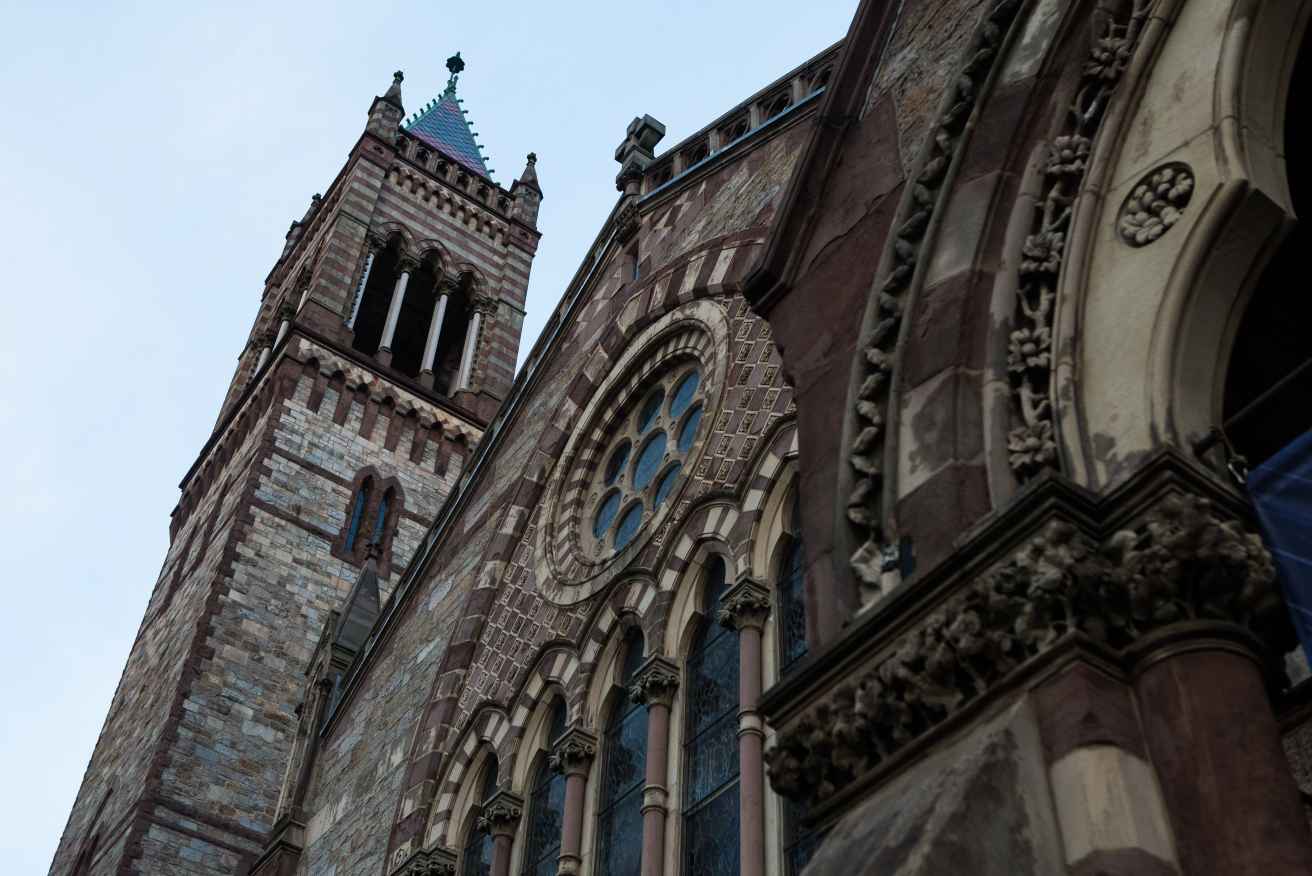
The Old South Meeting House (located on Milk and Washington Streets; now a museum) was the largest building in Colonial Boston. Historians estimate that on the day of the Tea Party (December 16, 1773) between 5000 and 7000 people were packed inside the Meeting House.
One way or another, nearly every patriot family participated in the events that led to the Boston Tea Party or in the action itself. Those who drank tea from costly silver tea sets, and those who drank tea from crude vessels, all joined in a common purpose.
Part of what was so transfixing and transcendent about the Boston Tea Party – a consequence of it, if not an intention of it – was that it resulted in a redefinition of Colonial America as a large neighborhood. The organizing efforts that led to the Tea Party had the effect of diminishing the social divisions of caste and class. To accomplish the bold act of civil disobedience they planned, the rich needed the poor; the poor needed the rich.
Church and state, politics and religion, nobility and laborer were mingled and merged as unlike elements joined forces to give voice and expression to a cause that united them as neighbors and compatriots … a cause they articulated as independence from Britain. At the same time, it was a cause that fostered among the Colonists an unexpected acknowledgment of their own growing interdependence.
Maybe, just maybe, some of those who participated in the Boston Tea Party remembered another perpetrator of civil disobedience: Robin Hood – that partly historical, partly mythical character from the English Middle Ages. For Robin Hood challenged the gated neighborhood of English nobility… an exclusive neighborhood composed of those whose political and economic power crushed and suffocated the under-classes.
Like the leaders of the Boston Tea Party, Robin Hood gathered an unlikely assortment of people – from religious professionals like Friar Tuck, to members of the aristocracy, and simple country folk. They shared one thing in common – a concern for their neighbors, the starving rural poor. They had no means to exercise justice except as outlaws … by stealing from the rich and giving to the poor. But one of the consequences of their actions was to invite a broader understanding of neighbor, of interdependence among people from different classes.
Robin Hood proclaimed, in effect: we have something to do with each other; we are connected; we are neighbors; and the inequality of the social system cannot be allowed to continue unchallenged. It is just what the Boston Tea Party participants said too!
In the reading this morning from Luke’s gospel a lawyer asks Jesus, “Who is my neighbor?” It’s a good question. Indeed, it is such a good question that it goes to the very heart of Jesus’ message. That is why it elicits one of the most compelling and memorable stories in all of religious literature: the Parable of the Good Samaritan. The Boston Tea Party and Robin Hood widened the definition of neighbors and neighborhood in their times. Yet, the Good Samaritan teaches an even wider view of neighbor: a view so expansive and gracious that it is, in the end, illimitable.
A lawyer in conversation with Jesus agrees that God’s demands that we love our neighbors as ourselves, ranks up there among the most important of God’s requirements. As a lawyer, he presses further and asks a clarifying question: “Who, precisely, qualifies as my neighbor?” No doubt he has in mind the other side of the question: “Who is not my neighbor? What is the limit to the demands on me?”
Jesus responds by relating a story about neighborliness and interdependence.
In his story, the first two people to ignore the man who has been beaten and robbed are pillars of society – a priest and a Levite. They are religious professionals, both working at different levels at the Temple in Jerusalem, the epicenter of the outward practice of faith. Yet, they do not recognize this roadside victim as their neighbor. They both give him wide berth, passing by on the other side.
By contrast, the Samaritan is an outsider, a member of a despised group, who practiced a distinct form of religion and lived in a largely isolated community. Surprisingly, he is willing to get involved up to his elbows with a stranger about whom he knows nothing. He dresses and binds the man’s wounds, caries him to an inn, and pays the innkeeper to care for him,
Clearly, the Good Samaritan has been down that very road before. Perhaps he himself has encountered the robbers, or knows others who have also been robbed and beaten. I wonder if perhaps the Good Samaritan, after having taken the victim to safety, goes to Jerusalem, to the place where public priorities are set, to talk to someone in charge to see if something could be done about those robbers.
He goes to City Hall, demands to speak to the mayor. He lays out the problem of this dangerous road between Jericho and Jerusalem. People are terrified, he tells the mayor. Moreover, he asks, What about those robbers? Are they outcasts who have no other means of support? Are they unsupervised youth who, if given employment and guidance, might become productive citizens? Who is looking into this? he demands.
Jesus describes the Good Samaritan as fulfilling God’s law because he holds a broad view of his neighbor, and because he has the courage and commitment, the compassion and the resourcefulness, to do something helpful.
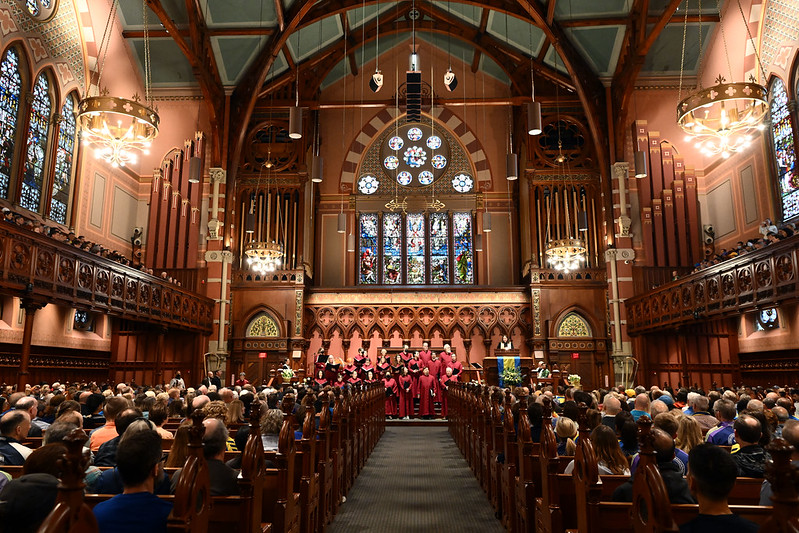
Today, on the eve of Independence Day, we celebrate and give thanks that the Old South congregation and Meeting House were so deeply involved in the events of the American Revolution. We give thanks for forebears and church members like Samuel Adams and George Hewes, who labored courageously for independence. As citizens we honor the heroes and heroines who imagined freedom and who risked life and limb for liberty.
We also celebrate Independence Day in the context of a nation and world that cannot stop talking and arguing about religion. Jesus continues to make the covers magazines like Time and Newsweek. Religion makes the front pages of the newspapers of the world: particularly religious extremism in the guise of Islamic fundamentalism, ultra-Orthodox Judaism, and the radical Christian right in America. We’ve witnessed a resurgence of Holy Wars and the language of crusade and jihad.
From a new Pope to stem cell research, from global poverty to capital punishment, from the Middle East to Northern Ireland, religion and politics are the warp and woof of our collective lives. Yet, while the interdependence of the nations and the peoples of the world is undeniable, many of these phenomena witness to our estrangement from one another, rather than our neighborliness.
Yet there are some who recognize and work for that neighborliness. Rock and pop stars – along with religious and political leaders – are inviting us to take up the mantle of the Good Samaritan. They have organized Live 8, a series of concerts and events across the world to highlight the problem of global poverty … to say to the world leaders of the G8 summit “We are all neighbors … we are all neighbors to the 30,000 children who die each day, needlessly, from the effects of poverty.” Live 8 is today’s expression of Live AID, which tried to focus attention on the pandemics of AIDS and extreme poverty.
Locally, there are numerous and serious efforts to take up the mantle of the Good Samaritan: the effort to provide accessible affordable healthcare to all and to address the genocide in Darfur among others.
On the eve of the anniversary of Independence, we cannot help but ask, How do we celebrate our nation’s independence in the context of an increasingly interdependent global community? Like the Good Samaritan, each of us is challenged to ask: What can I do? Or as the lawyer asked Jesus, Who is my neighbor?
Copyright © 2005, Old South Church and by author.
Excerpts are permitted as long as full accreditation is made
to Old South Church and to the author.