Old South Banner
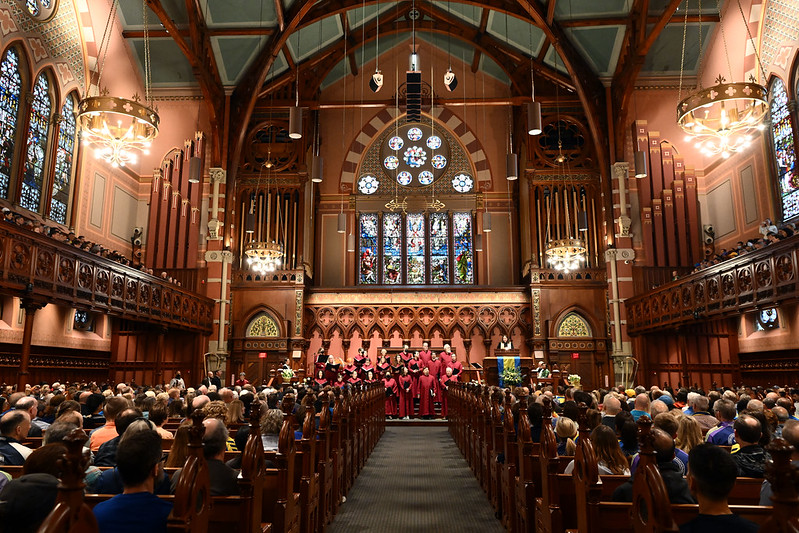
Old South Sanctuary (photo by Sarah Musemuci)


Copyright © 2008, Old South Church and by author.
Excerpts are permitted as long as full accreditation is made
to Old South Church and to the author.


Old South Sermons:

Calamity
 

a reflection by Nancy S. Taylor, Senior Minister

Based on Exodus 1: 8-19

Sunday, May 4, 2008 (Holocaust Remembrance)

Listen to this sermon


Pharaoh’s strategy is brilliant … ruthless, but brilliant: if you want to weaken and diminish the Hebrew population, take out the male babies. But, for the sake of appearances, to keep his own hands clean, it is imperative to have it taken care of efficiently and discretely by the least likely suspects … the midwives.

Pharaoh brings the midwives into the palace. He wines them. Dines them. Gives them a taste of riches and power. Then, only then, does he take the midwives into his confidence. He tells them how important they are to the future and the welfare of the state … how he cannot manage without them … how they will be rewarded.

After all, it is the midwives who alone are present at that critical moment – the moment of birth – which, in the ancient world, is a shaky thing even under the best of circumstances.

It is the midwives who pronounce life or death at birth, who judge whether a newborn is fit for a harsh world[1]. They can easily, so very easily, ever so discretely, assess that a newborn is unlikely to survive. With skilled hands a good midwife can see to it that such a baby does not even suffer.

Midwifery is as old as the emergence of the human race. Ever since women have been birthing children, there has been a need for aid during this challenging and dangerous time.

We know from Egyptian papyri that midwifery was a recognized female profession as far back as 1900 BCE.

A Greco-Roman physician from the 2nd century BCE wrote a description of the ideal qualities to be found in a midwife. Such a woman “will be literate, with her wits about her, possessed of a good memory, loving work, respectable … have a sympathetic disposition, be sound of limb, robust be possessed of soft hands … and endowed with long slim fingers with short nails…”[2]

Ancient evidence from the Roman West suggests that most midwives were of servile origin, but that they were well enough paid for their work to purchase their own freedom.[3]

To sum up, a midwife in the ancient world was literate, robust, of good disposition, sympathetic, and able by her own wits to rise from slavery to freedom! In other words, midwives in antiquity represented an elite, self-selected group of women who were unusually well-equipped to survive and even thrive in an oppressive, patriarchal society.

Which is what Pharaoh utterly failed to account for in his plan: you see, Pharaoh, had no idea with whom he was dealing.

It is no wonder then that in this darkest story from Exodus – a story of otherwise unmitigated horror – it is the midwives who are the bright lights, the heroes. It is they who meet cruelty with compassion, anguish with hope. It is they who take it upon themselves to commute sentences of death to the wonder of new life.

Defying the decrees of Pharaoh, risking their lives –  choosing to fear God rather than the king – the midwives courageously continue to deliver Hebrew babies. Eventually the Egyptians start to notice: despite the edict, Hebrew boy babies continue to multiply!

Summoned by the king and questioned about this inexplicable occurrence, the midwives shrug. Looking Pharaoh right in the eye, they innocently ask: “Is it our fault that the Hebrew women are vigorous (unlike the Egyptian women) and just happen to give birth before the midwife arrives?”

I would love nothing more than to dwell on these remarkable women this morning… to explore their courage, their chutzpah. For, surely, this is what God requires of us. In the face of calamity, in the face of injustice, in the face of evil: this is what God requires of us.

Let these defiant, courageous, life-affirming, God-fearing daughters of Abraham be our model. Let these midwives be the heroes to whom we turn when we are in need of tutoring in the ways of faith and in the ways of life.

But today, as we pause to honor Yom HaShoah, it is imperative to acknowledge and confess, that the midwives are the exception. Evil flourishes because midwives are the rare exception. They are not the rule.

The terrible truth, the hard truth, for Christians and for Jews – though immeasurably more terrible and harder for Jews – is that this ancient story from the Book of Exodus foreshadows too much of the Jewish experience since: a cruel and paranoid ruler; the resentment of the Israelites as outsiders, as strangers, as other; umbrage at their successes; increasingly regressive governmental edicts to restrict and subjugate them; and, eventually a program of execution or deportation, or both … and, accompanying it all: compliance, not resistance …  and, much of it, throughout the centuries at the hands of those who claim the mantle of the Christian Church.

It happened in the early 300’s when the Roman Emperor Constantine issued laws which radically limited the rights of Jews as citizens of the Roman Empire. These laws set in motion the progressive deterioration of Jewish rights. By the Middle Ages the second-class status of the Jew was crystallized.

It happed in the 1300’s when Christians blamed Jews for the epidemic of the bubonic plague. In response to these ludicrous charges, mobs took matters into their own hands and thousands of Jews were butchered or burnt across Europe.

It happened a century later when Spanish Inquisitors expelled hundreds of thousands of Jews from Spain where, during Spain’s Golden Age under tolerant Moorish rule, Jews had grown prosperous, numerous and influential.

It happened in the mid-1600’s in Poland, when the Cossacks carried out an infamous pogrom, murdering untold numbers of Jews.

It happened in the 20th century in Germany when a paranoid ruler rose up and, with the collaboration of the Church, put in place a system of discrimination, repression, oppression and murder that remains among the most shameful and horrific of human history.

The biblical word to describe these horrors, a Hebrew word, shoah, means calamity, catastrophe, disaster, destruction. It is the word that has come to be used by Jews to describe the indescribable … to describe the systematic extermination of the Jews under the Nazis: shoah, calamity.

Today on Yom HaShoah we pause to express horror and shame for what occurred to Jewish brothers and sisters, Jewish grannies and grampas, Jewish babies and teenagers in the name of the Church.

The calamity that befell the Israelites under Pharaoh and the calamity that befell the Jews under Hitler – and in all the instances between – were not nature’s caprice but willful, strategic, systems of evil wrought by human beings, human with brilliant, if ruthless plans … humans with a focus, a program, a pogrom.

Do not forget the midwives … those in Nazi Germany or those in ancient Egypt. Do not forget those who, with cleverness and courage, resisted evil. Do not forget the heroes and heroines who brought light to darkest night and hope to a time of annihilation, and humanity to a manifestly beastly time.

Do not forget the midwives. Look to them: practice their courage, their cunning, their chutzpah. Practice it, study it, pray for it, yearn for it, work for it. For they – and those like them – provide hope and mercy in a brutish world, melting hard hearts with soft hearts and hands.

Don’t ever forget the midwives. But today, in the moments ahead, we pause to remember the others … the rest. We pause in shame, remembering that of which humans are capable. And we pause in solemn remembrance of six million victims of human evil.

______________________________________________________

Exodus 1:8 - 19 Now a new king arose over Egypt, who did not know Joseph. He said to his people, “Look, the Israelite people are more numerous and more powerful than we. Come, let us deal shrewdly with them, or they will increase and, in the event of war, join our enemies and fight against us and escape from the land.” Therefore they set taskmasters over them to oppress them with forced labor. They built supply cities, Pithom and Rameses, for Pharaoh. But the more they were oppressed, the more they multiplied and spread, so that the Egyptians came to dread the Israelites. The Egyptians became ruthless in imposing tasks on the Israelites, and made their lives bitter with hard service in mortar and brick and in every kind of field labor. They were ruthless in all the tasks that they imposed on them.

The king of Egypt said to the Hebrew midwives, one of whom was named Shiphrah and the other Puah, “When you act as midwives to the Hebrew women, and see them on the birthstool, if it is a boy, kill him; but if it is a girl, she shall live.” But the midwives feared God; they did not do as the king of Egypt commanded them, but they let the boys live. So the king of Egypt summoned the midwives and said to them, “Why have you done this, and allowed the boys to live?” The midwives said to Pharaoh, “Because the Hebrew women are not like the Egyptian women; for they are vigorous and give birth before the midwife comes to them.”


[1] Valerie French, “Midwives and Maternity Care in the Roman World” (Helios, New Series 12(2), 1986), pp. 69-84

[2] Soranus, “Gynecology”, translated with an introduction by Owsei Temkin. Baltimore and London: The Johns Hopkins University Press, 1991.


[3] Valerie French, “Midwives and Maternity Care in the Roman World” (Helios, New Series 12(2), 1986), pp. 69-84


Copyright © 2008, Old South Church and by author.
Excerpts are permitted as long as full accreditation is made
to Old South Church and to the author.

Old South Church
645 Boylston St. Boston, MA 02116
(617)536-1970 Tel (617)536-8061 Fax

You can E-mail us by clicking here: OSC Communications

Copyright © 2008, Old South Church