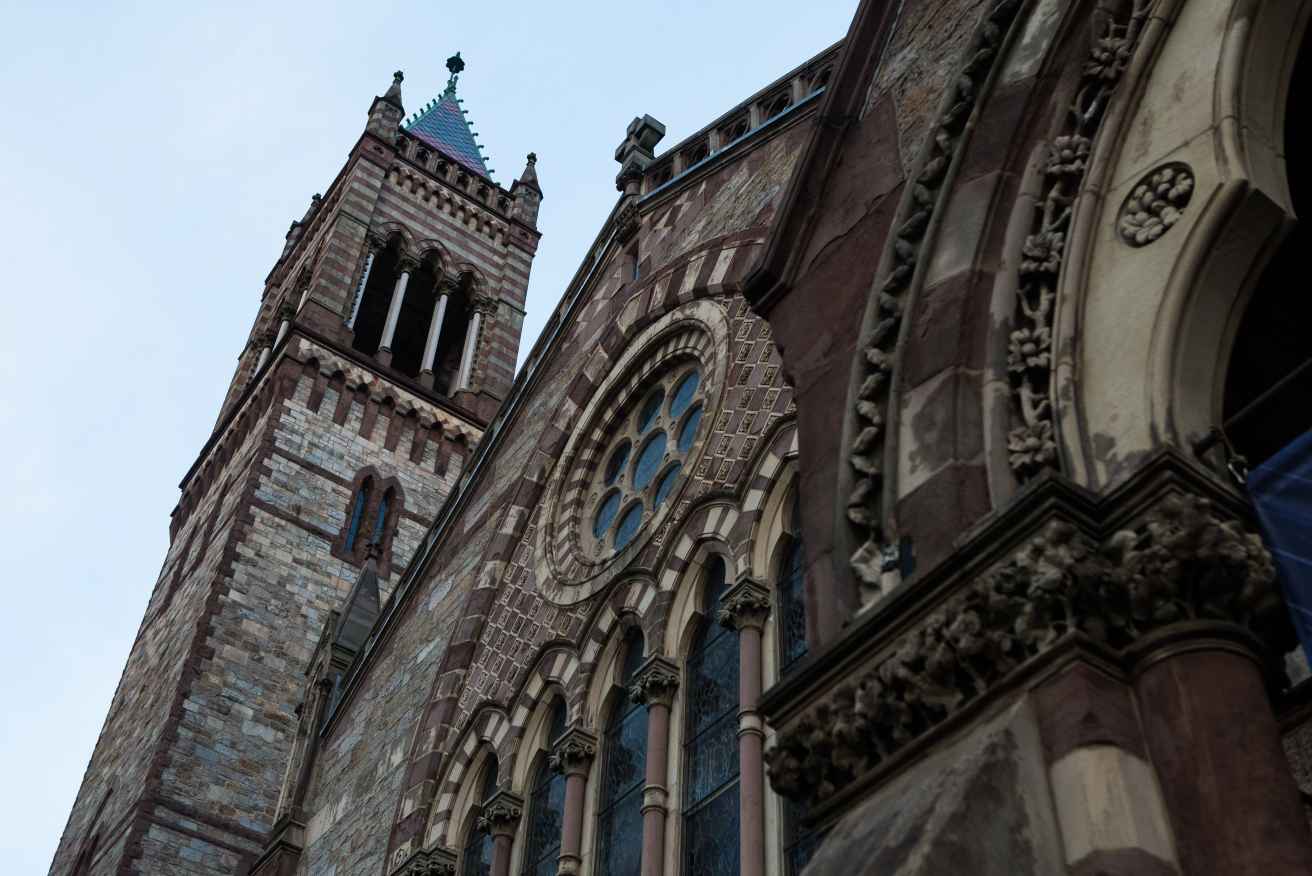
The Old South Church in Boston

An Election Sermon!

A Sermon by Rev. Nancy S. Taylor

All Saints Sunday

November 5, 2006

based on Matthew 5:1-16


On the eve of the 2006 elections God and politics are everywhere … battling it out in this, the most religious nation in the world.

Governor Mitt Romney, a Mormon, teamed up with a Baptist church in Boston to claim that same gender marriage violates their religious freedom.

Cardinal Sean O’Malley issued a letter to 3 million Massachusetts Catholics urging them to lobby legislators to restrict marriage to heterosexual couples.

Jim Wallis’ book, God's Politics: Why the Right Gets It Wrong and the Left Doesn't Get It, enjoyed fifteen weeks at the top of the New York Times Bestseller list.

The IRS is investigating All Souls Episcopal Church in Pasadena, California because of a sermon in which the priest imagined a conversation among Jesus, George W. Bush and John Kerry.

The religious right continues to issue Voters Guides that all but endorse right-wing Republican candidates.

In a story in the Boston Globe, Michael Paulson reports that, “In the face of increased federal scrutiny of politics in the pulpit, religious denominations are warning clergy against overtly partisan preaching.”[1]

            It was in 1954 that Congress passed an act that prevents religious groups from engaging in partisan politics. But that hasn’t stopped religious groups from testing the boundaries of what will and will not fly.

It is our Puritan forebears, more than almost anyone else, who can be blamed for this current state of affairs. For them, religion and politics were inseparable. Although the Puritans are much maligned and their sins, which were many, have been well scrutinized,  in many ways we continue to live as a nation fashioned by their vision.

At the center of every town in Puritan New England there was a Congregational church. Every church had a self-proclaimed mission to be a “light” or a “City Upon a Hill” to a lost world … language taken from Jesus’ Sermon on the Mount.

Historians have pointed to various factors to explain the uniqueness of colonial New England … a world in which every man, woman and child was called to be a battlefield between the forces of good and evil.

There was one power, however, a single, formative activity that stood out above all others … one activity that molded and held the Puritan community together: the Puritan sermon. To appreciate the unique position and power of the sermon in Puritan New England, let me share some statistics:

Over the span of the colonial period, New England ministers in total, delivered something on the order of five million sermons … each of them sixty to ninety minutes long.[2]

The average New England churchgoer (and remember, all were required to attend church) … went to church twice each week and listened to 7000 sermons in a life-time. Seven thousand sermons … or 15,000 hours of concentrated listening.

Now, compare this to the number of hours a typical college student spends in a modern university classroom. (Are there any college or university students here this morning? Please raise your hands.) Fifteen thousand hours of sermon listening, corresponds to the equivalent of ten separate undergraduate degrees.

Colonial New Englanders lacked in formal education, but they were not unschooled. Through the sermon New Englanders were introduced to ideas and arguments that were well researched and rigorously presented and defended by the most well-educated, well-read residents of the land.

Not only that, but the Puritan sermon had no competition: there was no mass media, no internet, radio, television, no daily paper or weekly magazine. The Puritan minister had a monopoly on the communications business. He was it. The sermon, a monolithic and commanding voice, spoke authoritatively to every important aspect of the life of the community.

Next to Sunday, Election Day was the most important day in the life of the community. Remember, they didn’t celebrate Christmas and theirs was a theocratic project. On election days the community gathered. But they did not hear the orations of the governor, nor political stump speeches by candidates. On Election Day the governor, lieutenant-governor, assistants, council members and the community gathered in the General Court and it was a member of the clergy who held forth … delivering the much anticipated Election Sermon.

The Election Sermon was a sermon genre peculiar to Puritan New England. The Election Sermon typically touched on the nature of government, human nature (including our capacity and tendency toward sin), the qualifications and duties of rulers,  and the need for repentance and reformation.

Through the Election Sermon elected officials were instructed on what the Bible said about how they should govern. The community was listening in and could and would, hold their politicians accountable for how they governed … and whether they measured up to the theological and biblical standards that had been set forth.

There were a lot of things the Puritans got wrong. They are responsible for some terrible oppressions and injustices: the way they regarded and treated the native peoples; the so-called witch trials; their unwillingness to suffer the religious aspirations of others, even as they sought religious freedom for themselves. God knows, the Puritans got many things terribly wrong.

But they got some things very right. They dearly believed theirs was a holy experiment in how to live for each other, for the common good. Theirs was an experiment in which God was watching to see if humans could be their brother’s keeper and whether government could serve as an agency of justice and mercy. They endeavored to create a commonwealth wherein all had both a stake in, and a piece of the pie.

The Election sermon was a much anticipated event precisely because our Puritan forebears believed God had something to say about they way they ordered their common life.

Now, we are not in Puritan New England any more and thank God for that. But let’s not throw out the baby with the bathwater. Old South is a Christian church and we have a right and a responsibility to bring our Christian faith to bear upon and to inform our citizenship. We’ve been doing so ever since our Meetinghouse and our members hosted the Boston Tea Party.

This is a robustly pluralistically religious nation: a nation of Christians, yes, but also of Jews, Muslims, Hindus, Buddhists and non-believers. And, we are a better nation for it. Moreover, it was people of faith who rigorously pursued and defended the separation of church and state. This is a good thing. But let’s not throw out the baby with the bathwater. It was also people of deep faith who, from a deeply rooted Judeo-Christian ethic and without violating the separation of church and state … called this nation to account for its sins of racism and gender discrimination and who called us to corporate accountability for the plight of poor: people like Frederick Douglas, Sojourner Truth, Dorothy Day, and Martin Luther King, Jr.

Today, the Sunday before Election Day, no one wants to turn the clock back to the Puritan days … but neither can we allow the extreme religious right to dominate or define the dialogue on politics and religion. So, let’s turn the clock back past James Dobson, Jerry Falwell and Pat Robertson … back past our Puritan forebears … right back to the time of Jesus … to hear again Jesus’ inaugural address.

The Sermon on the Mount was Jesus’ platform, his position paper. Jesus described a way to order our common life … a way to live together if we are serious about living out God’s claim upon us. In it, he issues an ethical summons to feed the hungry, clothe the naked and challenge the powers and principalities. All too aware of our human propensity for indifference to the plight of others, Jesus defined a way of life that is fundamentally oriented, not to the “I” with whom we are each so absorbed, but to the “Thou” the neighbor, the other, the foreigner, the stranger.

In that address he didn’t inspire his hearers to war, he didn’t get their blood boiling or pump his fist or wag his finger … he blessed peacemakers.

He didn’t call upon us to get our enemies in our sites and track them down, he blessed the merciful.

He didn’t praise the mighty – those with armies and war rooms, with nuclear weapons and oil – he praised the meek and said that, despite the evidence, it is they who will inherit the earth.

He said that to live this way was not only to be blessed, but to be a blessing. To live that way, together and for each other, is to be as light to a world plunged in the darkness of violence and despair.

Whether you vote and how you vote, does matter. Now, it is unlikely that either your vote or my vote will usher in the kingdom of God. But what we can do – what we are obligated to do by our Christian faith – is to vote to strengthen the common good.

We need not shrink from bringing God and faith to bear upon our life together as a nation and as a city. After all, it was God who instructed Moses to lobby Pharaoh, Egypt’s head of state. God sent Moses to intervene in public affairs on behalf of an oppressed people. A God who sends people to liberate slaves is a God who is hip deep in our moral and political lives. This is a God who stretches out a hand to the poorest of the poor and the most wretched and who assures them: you are not forgotten. And, who backs up that assurance with release from captivity and with food to nourish their bodies.

The problems that afflict our nation and our city – violence in our streets, racism, poverty, youth lost to drugs and guns, to pregnancy and illiteracy – are primarily moral failures … failures of our corporate human will to care for each other. These are problems that are best addressed by vigorous public discourse, including religious discourse, some of it – not all of it – inspired by the Judea-Christian ethic.

The idea of an entire community gathered on Election Day to hear a sermon about how we order our corporate lives for the good of all, doesn’t sound too bad.

But since that’s not going to happen, I invite you to do this: On Tuesday morning, when you wake up, before you vote, I invite you to read the Sermon on the Mount. Better yet, read it Monday night before you go to bed. May it cause you to dream dreams and see visions of God’s justice and mercy, of God’s kingdom come and God’s will being done on earth as it is in heaven.


[1]Clergy warned on partisan preaching: several faiths act to keep tax status,” by Michael Paulson, the Boston Globe, October 27, 2006

[2] This and the statistics that follow come from, Concise Encyclopedia of Preaching, ed. by William H. Willimon and Richard Lischer, Westminster John Knox Press (Louisville, Kentucky) 1995, pages 394-7.


Copyright © 2006, Old South Church and by author.
Excerpts are permitted as long as full accreditation is made
to Old South Church and to the author.

Back to Sermon Page

The Old South Church in Boston
645 Boylston Street
Boston, MA 02116
(617) 536-1970