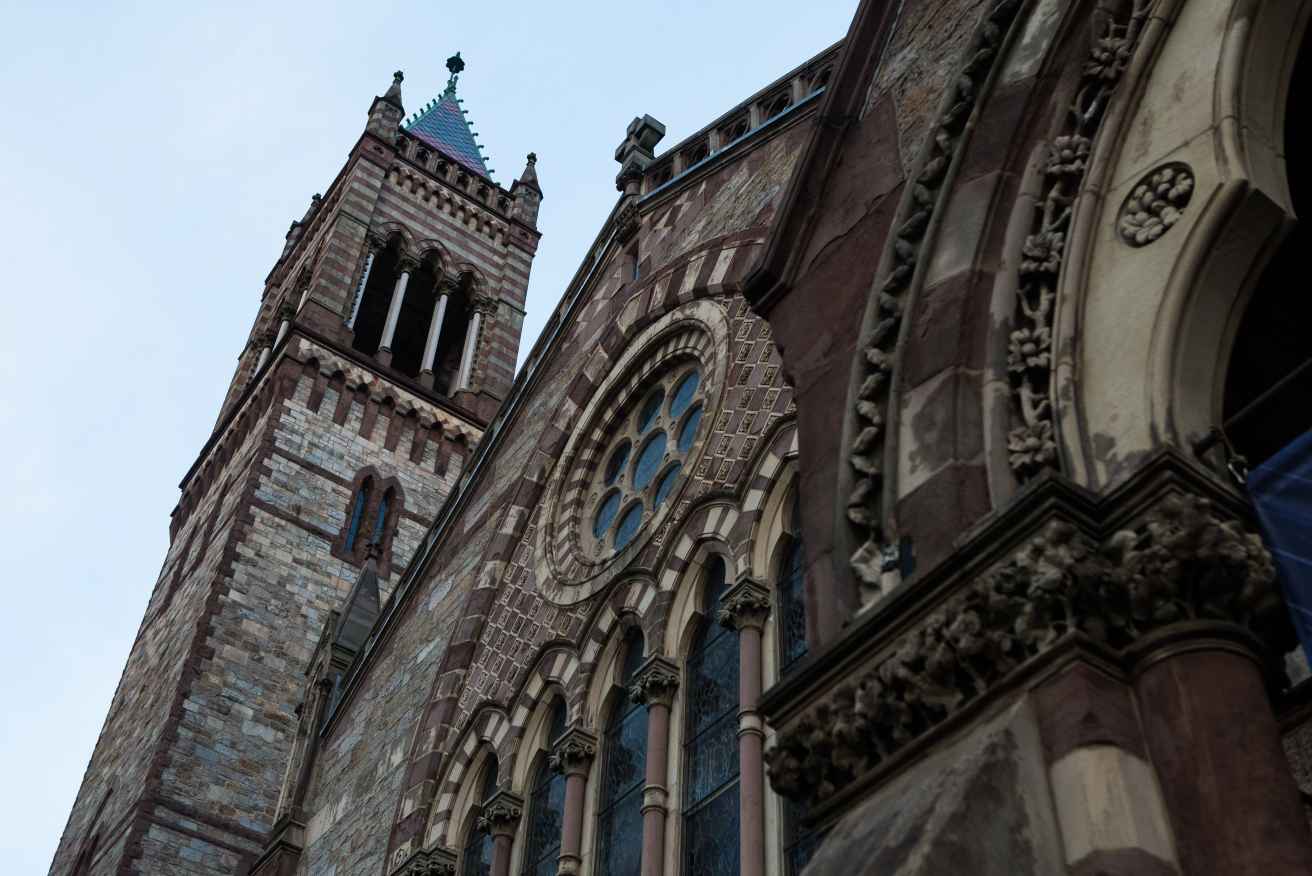
The Old South Church in Boston

Blessing and Blessed

A Sermon by Senior Minister Nancy S. Taylor

Based on a selection of verses from Genesis, Exodus, Deuteronomy, Job, Proverbs, Matthew and Mark.

May 7, 2006
Third Sunday of Easter

Listen to this Sermonmp3 file


Every year, once a year, the residents of upper Manhattan witness something rare and wonderful: a blocks-long, unlikely procession of animals. A camel, rare birds, snakes, monkeys, dogs and cats – lots of dogs and cats – weasels and donkeys, cows and an elephant, and many, many more wonderful representatives of God’s creatures.

No, they have not escaped from the Bronx Zoo. No, Noah’s Ark is not re-boarding. It is the annual Parade and Blessing of the Animals held at St. John the Divine, Manhattan’s Episcopal Cathedral. Annually, 4,000 people and as many creatures, line up for blocks and blocks, waiting to participate. This is the largest such Christian ceremony on earth.

St. John the Divine holds this annual event in honor of Francis of Assisi, the 12th century saint who renounced his wealth and lived in simple poverty. Francis preached that every creature was his equal – both human and animal.

The highlight of the Blessing of the Animals at St. John the Divine is the long procession when, one by one, humans and creatures – large and small, furry and hairy, cloven-hoofed and pawed – march through the bronze doors of the Cathedral, into the grand Gothic nave and up the center aisle. There, each creature is blessed by the bishop.

While many believe the blessing of the animals began with Francis of Assisi, it turns out that the origin of animal blessings has as many parents as a centipede has feet. For instance, every year in downtown Los Angeles, residents bring their animals to the church for a blessing, in honor, not of Francis of Assisi, but of Antony of the Desert. Antony of the Desert was a third century hermit who, it is said, lived among and blessed the wild beasts.

The annual celebration in Los Angeles begins as brightly adorned animals and their human companions assemble in the historic Olvera Street Plaza on a Saturday in April. At 2:00 p.m., the procession of the animals begins. At the very head of the procession is a cow, decorated with flowers. She has pride of place, the honor of going first because according to tradition, she is the animal who gives most to humanity. Behind the cow are the merchants of Olvera Street, and behind them, a colorful and diverse array of animals and humans. The procession winds its way up the street and past the platform where the Cardinal blesses each animal as it goes by.

In earlier days, farm animals were brought to receive a fertility blessing. These days a somewhat different assemblage of creatures graces Olvera Street: a lively assortment including cows, cats, dogs, snakes, pigs, sheep, goats, donkeys, horses, opossums, hamsters, birds, monkeys, llamas, camels, chickens and peacocks.

Yesterday, here at Old South, we held our first blessing of the animals. Old South members, whose lives are lived in the company of beloved pets, told us they were touched, delighted, and moved that the church had decided to acknowledge this important part of their lives. And so it was that people volunteered to usher, to sing, to take pictures and to assist with music and publicity. After all, those who have pets will tell you that what they experience from their pets in the way of unconditional love, of companionship and relationship, is as dear and as life-giving to them as anything else. As one Old South members said to me in introducing his dog: this is my family.

Yesterday, Old South was host to a wagging, squirming, wriggling, fluttering array of beloved creatures. The Gordon Chapel was filled. As far as we know, the last time so many of God’s creatures entered an Old South sanctuary was in 1775. It was in that year that British troupes, angry at us over a certain Tea Party, took over the Old South Meetinghouse. They tore out the pews, and turned the sanctuary into an exercise ring for Calvary horses.

By contrast, yesterday’s affair was gracious and respectful. Old South had sent out invitations. Yesterday, our guests arrived: two-legged and four legged, hoofed and pawed, big and little, feathered, furry, hairy, scalely and smooth-skinned. They were a grand assortment of dogs and cats – of every size, color, temperament and pedigree – but also a turtle, rabbit, parrot, and two enormous, patient, well-mannered horses from the Boston Police Department.

They came to this Christian church to receive a blessing. We, in our turn, were blessed: blessed by the joy we saw in so many faces; blessed by the relationships we witnessed; blessed by the privilege of having met additional members of your families. Blessed, too, that our sanctuary gave welcome to human neighbors in Boston who might not have entered a church for any other purpose.

Whether in New York or Los Angles or Boston, whether in Episcopal, Catholic, or UCC churches, whether in honor of Francis of Assisi or of Antony of the Desert, or no one in particular, the Blessing of the Animals is intended to convey that God’s care extends beyond the human family; indeed, God’s care extends to the whole family of creation. In the eyes of God, all creation is good and sacred.

The Bible is full of stories of animals and the natural world. Biblical authors proclaim that in the beauty and diversity and complexity of the natural world, we see the hand of the Creator.

The Bible includes our animal cousins in the blessings of the covenant we share with God. In the Book of Genesis God says, “I will make a covenant with you and with all living creatures.” Jesus, in his turn, commands his disciples to, “Go in to the whole world and proclaim the Gospel to every creature."

The creatures with whom we share the earth and the skies and the seas, also share in the fortunes of human existence and have part in human life. Their fortunes are affected by pollution and oil spills, gill nets and clear-cutting, population growth and pesticides, war and famine, fire and earthquake, and by our human appetite for meat and furs.

Last December, the San Francisco Chronicle[1] ran a front-page story about a female humpback whale. The whale had become entangled in a web of crab traps and lines.

The fifty-foot whale was weighted down by hundreds of pounds of traps. Hundreds of yards of line-rope were wrapped around her tail and torso. She was struggling mightily to stay afloat.

A fisherman spotted the whale just east of the Farollone Islands, outside the Golden Gate. The fisherman radioed an environmental group for help. Within a few hours, a rescue team arrived. They quickly determined that the whale was in such bad shape, that the only way to save her was to dive into the water and untangle her themselves, then and there, with their own hands. This was a very dangerous proposition. One slap of her tail could easily kill a diver.

The divers worked for hours. Using curved knives, they worked to free her, one line at a time. Once she was free, she swam in what the divers described as joyous circles. And then, she turned her attention to the divers. She swam up to each one of them and, one by one, she nudged them gently. In the words of the divers, she thanked them.

In the blessing of the animals, we acknowledge our essential kinship with the grand assortment of creatures with whom we share God’s good earth.

In the blessing of the animals, we acknowledge, bless and confess the myriad and complex relationships between humankind and animal kind: whether the relationship is that of pet to a guardian, or that between a sight-impaired person and their seeing-eye dog, or that between a rancher and a herd of cattle, or a fisherman and the creatures of the sea, or the relationship between a wildlife specialist and a pride of lions.

In blessing the animals we praise the Creator for the gift of creatures who supply our food, who carry our burdens, who share our fortunes, who provide us with clothing, who give us companionship, who have tendered a service to humankind since the world began and who, in the words of Francis of Assisi, are, indeed, our brothers and sisters.

Yesterday we welcomed and blessed them. In our turn, we were richly blessed.


[1] San Francisco Chronicle, Thursday, Dec 15, 2005


Copyright © 2006, Old South Church and by author.
Excerpts are permitted as long as full accreditation is made
to Old South Church and to the author.

Back to Sermon Page

The Old South Church in Boston
645 Boylston Street
Boston, MA 02116
(617) 536-1970