Old South Banner
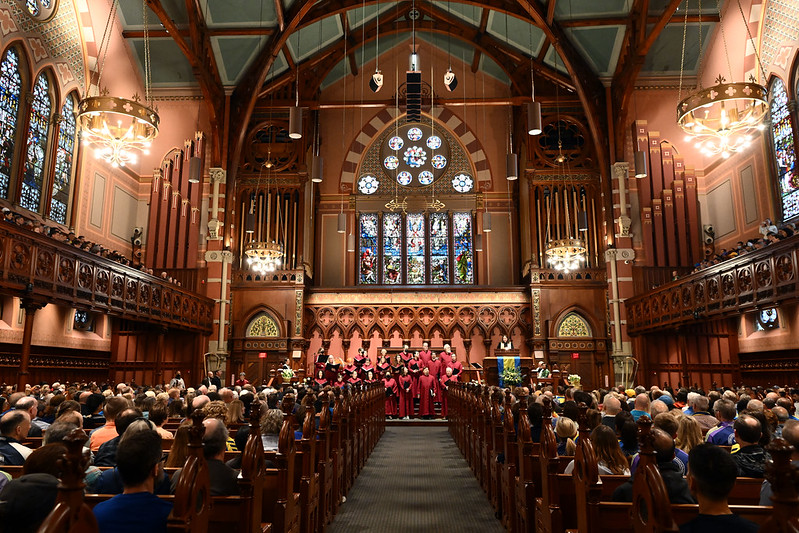
Old South Sanctuary (photo by Sarah Musemuci)


Copyright © 2008, Old South Church and by author.
Excerpts are permitted as long as full accreditation is made
to Old South Church and to the author.


Old South Sermons:

Vade Mecum (Go With Me)[1]
 

Preached on the occasion of the 250th anniversary of the death of Thomas Prince, 5th minister of Old South

by Rev. Nancy S. Taylor, Senior Minister

Psalm 71:14-17

Sunday, November 10, 2008

Listen to this sermon


It was a warm Sunday in July of 1717. A ship, having originated in London, sailed into Boston Harbor. Throughout Boston word spread that among its passengers was Mr. Thomas Prince. So famous was he as a preacher and scholar that more than 500 people gathered at Long Warf to greet him and welcome him home.

The poised thirty-year-old gentleman who stepped off onto the Warf was almost unrecognizable from the young man who, eight years before, had departed on an adventure from that same Warf.

In the intervening eight years had had traveled widely and lived for long stretches in Barbados, Madeira and England. He had met dangers, tasted exotic  foods, strained to understand unfamiliar languages, and observed customs foreign to his own.

He had examined and recorded the beauties, diversities, dangers and powers of earth and sky and sea … and he marveled at nature’s God. He returned as a famous preacher, a sought after pastor, and a man of the world. As he stepped from boat to shore, he cut a dashing figure in his English russet coat and he set Puritan tongues wagging at the sight of his periwig.

Thomas Prince returned to his native country the Puritan equivalent of a rock star. In the months that followed he had preaching gigs at a variety of churches and he was haggled over, wooed and courted by hopeful churches to be their permanent pastor. Back in England, no less than four churches sought to keep him there as their pastor … but he pined for home … for this soil. Once returned to Boston he had offers from Hingham’s Old Ship Church, the Bristol Church… and Boston’s Old South.

Old South won the bidding war. Though he played hard to get and delayed giving his consent for many days, Thomas Prince finally accepted Old South’s call and terms. He was ordained in 1718.

Participating in Prince’s ordination were Dr. Increase Mather, Dr. Cotton Mather, Chief Justice Samuel Sewell, and perhaps the most influential clergyman of his day: the Rev. Charles Chauncey of Boston’s First Church.

Prince preached at his own ordination service. Charles Chauncey later wrote of Prince’s sermon, “… no ordinary man could have written it.”

It was said of our Rev. Prince that he had “a pleasing personality … was a favorite with young and old, being in private conversation both interesting and instructive. He was a tender and faithful pastor …”

About his sermons it was said that they were “learned, prepared with care, abounding in facts and pertinent illustration.”

His delivery, on the other hand, was “… unhappy; his sermons always being read, with but little animation or variety of modulation.”[2] It seems he read his sermons, bent over his manuscript, concealing from the congregation his countenance.

Prince was a man of his day, deeply immersed in the affairs of the world. He preached and prayed about what was happening at the time. He will always be remembered for an incident about which he prayed in 1746 …

In 1746, word spread that a French fleet of 70 ships rapidly approached by way of the Atlantic Ocean. The menacing fleet, bristled with guns and carried 10,000 troops. Their orders: burn Boston to her foundations.

Boston prepared in two ways: All able bodied men were alerted to gather at the Boston Common with whatever weapons they had.

William Shirley, colonial Governor of Massachusetts proclaimed a Fast Day and all good citizens were to stop work, to fast and to gather in the meeting houses to pray for deliverance from the peril that approached.

From the pulpit of the Old South Meeting-house Thomas Prince prayed before his congregation. The morning was clear and calm. People had walked to church through sunshine.

“Deliver us from our enemy!” Prince implored. “Send thy tempest, Lord, upon the waters to the eastward! Raise Thy right hand. Scatter the ship of our tormentors and drive them hence. Sink their proud frigates beneath the power of Thy winds!”


He had scarcely pronounced the words when the sun disappeared. All the church darkened. A wind shrieked so hard that the great church bell struck twice and the windows rattled. Thomas Prince paused in his prayer, both arms raised. “We hear thy voice, O Lord! We hear it! Thy breath is upon the waters of the eastward, even upon the deep. The bell tolls for the death of our enemies!”

He bowed his head; when he looked up, tears streamed down is face. “Thine be the glory, Lord. Amen and amen!”


The French attack never came. History bears witness to this fact: that a hurricane or sudden storm overcame the French fleet. Ships sank. Two thousand men died. Four thousand succumbed to a pestilential fever. The few remaining ships, half manned, limped off to the southward.

There would be no French invasion of America!

Henry Wadsworth Longfellow enshrined the story in verse.

Here are some of the verses of Longfellow’s, Ballad of the French Fleet … a ballad which he places in the mouth of Thomas Prince:

<>
There were rumors in the street,
  In the houses there was fear
Of the coming of the fleet,
  And the danger hovering near.
And while from mouth to mouth
  Spread the tidings of dismay,
I stood in the Old South,
  Saying humbly: "Let us pray! 

"O Lord! we would not advise;
  But if in thy Providence
A tempest should arise
  To drive the French fleet hence,
And scatter it far and wide,
  Or sink it in the sea,
We should be satisfied,
  And thine the glory be." 

This was the prayer I made,
  For my soul was all on flame,
And even as I prayed
  The answering tempest came;
It came with a mighty power,
  Shaking the windows and walls,
And tolling the bell in the tower,
  As it tolls at funerals. 

The lightning suddenly
  Unsheathed its flaming sword,
And I cried: "Stand still, and see
  The salvation of the Lord!"
The heavens were black with cloud,
  The sea was white with hail,
And ever more fierce and loud
  Blew the October gale. 

The fleet it overtook,
  And the broad sails in the van
Like the tents of Cushan shook,
  Or the curtains of Midian.
Down on the reeling decks
  Crashed the o'erwhelming seas;
Ah, never were there wrecks
  So pitiful as these! 

<>
<>Thomas Prince spent forty years, until his death, as pastor of Old South. During those years the church prospered and grew … and Prince himself grew: he grew in faith and grace to become <>one of the most highly respected divines of his time and place.

Prince stood apart from most of his colleagues in welcoming and embracing the “heart-religion” of George Whitefield and the revivals and Great Awakening that Whitefield engendered.

Prince oversaw the demolition of the Cedar Meeting House, our first church home, as well as the design and construction of the Old South Meeting House, one of the great gathering places of Colonial New England.

One of his greatest achievements was the collecting of a notable library which, only days before his death, he bequeathed to Old South … a library you will hear more about, and some contents of which you can see, at our Prince Library Forum this afternoon.

He also wrote and published … sermons, pamphlets and books. It is one from one of his most interesting enterprises that I have taken the title for my sermon: Vade Mecum. Latin for “Go with me,” vade mecums are travel guides.

Thomas Prince produced the first vade mecum for this region: A Vade Mecum for America: A Companion for Traders and Travelers (1732). The guide provided tables for computing interest and values, a directory of major towns, a description of principle roads, the names of the streets of Boston, a list of British kings and queens, and, most unexpectedly for a Puritan minister, a schedule for the General Meetings of both Baptists and Quakers.

After a long illness during which he said he was "weary of this life" he passed away on Sunday, Oct. 22, 1758.

Rev Prince’s mortal remains were buried in a tomb in the Granary Burial Ground (in a tomb belonging to the Old South Church) and a marker at this spot now bears his name.

The preamble to his will, dictated of course by himself, reads thus:

"…I do hereby commit both my soul and body into the merciful hands of God, my Creator, preserver, continual benefactor, and redeemer (trusting) that of his infinite goodness through Christ, he will forgive me, save me, make my imperfect spirit perfect in holiness…  and raise my body, form it a perfect and glorious structure, unite my body and soul again, and acquit and justify me in the public judgment, and then carry me up to live with Him in Heaven forever."

Thomas Prince was a traveler, a pilgrim, a sojourner and explorer. He traveled the world by ship, by horse, by ferry and by foot. But he also traveled by way of the mind: in the collecting and reading of books of astronomy and chemistry, of geography and geology, of philosophy and religion, of languages and cultures.


His intellectual travels caused him to read more than books: he read the stars at night, and the sea and woods and fields by day …


His spiritual travels made him a careful, tender reader and observer of the souls of his parishioners and of his own soul…


For to his pilgrim heart and soul and mind, everything in the wide world was an illuminating reflection of God by whose light he lived.


Two hundred and fifty years ago, this worthy, pious, excellent pilgrim, traveled on, ahead of us, that he might explore and observe the dwelling place of the saints in light.


[1] A vade mecum is a small guidebook whose Latin name is best translated, “go with me.” Thomas Prince produced the first vade mecum for a region of colonial America: A Vade Mecum for America: A Companion for Traders and Travelers (1732). Intended for traders and travelers, the guide provided tables for computing interest and values, a directory of major towns, a description of principle roads, the names of the streets of Boston, a list of British kings and queens, and, most unexpectedly for a Puritan minister, a schedule for the General Meetings of both Baptists and Quakers.

[2] Wisner, Benjamin B. “The History of Old South in Four Sermons” (1830), from Sermon II, p. 24f


Copyright © 2008, Old South Church and by author.
Excerpts are permitted as long as full accreditation is made
to Old South Church and to the author.

Old South Church
645 Boylston St. Boston, MA 02116
(617)536-1970 Tel (617)536-8061 Fax

You can E-mail us by clicking here: OSC Communications

Copyright © 2008, Old South Church